Macol’s overthrow of Macbett
The KillerMacol’s overthrow of Macbett is the violent transfer of power that ends Macbett’s rule and exposes the prophecy on which he relies as a deception. The scene makes that reversal theatrical as well as political: Macbett declares himself untouchable, a forest advances in deliberately constructed stage imagery, and Macol kills him from behind. The cheers that follow welcome a new sovereign even as they announce that the tyrant is dead.
Causes and Background
The confrontation begins with the collapse of Macbett’s political support. Lady Duncan tells him that Macol, Duncan’s son, has returned from Carthage, assembled a large and powerful army, and found the whole country against Macbett. She warns that he has run out of friends and will not remain king for long. Her warning identifies the force behind the immediate challenge: Macbett’s claim to rule is no longer protected by loyalty at home, while Duncan’s son has returned with the means to oppose him. Lady Duncan then disappears, leaving the threatened ruler face to face with the consequences of his isolation.
The change in allegiance is made audible before Macol appears. Shouts call for Macbett’s downfall and Macol’s accession, repeating the paired demands as a refrain. Fanfares accompany Macol’s entrance, giving his arrival the public ceremony of a claimant already backed by a movement. Against that acclaim, Macbett says that he fears no one and insists that he needs no help. His confidence is strikingly out of step with the report of a hostile country and a formidable army: the scene places his private certainty against a public rejection that is already gathering around him.
The Confrontation
Macol and Macbett first meet in a contest of denunciation. Macol heaps insults on the ruler, calling him a murderer and a monster among a string of other attacks; Macbett answers by belittling Macol as a foolish boy and an inexperienced upstart. Neither exchange changes the balance of force. Instead, their verbal abuse sets the scene’s bitterly comic register before the conflict turns to inheritance and revenge. Macbett openly admits that he killed Macol’s father, then warns Macol that he cannot be harmed because no man born of a woman can hurt him.
Lady Duncan directs Macol to kill Macbett and throw away the sword that has been tainted by the act. Macol draws his sword and declares that old scores remain to be settled. Macbett counters with the condition on which he believes himself vulnerable: he can be beaten only when the forest marches against him. The prophecy does not protect him; it furnishes the scene with its means of defeating him. Macol tells him to look behind, and the audience sees the threat materialize not as a natural landscape but as a stage action.
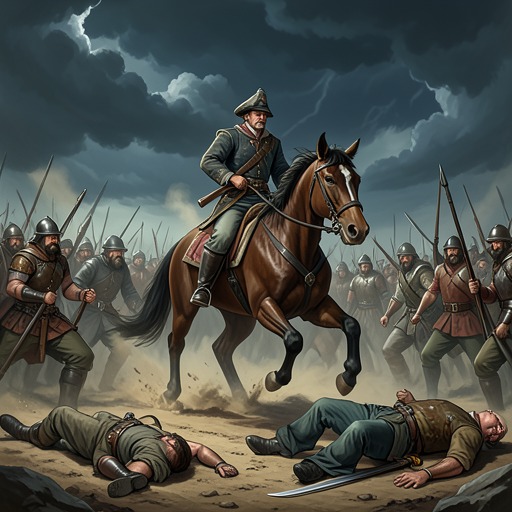
Men and women approach the two men at center stage carrying placards marked with trees, or even only branches. The accompanying stage direction explains that this is a fallback for inadequate technical resources: what should really happen is for the whole set, or at least its upstage portion, to lumber forward and encircle Macbett. The direction turns the prophecy into a visible theatrical mechanism. Whether represented by placards or by the moving set, the forest closes the space around the man who treated its approach as a remote condition. Macbett turns; his brief exclamation registers the recognition that his certainty has failed. Macol stabs him in the back, and Macbett falls.
Prophecy, Revenge, and the Transfer of Power
The killing also exposes the false foundation of Macbett’s confidence. When Macol tells him that he has been deceived, the revelation reframes the prophecy of invulnerability: Macbett has mistaken a promise designed to reassure him for a guarantee that could make him safe. His defeat comes at the very moment the forest appears to fulfill the condition he had named, but the force of the scene lies in the gap between supernatural-sounding assurance and the practical arrangement that brings him down. He does not meet an invincible opponent in open combat; he is distracted by the approaching sign and struck from behind.
Macol presents the conflict as more than a simple succession. He says he will avenge both his natural and adoptive fathers, while also insisting that he will not give up his name. Lady Duncan calls him ungrateful and invokes his obligations to Duncan’s memory, lamenting that the good behave worse than the bad. Together, these statements complicate the victory’s language of rightful inheritance: Macol’s motives are bound to more than one filial claim, and the scene does not make revenge a morally uncomplicated act. Yet Duncan’s memory gives the new ruler a connection to the king Macbett killed, while the crowds’ cheers supply the public support that Macbett has lost.
After the stabbing, Macol orders that Macbett’s body be taken away, calling it carrion. Offstage shouts proclaim that the tyrant is dead and hail Macol as their beloved sovereign. The transition is staged in the same instant as the removal: two guests carry Macbett’s body out while a throne is brought on. The throne makes the change of ruler materially visible, but the repeated acclamations show how quickly condemnation and allegiance can be redirected. Macbett’s fall ends one reign; the ceremony surrounding Macol’s arrival establishes the next without showing that power itself has changed its character.
Theatrical and Political Significance
The event compresses a political reversal into a sequence of exposed stage devices: a hostile crowd, fanfares, tree placards, a falling ruler, a body carried away, and a throne brought in. The forest is both the fulfillment of Macbett’s stated condition and an openly constructed theatrical effect. That double status makes the prophecy less a stable law of fate than an image that can be staged, interpreted, and used against the person who trusts it. Macbett’s boast does not merely prove wrong; it helps direct his attention at the decisive moment.
The ending also makes succession look like a public performance. Macol’s arrival is announced by fanfares, his victory by acclamation, and his new position by the throne placed onstage as Macbett’s corpse is removed. The people’s shouts declare the old tyrant dead and welcome the new sovereign, while the physical choreography leaves no pause between the two roles. The overthrow therefore resolves the immediate contest but offers no assurance that rule will become just: the scene shows a change of ruler, backed by revenge and popular acclaim, rather than a demonstrated change in the structure of power.