Mother Peep's geese
The KillerMother Peep's geese is the political faction Mother Peep presents as a popular vehicle for governing, with geese as both its emblem and the imagined force drawing the state chariot. Its platform promises reform in the language of justice and collective benefit, yet openly reserves the greatest share for its leader and her geese. The faction’s public acclamations and final act of violence make it a compact portrait of how political spectacle can turn the promise of demystification into another mystifying performance of power.
Formation and public appeal
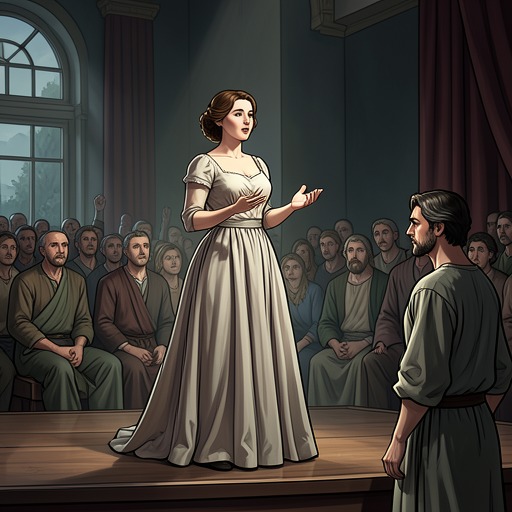
The faction is introduced through sound before it is seen: as the curtain rises, the audience hears the crowd acclaiming Mother Peep's geese. On the raised part of the stage, Mother Peep addresses people who remain out of sight. Two or three flags provide the visible sign of the gathering, each bearing a goose against green; the white emblem stands out against its background. The staging gives the faction a leader, a symbol, and a chorus of support, but not a visible mass of members. Its apparent scale is carried by flags and voices.
Mother Peep identifies herself as the keeper of the public geese and claims long experience in politics. She asks the crowd to entrust her with the chariot of state, which her geese will draw, and links that image to her ability to legislate. Her request for confidence and power presents political authority as a popular choice. Yet the metaphor also establishes the faction’s hierarchy: Mother Peep will guide the state, while the geese supply its motive force. The promised political vehicle is collective in name, but its direction and destination are set by its leader.
Platform and the promise of demystification
The faction’s rhetoric absorbs the language of opposition almost as soon as it appears. A voice in the crowd cries, “Down with mystification!” while also acclaiming Mother Peep's geese. Mother Peep answers that she has raised demystifiers who will demystify the people, then insists that demystification requires mystification first and calls for a new one. The contradiction is not hidden behind a complicated program: the faction openly recasts the very process of exposing political illusion as a reason to create another illusion.
Its proposed reforms sharpen that contradiction. Mother Peep promises not to persecute but to punish, not to colonize but to occupy countries described as liberated, and not to exploit people but to make them productive. Compulsory work will be called voluntary; war will be renamed peace. Her speech presents changes of wording as changes of political reality, culminating in the claim that everything will be altered by her and her geese. The parallel constructions make the platform sound orderly and decisive, while their reversals preserve coercion beneath the new terms.
The crowd, opposition, and material interest
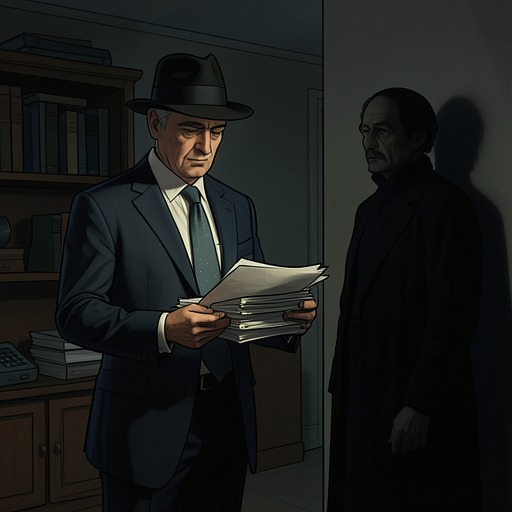
The crowd supplies a running chorus to Mother Peep’s speech, acclaiming the geese and calling for soup kitchens. This public voice does not develop an independent program in the scene; its short slogans accompany Mother Peep’s campaign and help make her claims sound collectively endorsed. At the same time, Édouard and Bérenger cross the stage urgently, searching for a missing briefcase and trying to reach the Prefecture before its offices close. Their practical crisis proceeds alongside the rally: Mother Peep is visible and gesticulating, while the crowd’s acclamations form a background to their exchange.
Mother Peep promises that her administration will dole out public property and provide fair shares, then immediately declares that she will keep the lion’s share for herself and her geese. The qualification exposes the distribution at the heart of the faction’s program. “Fair shares for all” is not an operative limit on the leader’s privilege; the geese are to receive more so they can draw the carts of state. The image joins material reward to political service, making the faction’s self-interest part of its own announced machinery rather than a secret the audience must discover.
Violence and political performance
The faction’s treatment of dissent clarifies the force beneath its promises. When a drunken Man argues that science and art have changed thought more than politics, Mother Peep denounces him to the crowd as an enemy of the people and of history. The crowd’s response turns denunciation into a demand to kill him. Later, Mother Peep produces a huge briefcase, calls for a free discussion, and strikes him over the head with it. The clash between the invitation to discussion and the blow makes the faction’s political language physically legible: dissent is welcomed as a slogan, then silenced by force.
Mother Peep and the Man struggle on the raised pavement amid a hubbub of voices supporting her and condemning him. At the end, only Mother Peep’s hideous head reappears; she says that her geese have liquidated him, but only physically. The staged violence has already shown what that qualification cannot undo. The scene is directed in the manner of a Punch and Judy show, turning political conflict into grotesque public entertainment. Elsewhere, Duncan’s formal address to soldiers and the solemn arrangement of his healing ceremony likewise make authority visible through speeches and ritual; the later appearance of Macol with Macbett’s head on a pike offers a harsher image of power changing hands. Against these other displays, Mother Peep’s faction compresses political succession into a rally, a promise of reform, and a violent silencing. Its geese remain at once the emblem of popular support, the imagined labor force of the state, and the beneficiaries of the unequal order Mother Peep proposes.