Prophecy of the Forest Marching Against Macbett
The KillerThe Prophecy of the Forest Marching Against Macbett is the condition Macbett believes must be met before anyone can defeat him, and the theatrical mechanism by which that condition is finally fulfilled. Its decisive force lies in the passage from a boast about an impossible future to a visible stage action: a forest advances, Macbett turns to look, and Macol kills him from behind. The prophecy’s language, its practical staging instructions, and its fulfillment converge in one abrupt reversal of power.
The condition of defeat
Macbett states the prophecy while facing Macol, who has drawn his sword and threatens to settle their old scores. Macbett warns him that he is making a mistake, then declares, “I can only be beaten when the forest marches against me.” The conditional sounds like a limit on Macbett’s vulnerability: defeat is not impossible, but it depends on an event that seems remote or unreal. His confidence rests on the presumed distance between the image of a marching forest and the immediate danger posed by an armed opponent.
The wording also leaves room for the prophecy to be fulfilled through theatrical action rather than through an ordinary natural event. The passage does not describe a forest uprooting itself or explain how such a movement might occur. Instead, it presents the forest as something the production can construct in front of the audience. The prophecy therefore establishes both a plot condition and a stage problem: the action must make the forest march, while preserving the threat that Macbett thinks the condition places safely beyond reach.
The forest made visible
The play gives two practical solutions. In the simpler version, men and women approach the two central figures, each carrying a placard on which a tree is drawn; the directions add that branches alone would suffice. The scene thus allows the forest to be represented by portable signs rather than by realistic scenery. A group of people and a few drawn trees can turn an abstract image into an unmistakable stage event.
The preferred solution makes the scenery itself move. The directions say that the placard approach should be used only when technical resources are inadequate, and that the whole set—or at least its upstage part—should lumber forward to encircle Macbett. This alternative changes the scale of the prophecy’s fulfillment: instead of a small group representing trees, the theatrical world becomes the advancing forest. The deliberate contrast between a minimal substitute and the moving set keeps the practical limitations of performance in view while making the same dramatic requirement clear. Whatever the production can manage, the forest must visibly come toward Macbett.
These instructions make the prophecy unusually concrete without requiring a single fixed scenic effect. Placards, branches, a moving section of scenery, or the entire set can all enact the same condition. The image remains legible across different technical means, and its movement—not botanical realism—is essential. The forest’s advance becomes the decisive action because the play has already named it as the boundary of Macbett’s supposed invulnerability.
Fulfillment and reversal
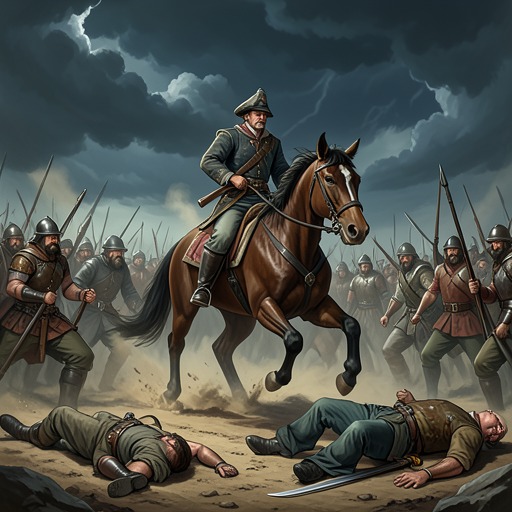
Macol supplies the cue that turns the stage image into a confrontation: “Look behind you. The forest is on the march.” Macbett turns. The direction is immediately followed by his exclamation, “Shit!”, and Macol stabs him in the back. The sequence gives the prophecy a precise physical consequence. Macbett sees the condition he has named, but his attention is drawn away from the man who is threatening him; Macol uses that instant to strike.
The prophecy is therefore fulfilled at the same moment that Macbett’s confidence fails. He had treated the marching forest as the one exceptional circumstance under which he could be beaten. When it appears, however, the prediction offers no protection or means of escape. Its fulfillment coincides with the direct act of violence that ends his resistance: Macbett falls, and Macol orders that the body be taken away. The forest does not itself attack him; its appearance creates the opening in which Macol’s blow becomes fatal.
Dramatic and theatrical significance
The scene turns a verbal condition into a test that the audience can watch being met. Macbett’s declaration gives the image its stakes; the stage directions make it practicable; Macol’s warning identifies the moment of fulfillment; and the turn exposes Macbett to the fatal blow. The result is a compact reversal in which a claim that seemed to guarantee safety instead announces the form his defeat will take.
The production instructions also preserve a tension between scale and artifice. A forest may be no more than people carrying tree placards, or it may be the set itself lumbering forward to encircle its central figure. Both choices disclose that the prophecy’s power depends on theatrical representation, not on an attempt to make the stage resemble an actual woodland. The image works because the play has made the audience recognize what it means: the forest has arrived, and Macbett can be beaten.