Radiant City serial murders
The KillerThe Radiant City serial murders transform a beautiful district into a landscape of fear and abandonment. The contrast between the district’s hopeful name and the violence within it becomes central to Bérenger’s account: an insatiable murderer has made the place hell, terrorizing and killing its inhabitants until the district itself seems close to vanishing. The murders are both a series of crimes and a force that empties the setting in which they occur.
A district turned to terror
Bérenger introduces the Radiant City to Édouard as a beautiful district he has just visited, one Édouard did not know existed. Its name promises brightness, but Bérenger immediately rejects any implication that it is a model or perfect neighbourhood. The district’s defining reality is instead the presence of The Killer, whose repeated violence has made ordinary life precarious.
The threat is collective as well as individual. Bérenger says that The Killer terrorizes and kills everyone, and that the district is becoming deserted. His warning that it may soon cease to exist gives the crimes an unusually broad consequence: the murders do not merely claim victims but drive the population away and imperil the community’s continued life.
The ruse and its recognition
Édouard recognizes the crime pattern before Bérenger has finished explaining it. He associates the murders with a beggar who shows people the Colonel's photograph and, while they are looking, throws them into the water. In Édouard’s account, the photograph functions as bait: attention is diverted at the moment the victim becomes vulnerable. His familiarity with this method contrasts with Bérenger’s surprise that he already knows about the killings.
That recognition does not initially carry the same gravity for Édouard that it does for Bérenger. Édouard treats the affair as a trick for catching a fool and assumes Bérenger must mean something else. Bérenger, by contrast, stresses that the killings are turning the whole district into hell. Their exchange exposes a gap between knowing the method and grasping the scale of the danger.
Evidence and the prospect of capture
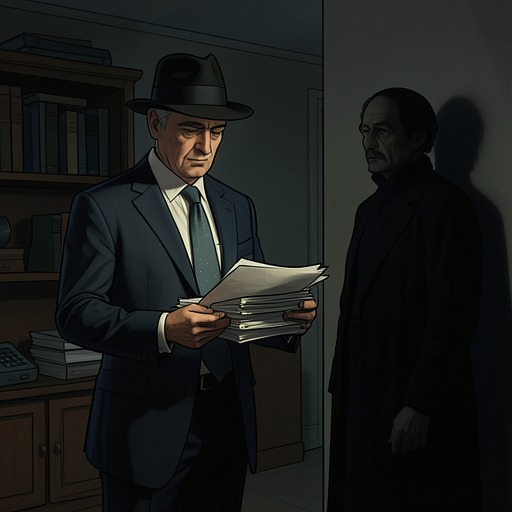
The account later gains material support when Bérenger lays out objects associated with The Killer: an address, an identity card, and a photograph of him clipped to the Colonel's photograph. The juxtaposition links the man’s identity to the image used in the ruse. An address book containing the names and addresses of his victims further connects him to the people targeted in the murders.
Bérenger responds to these documents with growing excitement and insists that The Killer can be caught. The address book gives the list of victims a concrete form, while the identity card and photographs offer a line from the crime’s recognizable method to a named individual. The murders therefore shift, in Bérenger’s understanding, from a terrorizing pattern that empties the Radiant City toward a case with evidence that may make pursuit possible. The passage establishes that possibility, not the outcome of the pursuit.