Sacred kingship
The KillerSacred kingship in the play is not merely a title: it is staged as a transfer and confirmation of power through prayer, consecrated regalia, and public recognition. Duncan’s enthronement gives this claim its fullest ritual form, joining divine sanction to the crown, purple cloak, and healing scepter. Later displays of royal authority echo its pageantry, but they also reveal how readily sacred signs can be separated from the solemn promises they appear to authorize.
The Ritual Confirmation of Duncan
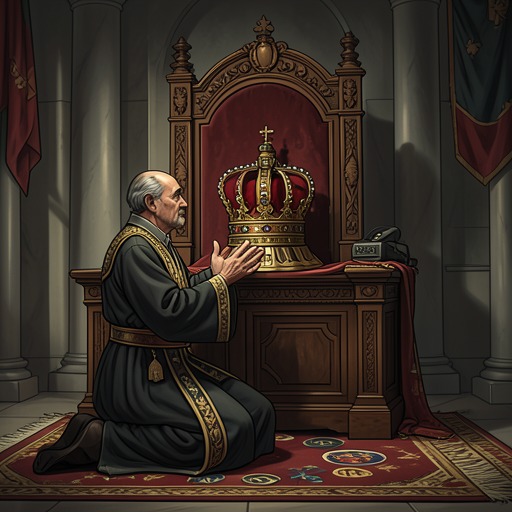
Duncan’s investiture is carefully ordered. The Officer brings the purple robe, crown, and royal scepter to the Monk; the Monk blesses the crown, approaches Duncan, and places it on his head as Duncan kneels. He declares, “In the name of Almighty God, I confirm you in your sovereign power.” The wording presents authority as something confirmed by God through a human officiant, rather than as a possession established solely by Duncan’s force. Duncan answers with a prayer that he may prove worthy, acknowledging a standard beyond the fact of his accession.
The purple cloak receives its own blessing. The Monk puts it around Duncan’s shoulders and prays that no harm come to him so long as he wears it. The ceremony thus attaches divine protection to a visible royal object: sovereignty is made legible on Duncan’s body, in crown and cloak. The promise also gives the garment a protective significance beyond its status as ceremonial dress, though the scene does not establish that the blessing makes Duncan invulnerable.
The rite links kingship to healing as well as rule. The Monk renews the gift of healing transmitted by God, praying that the rite purge jealousy, pride, luxury, and the base striving for power, and open people’s eyes to the vanity of worldly goods. He asks that hatred and anger pass away and that humanity prevail against suffering and destruction. The Officer and Duncan join in the responses. The scepter is then handed to Duncan with the instruction that he use it to touch the sick. Royal power is represented here as a religiously authorized duty to heal, while the prayers explicitly condemn the self-interest and ambition that can also drive rulers.
The staging reinforces the transformation. After the prayers, Duncan and the Officer rise; the Monk kneels before Duncan, who mounts the throne and sits. The composition places the newly invested king above the officiant, even though the ceremony has just represented the Monk as the channel through which divine authority is confirmed. Duncan then orders that the patients be brought in, turning the blessing of the scepter into a public function of the reign.
Signs of Authority Beyond the Rite
The play sets this elaborate religious confirmation beside less solemn forms of authority. In another setting, the Architect says that serving as the district’s police superintendent is among his duties as a special architect. When a further victim is reported, he directs that the usual routine report be made and phones in the case, while stressing that no one was caught in the act and that there are only suspicions. This is administrative authority working through assigned duties and familiar procedure, not a sacred investiture. The contrast helps distinguish the ceremony’s claim to divine sanction from the everyday machinery by which officials exercise power.
Military obedience offers a different measure. When Duncan demands to know why a captured enemy has not been killed, Macbett answers that he was waiting for the king’s orders. Duncan immediately gives the order for the prisoner’s execution and asks what has been done about Glamiss. The exchange presents Duncan’s command as effective because a subordinate recognizes it and acts within a hierarchy; its force is direct and coercive, unlike the healing purpose expressed in the coronation prayers. The play therefore places sacred authority alongside the capacity to command violence without suggesting that the two are identical.
Banco’s complaint makes the limits of royal favor visible from the other side. He insists that Duncan cannot deny him the promised reward, whether a title or lands, and protests that the king cannot do this to him. Macbett tells him that Duncan’s concern for him has already been conveyed to the Archduke, and that both Macbett and Lady Duncan have intervened. When those efforts fail, Macbett proposes using more cogent arguments and then stronger ones, describing Duncan as stubborn as a mule who can nevertheless be made to budge. These exchanges do not define the coronation rite, but they expose the gap between a king’s elevated status and the expectations of subjects who believe they have earned his favor. Political authority is negotiated through promises, petitions, and pressure as well as sanctified in ceremony.
Acclamation, Succession, and Repeated Pageantry
Macbett’s public appearance gives kingship a conspicuously theatrical form. He and his bride enter in state robes, crowns, and purple garments; Macbett carries a scepter as bells ring and the crowd cheers. They stop at center stage, turn their backs to the audience, and wave to spectators on either side. The acclamations welcome the new king and bride, and also hail the Archduke and Archduchess. The scene surrounds royal display with popular sound and gesture, but the evidence here emphasizes spectacle and acclaim rather than a religious rite matching Duncan’s.
The difference matters: the outward vocabulary of sovereignty can recur even when its confirmation takes another form. Crowns, purple robes, a scepter, and public celebration make Macbett’s position visible, as Duncan’s regalia had done. Yet Duncan’s investiture carefully represented the Monk as the intermediary who confirmed sovereign power in God’s name. Macbett’s entrance instead foregrounds the response of a cheering crowd. The parallel invites comparison between ritual authorization and public performance without establishing that the two forms of recognition carry equal weight or guarantee stable rule.
Macol’s accession introduces yet another combination of claims. Guests display placards asserting that Macol is always right and call for Banco’s dynasty alongside the new king. Bells sound as Macol stands by the throne and asks the Bishop whether he has come to crown him; the Bishop confirms that he has. The scene thus places an approaching ecclesiastical coronation beside slogans, applause, and an invocation of dynastic continuity. Its competing public messages matter: the crowd acclaims Macol while also naming Banco’s dynasty, so the language surrounding the new accession does not resolve into a single uncontested basis of legitimacy. The Bishop’s presence signals a religious dimension to the ceremony, but the excerpt does not yet show the crowning itself.
Political Meaning and Limits
Together, the scenes make sacred kingship a visible claim rather than a simple synonym for power. Duncan’s coronation gives that claim a structured form: a blessing, an oath-like confirmation, regalia, prayer, and a stated responsibility to heal. The ceremony asks the king to be worthy and places the striving for power among the failings to be purged. Its ideal of rule therefore contains a tension: the sovereign is elevated by the rite, but the prayers also warn against the pride and ambition that elevation may encourage.
The later scenes keep that tension open. Royal authority appears in orders that send prisoners to execution, in a disputed promise of land or title, in the staged acclamation of Macbett, and in Macol’s impending coronation amid rival dynastic language. Divine sanction, administrative competence, military command, popular approval, and hereditary claim are not interchangeable, even when they gather around the same throne. Sacred kingship gives rule a language of higher purpose and public ceremony; the recurring pageants show that the language must coexist with practical force and contested expectations.