Second Witch
The KillerSecond Witch is both a prophet and a performer whose changing appearance makes uncertainty itself part of her power. She announces the death of Glamiss, tells Banco that he will not receive the title, and promises him a royal dynasty; later, in a staged transformation, she becomes Lady Duncan’s attendant. Her scenes turn political knowledge into spectacle: what appears to be rumor, a bodiless voice, or witchcraft is repeatedly given a new face before Macbett and Banco can master its meaning.
Identity and First Encounter
Second Witch first addresses Macbett as thane of Glamiss, a title he disputes because Glamiss is still alive and Duncan has promised the lands and title to Banco. The First Witch answers that Glamiss has drowned, swept away with his horse by a torrent. Second Witch’s greeting thus arrives before Macbett can know that its apparent impossibility has become fact. The scene gives her access to information that unsettles the ordinary order of inheritance, while Macbett’s surprise establishes the gap between what the characters believe and what the witches announce.
Her introduction is inseparable from the First Witch’s. The two appear as old women, and Macbett initially treats the figure before him as merely an old woman who looks like a witch. He asks how she could know his title, wondering whether rumor has carried the news through the forest. The question gives a natural explanation for their knowledge even as the scene makes that explanation inadequate: the witches speak not only of Macbett’s present standing but of Glamiss’s death, which Macbett has not yet accepted as true. Second Witch’s authority is therefore established through a prediction that collides with his understanding of current events.
Banco and the Dynasty Prophecy
The witches later emerge from hiding and close in on Banco from both sides. Second Witch greets him with the title he will not receive: thane of Glamiss. Banco asks how she knows that Duncan had meant the title for him, and protests that he cannot become thane of Glamiss. Again the prediction is bound to Glamiss’s death, which the First Witch confirms in the same stark terms: he has drowned, and the torrent carried him and his horse away. The repeated announcement makes the earlier encounter more than an isolated surprise; the witches’ knowledge reaches across Macbett’s and Banco’s separate encounters, while the same death overturns the expectation of a succession to Glamiss’s title.
After Banco draws his sword and tries to strike at the witches, they seem to dissolve into wind, storm, and tree roots. He wonders whether he really saw and heard them, or whether the encounter was a dream. At that point Second Witch’s voice returns, now pleasant and melodious. It tells Banco that he will not be king, but will be greater than Macbett: he will found a dynasty ruling the country for a thousand years, and become the root and father of many kings. The promise distinguishes personal kingship from lasting dynastic influence. Banco is denied the immediate title he expected, yet offered a future on a scale that exceeds Macbett’s individual power.
Banco does not accept the prophecy without resistance. He repeats that he does not believe it, continues striking, and asks who is speaking and whether the voice has a body or a face. The voice answers that it is beside him and far away, and promises that he will see it again. This exchange makes Second Witch’s invisibility active rather than incidental: her claims are heard before Banco can identify their speaker, and her promised return holds recognition in suspense. The witches’ disappearance into natural forms and the disembodied voice leave Banco without a stable explanation for what has happened.
Theatrical Transformation
When Macbett submits, the scene shifts from prediction to an overtly staged revelation. Second Witch circles the First Witch like a conjuror’s assistant; repeated jumps develop into a gracious dance, which slows as the witches’ new aspects are unveiled. During this performance she recites a Latin incantation, takes the First Witch’s stick, and throws it away. The First Witch, previously bent double, straightens. The sequence makes transformation visible as a succession of gestures and changes in appearance, rather than simply reporting that an enchantment has occurred.
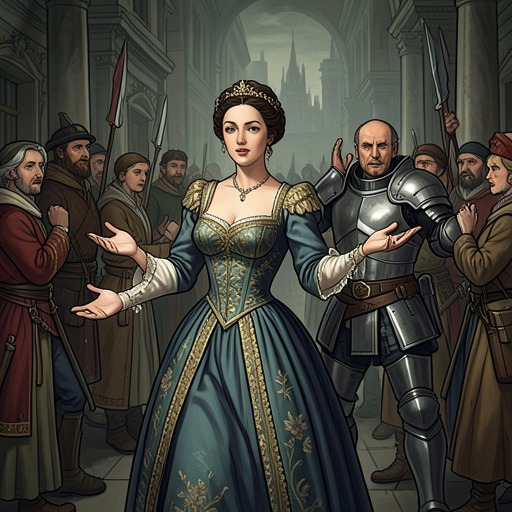
As she passes behind the First Witch, Second Witch removes her mask and old clothes in a single movement. The First Witch is revealed as Lady Duncan, while Second Witch becomes Lady Duncan’s equally young and beautiful maid. Macbett falls to his knees and addresses the revealed ruler as his Majesty. The visual reversal is decisive: the figure who had spoken from concealment now occupies the recognizable role of an attendant, while the bent old woman becomes a queen. Second Witch’s part in the change is practical as well as theatrical; once the First Witch is Lady Duncan, she places a stepladder behind her so she can climb.
Narrative Role and Significance
Second Witch links prophecy to political appearances. Her first message announces a title that Macbett cannot reconcile with present events; her later words deny Banco the same title while granting him a future lineage. The prophecies do not provide Banco with immediate authority, and the scene gives no confirmation of the dynasty’s eventual realization. Their force lies instead in enlarging the political horizon beyond the contest for Glamiss’s lands and beyond Macbett’s own rise.
Her shifting forms also make recognition a recurring problem. She appears beside the First Witch, speaks through a voice Banco cannot locate, vanishes into images of wind and roots, and finally sheds her disguise to become a maid. The stage reveals the disguise to the audience, but the earlier exchanges show how little the characters can verify when confronted by the witches. Second Witch’s performance thus supports the play’s larger pattern of unstable titles and identities: knowledge can arrive before proof, and a figure who seems to possess supernatural distance can reappear in a courtly role. In the final revelation, she does not become the queen herself; she becomes the attendant whose transformation helps install the First Witch as Lady Duncan.