The Architect
The KillerThe Architect is an ageless bureaucrat whose double function—as the recipient of praise for a remarkable building and the official who reports construction’s suspension—places him at the intersection of the Radiant City’s grand promise and its breakdown. His most chilling appearance comes when, with apparent amusement, he explains the Killer’s method in precise, administrative detail.
Identity and Introduction
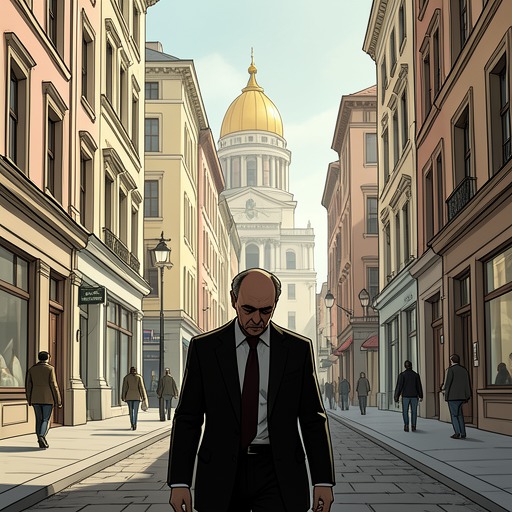
The Architect is described as being of ageless, bureaucratic age. He first appears following Bérenger, who turns to congratulate him warmly on an architectural achievement, calling it a miracle or marvel and praising him as a marvelous architect. The Architect responds modestly, but Bérenger insists that the result is incredible and beyond imagination. The exchange establishes the scale of the achievement through Bérenger’s admiration, while the Architect’s brief, restrained reply leaves the praise largely unanswered.
His appearance gives him an official, practical air: he wears a summer-weight jacket, light trousers, and an open-necked shirt, carries no hat, and has a thick, heavy briefcase under his arm. The contrast with Bérenger, who arrives in a grey overcoat, hat, and scarf, marks their different temperaments and circumstances as they meet onstage.
Official Role and the Halted Construction
The Architect explicitly identifies himself and Bérenger as civil servants and bureaucrats rather than businesspeople. He uses that shared status to frame his report as an official communication: the house that seemed abandoned really has been deserted by its builders, and the police have suspended all construction work. He had known this already, he says, but has just received confirmation by telephone.
The announcement reverses the earlier mood of architectural wonder. The interruption arrives amid smashed windows: Bérenger counts two broken windows, then three after a stone knocks his hat off. Against this immediate disorder, the Architect delivers the news in formal bureaucratic terms. He adds that suspending work is unnecessary in any case because Bérenger is the only person who still wants to buy property. His report thus links the empty building market to the larger crisis overtaking the Radiant City, without suggesting that he can alter either circumstance.
The Killer’s Method and the Architect’s Detachment
Later, addressed as Monsieur Superintendent, the Architect appears almost amused by the murders. He describes the Killer’s routine as though explaining a process visible through a window. At the tram stop, the Killer waits for people returning home; because private cars are not permitted outside the Radiant City, they must walk toward the gates. Disguised as a beggar, he begins by asking for alms and presenting familiar appeals—to pity, unemployment, illness, or the need for somewhere to sleep—but these are only an opening gambit.
The Architect explains how the Killer selects a likely victim, keeps up a conversation, and follows even when the person tries to move on. He offers small goods from a basket: artificial flowers, birds, old-style nightcaps, maps, postcards, American cigarettes, obscene drawings, and other objects. The intended victim generally refuses the offers, but the bargaining carries both people toward the pool.
At the decisive moment, the Killer offers to show the Colonel's photograph. As darkness gathers, the victim leans closer to inspect it; the Architect says the close scrutiny is disturbing, and that the Killer exploits the moment to push the victim into the pool and drown them. Once the killing is done, the Killer simply looks for another prey. Bérenger’s response—that people know about the danger and still fall for the deception—sharpens the account’s central contradiction: the method is recognizable, yet recognition does not prevent its repetition.
Narrative Significance
The Architect’s two functions make him a figure of bureaucratic knowledge without effective control. He can officially confirm that construction has stopped, and he can describe the murder routine in meticulous detail, but neither announcement brings a remedy. His matter-of-fact account turns the Killer’s sequence of choices, objects, and movements into something like an efficiently reported procedure. The contrast between his amusement and the victims’ deaths makes the city’s violence feel not only frightening but also absorbed into the ordinary language of administration.