The Doctor
The KillerThe Doctor combines the offices of surgeon, executioner, bacteriologist, and astrologist in a single court figure. He enters the royal sickroom with the authority of a physician but also the imagery of an astrologer and executioner, and his most consequential judgment is that Berenger the First’s condition admits no change. In the later vigil, he measures the King’s progress not toward recovery but toward a death that fear no longer governs.
Identity and Dramatic Function
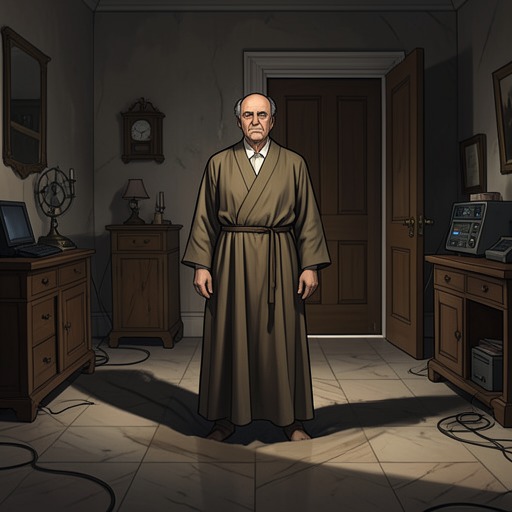
The play’s cast identifies The Doctor as both Surgeon and Executioner, as well as Bacteriologist and Astrologist. His role therefore gathers scientific, medical, judicial, and astrological associations rather than belonging to a single professional sphere. His entrance makes that combination visible: he wears a pointed hat marked with stars, red clothing with a hood hanging from the collar, and carries a great telescope. The costume evokes the astrologer and executioner at once, turning his arrival into a theatrical announcement of the varied authority he represents.
His work at court is not presented as a promise of cure. The Doctor supplies diagnoses and interprets bodily signs, but his assessment of the King closes down the prospect of improvement. Later, as the King’s death approaches, he describes the process in exacting physical terms and explains what kind of death it will be. Medicine here can observe and accompany the end; it cannot reverse it.
Arrival at Court and Diagnosis
The Guard announces The Doctor’s return, and he enters through a large door on the right that opens and closes by itself. He apologizes to Queen Marguerite and Queen Marie for being late, explaining that he has come directly from the hospital, where he performed several operations that he calls important to science. The explanation places hospital work alongside the royal crisis, while his brisk greeting contrasts with the Queens’ immediate concern for the King.
When Queen Marie protests that he cannot operate on Berenger the First, The Doctor clarifies that he knows and is not referring to the King. Asked whether the King has improved, he gives a stark answer: the condition is critically ill in a way that allows no change. His diagnosis does not satisfy Queen Marie’s hope for a sign of recovery; she says there is no hope and looks to Queen Marguerite, whom she believes will not permit her to hope. The Doctor’s short, categorical assessment stands between Marie’s anxious questioning and Marguerite’s more severe acceptance of the situation.
Reading the King’s Fear
In a later examination, The Doctor describes the King’s body as it changes under terror. His temperature has fallen; the hair that had stood on end now lies flat, and the wrinkles of age are settling into his face. The King has dared to close his eyes because he can now see the fear within himself, though The Doctor expects him to open them again. The details make the diagnosis a sequence of visible signs rather than a simple declaration: the body registers panic, then begins to yield to what is coming.
The Doctor cautions that the process will include setbacks and will not be quick. The King will still experience fright, but The Doctor distinguishes this from the earlier panic, which had produced abdominal complications. He judges that the death will be fairly respectable, though it will not serve as an example to others. Most importantly, he says that death will now kill the King, rather than fear killing him. The distinction gives his medical account a precise dramatic force: the King has not escaped terror, but terror is no longer the immediate cause of his end.
The Final Vigil
The Doctor tells Queen Marguerite that Berenger the First will need considerable help through his last moments, until he has drawn his final breath. Marguerite answers that she will help him, describing her intention as driving fear out, cutting him loose, untying knots, and separating the wheat from the tares that bind him. The exchange establishes The Doctor as the clinician who names the bodily course of dying and Marguerite as the attendant who claims the work of emotional release. He neither promises rescue nor leaves the King alone: his forecast ends with the need for sustained assistance, carried through to the last breath.