The Guard
The KillerThe Guard is both the public voice of Berenger the First’s court and a former companion who claims to have worked beside him. His announcements help stage the King’s authority, while his recollections turn that authority into an extravagant personal legend: he describes the King as a maker of inventions and himself as the mechanic and playmate who witnessed it all.
Identity and Ceremonial Role
At the opening, the Guard announces Berenger the First with the formal acclamation “Long live the King!” His announcement precedes the King’s rapid crossing of the stage in a crimson cloak, crown, and scepter. The Guard then announces Queen Marguerite and Juliette, marking him as a functionary of the royal household who gives public voice to its hierarchy and ceremony.
That ceremony is undercut by the derisive rendering of regal music heard around the rise of the curtain. The Guard’s loyal formula remains intact, but the theatrical frame makes royal display sound exposed to ridicule. He is not merely a background attendant: his words help establish the gap between the court’s claims and the play’s unstable world.
Service to the King
The Guard’s most substantial speech is a sweeping account of Berenger the First’s supposed achievements. He credits the King with setting the Thames on fire, stealing fire from the gods, inventing gunpowder, founding the first forges, discovering steel, and designing machines from the balloon and zeppelin to the airplane. He extends the catalogue to railways, automobiles, the Eiffel Tower, agricultural tools, and tractors.
The account makes the King a near-mythic author of civilization, but the Guard places himself inside the legend as well. He says that he helped the King repair the world after an explosion, served as mechanic during the early airplane tests, and played with him when he was a little prince. The extravagant scale of the claims sits beside these details of personal service, making the Guard’s loyalty both a public tribute and a recollection of shared history. When Berenger the First hears the final item, he responds that he had forgotten tractors, briefly revealing the distance between the Guard’s comprehensive legend and the King’s failing memory.
An Attendant to Failing Authority
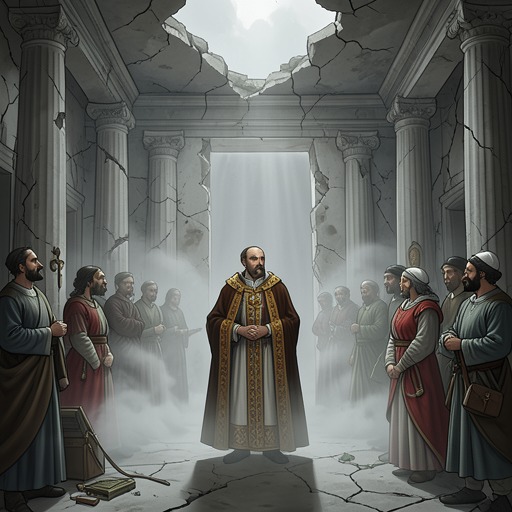
The Guard is also the person to whom Berenger the First directs an order to arrest those around him. The King first calls for their arrest, then expands the command to everyone and proposes the tower, cellar, dungeons, or even a rabbit hutch as places of confinement; the tower, he acknowledges, has collapsed. The Guard is positioned as the instrument through which royal authority might be enforced, but the scene supplies no confirmation that he carries out the order.
Across these appearances, the Guard connects ceremony, personal loyalty, and coercive power. He can proclaim the King’s majesty and remember him as the architect of almost everything, yet he also stands at the receiving end of commands issued amid material collapse. His role therefore helps expose the fragility beneath the royal image: the court can still speak in the language of command, even as the world that command presumes to govern is coming apart.