The Killer’s nihilism
The KillerThe Killer’s nihilism is presented less as a declared philosophy than as a void around which Bérenger’s arguments repeatedly fail to hold. Asked to explain his motives, The Killer answers with chuckles, shrugs, and finally the silent handling of a knife. Bérenger tries in turn to appeal to happiness, justice, fellow feeling, and the value of human existence; as each framework falters, the scene makes nihilism an unsettling absence of grounds on which either killing or its prohibition can securely rest.
An Unanswered Challenge
Bérenger first approaches The Killer as someone who might still be reasoned with. He insists that The Killer is a human being and therefore must have reasons he can explain. The appeal contains an assumption the scene will steadily undermine: that a person’s actions can be made intelligible through a motive, and that understanding might give the living a way to answer violence. The Killer’s chuckle does not supply a counterargument. It leaves Bérenger speaking into a silence that may be indifference, mockery, or simply a refusal to enter the exchange.
Bérenger initially frames the killings as the destruction of a possible common happiness. He imagines Radiant City’s radiance spreading outward, even describing it as a new light from France, and argues that patience rather than impatience might have allowed happiness to reach everyone, including The Killer. His appeal turns murder into the ruin not only of its victims but of a hoped-for future shared by the murderer and the wider community. Yet the hope belongs to Bérenger’s argument; The Killer does not confirm that he wanted happiness, rejected it, or acted from any particular belief about it.
Motives, Victims, and Failed Explanations
When Bérenger asks whether The Killer is an anarchist, dislikes happiness, hates humanity, or believes society irredeemably rotten, he offers possible explanations without obtaining an answer. The questions test political, social, and existential accounts of the murders, but the repeated chuckling keeps each one provisional. Even Bérenger recognizes that he has not found the real problem. The Killer’s nihilism therefore remains an interpretive pressure rather than a doctrine that the scene spells out: the audience sees the questions multiply while the person addressed declines to make his violence legible.
The death of Dany gives Bérenger’s questioning a particular human focus. He recalls her as kind-hearted and beautiful, while acknowledging that she could be hot-tempered and liked her own way. He sets those ordinary imperfections against the enormity of killing her, then compares her death with killing noisy neighbors or people who hold different opinions. The examples expose the disproportion between everyday irritation or disagreement and lethal violence. But Bérenger’s effort to establish that Dany did not deserve her fate still depends on a moral scale The Killer has not agreed to recognize.
Bérenger also confronts the possibility that The Killer imagines himself to be serving humanity by destroying it. He calls that position stupid and asks whether The Killer fears ridicule, then asks directly whether he hates mankind. These challenges try to make nihilism answerable either to social judgment or to an identifiable emotion. The Killer’s laughter again withholds confirmation. The scene does not establish that he is an anarchist, a revolutionary, a misanthrope, or a conscious enemy of the universe; it stages Bérenger’s inability to tell which, if any, of these explanations applies.
From Revenge to Uncertainty
The exchange changes when Bérenger admits that he had wanted revenge and to send The Killer to the guillotine. He then rejects punishment as an answer and describes a sudden movement from fury toward something like love: because the two men are human beings, he argues, they are brothers, and hatred of The Killer would become hatred of himself. His declaration of human fellowship is sincere within the scene, but it is also exposed as vulnerable. The Killer chuckles rather than reciprocating, leaving Bérenger’s appeal unsupported by any sign of shared feeling.
That failure pushes Bérenger beyond confidence in his own moral judgment. He considers whether the fault might be his, The Killer’s, no one’s, or not properly a matter of fault at all. He wonders aloud whether the human species matters, whether the universe is good, and whether mistakes exist; he even entertains the possibility that human beings are mistaken to want to exist. This is not presented as a settled position adopted by The Killer. It is Bérenger’s collapse into uncertainty under the pressure of trying to argue with someone who will not explain himself. The distinction matters: the scene reveals the reach of nihilistic doubt without granting its apparent advocate a clearly articulated philosophy.
The Plea and the Knife
At last Bérenger asks The Killer to stop even if there is no reason to do so. He pleads for people to be left alive in their ordinary lives and asks for a pause of a month, a week, or at least forty-eight hours. The request no longer rests on a promise that the universe is just or that humanity has a grand purpose. It becomes an appeal for restraint in the absence of certainty: if no reason settles whether one should kill, Bérenger still asks that people be spared.
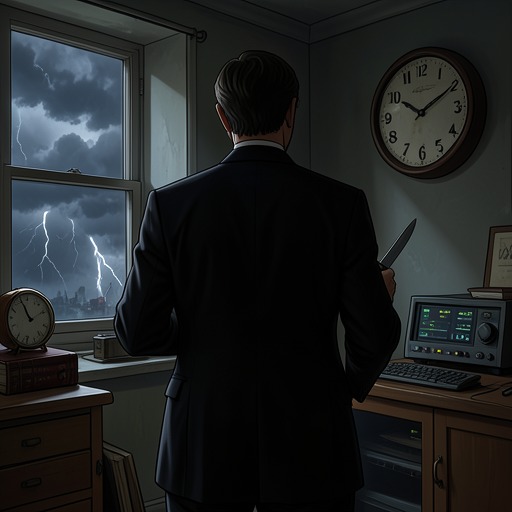
The Killer answers this plea not with a spoken refusal but with another chuckle and a slowly drawn knife with a large, shining blade, which he plays with. The gesture gives the scene’s silence a concrete and immediate consequence: while Bérenger searches for grounds on which to stop the killings, the instrument of violence is present in The Killer’s hand. Bérenger then turns from pleading to insults, calling him filthy, moronic, ugly, fierce, and stupid. That abrupt shift does not resolve the argument; it marks the breakdown of persuasion. The Killer’s nihilism remains powerful precisely because it is never proved as a set of beliefs: it is enacted as the refusal to answer while another person’s reasons, hopes, and pleas are left exposed.