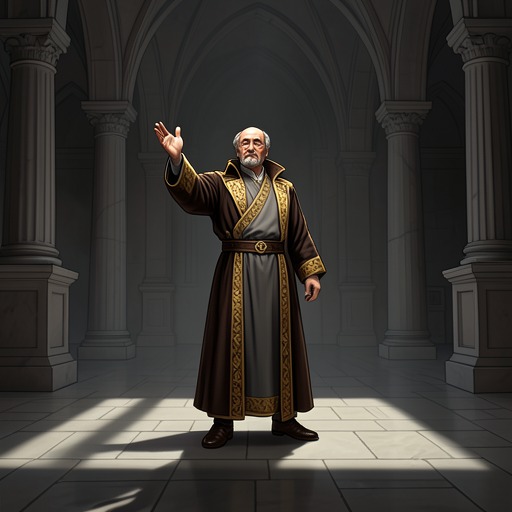
The King is dead! Long live the King!
The KillerThe King is dead! Long live the King! is a proclamation of royal succession whose two clauses collide in the death scene of Berenger the First. The first declares an irreversible fact; the second performs the continuity of kingship. In the play, that familiar formula is not allowed to pass as neutral ceremony: the King falls again, the words are repeated, and Queen Marguerite calls the spectacle a farce.
Wording and Function
The expression joins a death announcement to an acclamation of continued rule. Its force depends on the abrupt change from one sovereign’s death to the enduring office of the King: the person is mortal, while the title is treated as though it can pass immediately beyond him. In this scene, however, the formula’s confident rhythm is undercut by what the audience sees. The proclamation cannot revive Berenger the First or make the transition feel orderly; it sounds instead like a ritual struggling to contain a death that has already disrupted the court.
The Death Scene
The wording emerges through a sequence of competing reactions. After the King falls again, the death is announced. Queen Marie answers by repeating the acclamation, while Queen Marguerite responds with contempt. In a later exchange, Queen Marguerite says that there is no more time and that time has melted in the King’s hands. The Doctor, looking through a telescope said to see through roofs and walls, describes a gap in the sky where the Royal Constellation used to be and says that the King has been entered as deceased in the annals of the universe. The Guard then delivers the complete proclamation, only for Queen Marguerite to call him an idiot and demand silence. The Doctor confirms that the King is far more dead than alive. The ceremony’s assertion of continuity is thus immediately bracketed by evidence of death and by the court’s inability to agree on how—or whether—to perform the ritual.
Dramatic Significance
The Guard’s repeated acclamation makes the formula audible as an institutional reflex: even in the face of the King’s death, the language of monarchy insists on continuation. Queen Marie’s repetition gives that reflex a voice within the royal household, but Queen Marguerite’s dismissal punctures its authority. Her objection does not undo the announcement; it reveals the gap between the words’ intended reassurance and the scene’s visible reality.
The play’s final stage image sharpens that gap without repeating the proclamation. Queen Marguerite disappears, the King remains briefly seated on his throne, and the doors, windows, and walls of the Throne room slowly vanish. Then the King and throne disappear as well, leaving only gray light. Against that gradual erasure, the promise contained in Long live the King! appears less like a guarantee of permanence than a ceremonial claim made against mortality and loss.