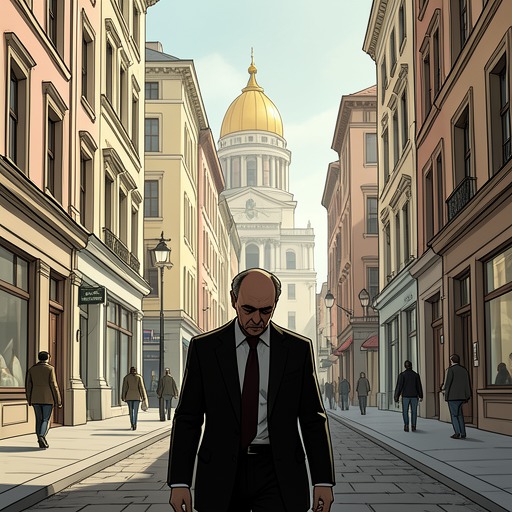
The Radiant City murder spree
The KillerThe Radiant City murder spree is a daily pattern of deception and drowning: a killer posing as a beggar leads people to a pool, uses Colonel's photograph to draw them close, and pushes them into the water. Its defining horror is the gap between knowledge and prevention. The method is displayed on walls and understood by people in the district, yet victims keep falling into the trap, the killer remains uncaught, and a new body can fall while the authorities discuss how difficult the murders are to stop.
The Pool and Its Victims
The pool first returns to view as an unmistakable place Bérenger and The Architect have already passed. The Architect says that two or three people are found drowned there every day. The report becomes immediate when Bérenger looks into the water: he describes a dead boy of five or six floating with his hoop, still clutching a stick, beside the bloated body of an officer in full engineers’ uniform. The Architect points out that there are three victims that day. Faced with the bodies, Bérenger tries to deny what he sees, calling it a plant in the water; the protest marks the distance between hearing about repeated deaths and confronting their physical reality.
The victims are not presented as a single exceptional case. The daily discovery of two or three bodies makes the pool a recurring site of violence, while the boy and the uniformed officer give the tally sharply different human forms. The scene supplies no personal histories for either victim, but their details resist reducing them to numbers: one is a small child with a hoop and stick, the other an officer who has drowned in uniform. The Architect’s matter-of-fact account and Bérenger’s effortful recognition place routine description beside visible death.
A Murder Method in Plain Sight
The Architect lays out how the killer works. At the tram-stop, people get off to go home and walk toward the gates because private cars are not permitted outside the Radiant City. The killer approaches disguised as a beggar, complains of hardship, and asks for alms. That appeal begins the encounter, but the killer continues by choosing a likely victim, striking up conversation, and persisting as the person walks on. He offers small goods from a basket: artificial flowers, birds, old-style nightcaps, maps, postcards, American cigarettes, obscene drawings, and other objects. The offerings are generally refused, yet the haggling keeps the chosen person alongside him until they reach the pool.
At the water, the killer brings out Colonel's photograph. The person leans closer to inspect it, particularly as darkness falls; the killer uses that moment to push the victim into the pool. The image is thus not merely an identifying clue but the bait at the heart of the attack. The sequence depends on ordinary movements—leaving the tram, walking home, stopping to look—and turns each into part of an engineered approach to the water. The victim’s curiosity supplies the opening the killer needs.
Warnings, Evidence, and Failed Prevention
The murders are not secret in the district. The Architect says that pictures of the killer have been posted on walls, and that some information about the method has come from people found on the drowned victims’ bodies. Some victims have briefly been brought back to life and provided further information. The Architect insists that everyone in the district knows how the trap works, yet two or three people still fall into it every evening. Bérenger is astonished that people continue to be deceived; The Architect answers that the killer has never been caught in the act. Public knowledge has not translated into effective protection.
Bérenger proposes keeping a plainclothes inspector permanently at the pool. The Architect rejects the plan as technically impossible: inspectors are overworked and have other duties. He adds a further danger: an inspector would want to see Colonel's photograph too, and five inspectors have already drowned in that way. The evidence and the lure are therefore entangled. Trying to establish who the killer is can bring investigators within reach of the same temptation that endangers ordinary passersby, while the killer’s identity remains unproved and his whereabouts unknown.
Another Death and the Scene’s Reversal
The account becomes a demonstration before it can become a solution. A cry sounds, followed by the heavy noise of a body falling into the water. Bérenger jumps to his feet and asks whether The Architect heard it. The Architect remains seated, biting his sandwich, and says that the killer has struck again. He explains that a moment of inattention is enough. His composure makes the event more disturbing: the discussion of a system that repeatedly takes lives continues alongside food and conversation, and the fresh sound of a victim falling does not interrupt the official’s detached manner.
The spree’s immediate consequence is not the apprehension of the killer but confirmation that he is still operating. The Architect’s account has made the mechanism legible, and Bérenger has proposed surveillance, but the audible fall shows that explanation and intention have not stopped the violence. The murders expose a grim contradiction within the Radiant City: the threat is visible enough to be described, pictured, and anticipated, yet it repeatedly escapes intervention. The pool returns as both crime scene and proof of that failure.