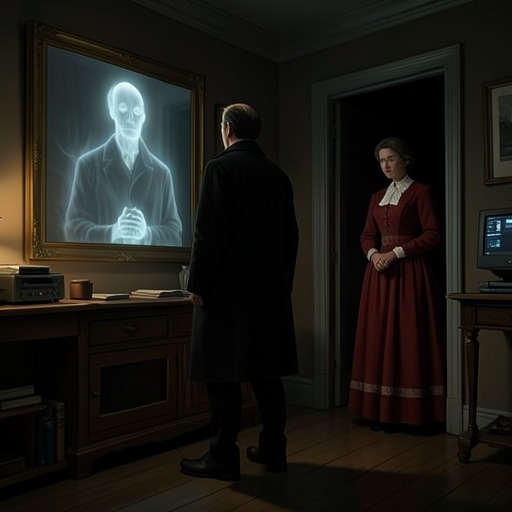
The apparitions at Macbett’s wedding feast
The KillerThe apparitions at Macbett’s wedding feast interrupt Macbett’s performance of unquestioned sovereignty with the return of the men whose deaths secured his power. Banco confronts him as a ghost, and Duncan appears seated on the throne Macbett has taken. Before the guests, Macbett tries to dismiss both apparitions and command obedience; their accusations and Duncan’s admission of mass killing instead expose the violence beneath the court’s submissive ceremony.
The Feast Interrupted
The supernatural sequence begins after Macbett taunts the assembled company, demanding that anyone who doubts his claim to be the best and greatest ruler stand up and speak. The stage then removes the feast’s projected or mirrored tables: the lights go out upstage, and the images disappear. Banco appears in the stage-right doorway and moves forward as he speaks. The staging makes his entrance a visible breach in the court’s carefully managed spectacle, while Macbett’s response—giving ground—registers a loss of composure before he can recover his rhetoric.
Banco answers Macbett’s challenge directly, declaring that he dares to speak and accusing Macbett of treachery, fraud, and murder. Macbett exclaims that Banco is not dead after all. A guest corrects him: this is not Banco in flesh and blood, but his ghost. Macbett then laughs off the revelation, claiming he can see through the apparition and put his hand through it. He concedes that Banco is dead, but insists the ghost cannot frighten him and says he regrets only that he cannot kill him again. His attempt to make the supernatural harmless does not stop him from retreating as Banco advances.
Banco’s Accusation and Macbett’s Defense
Banco says that all he can do now is curse Macbett. Macbett answers that Banco cannot make him feel remorse, then supplies a justification built from mutual suspicion: had Macbett not killed Banco first, Banco would have killed him, as Banco had killed Duncan. Macbett adds that he had intended to make Banco chamberlain, but that Banco wanted to rule in his place. Banco counters that Macbett himself took Duncan’s place, though Duncan had made him a baron twice over. The exchange contests not only who struck first but what service and reward were supposed to mean in a court where advancement could become a prelude to murder.
Banco recalls trusting and following Macbett, then says that Macbett and The Witches put a spell on him. Macbett turns the accusation toward succession: he claims Banco wanted to replace Macbett’s descendants with his own, but that Banco’s children, grandchildren, and great-grandchildren all died before birth. The scene presents this as Macbett’s answer, not as an independent confirmation of what happened to Banco’s line. By describing the unborn descendants as already extinguished, Macbett treats dynastic competition as a struggle he has won by striking first. Banco warns him that surprises and punishment remain ahead. Macbett reduces the speaker to scraps of personality, a robot or collection of leftovers, trying to make the accuser seem less than a person. Banco then disappears.
Duncan on the Throne
Almost immediately, Duncan appears, mounting the throne. The guests recognize the Archduke and turn toward him. Macbett points out their unequal responses: they had refused to believe Banco was real, yet accept Duncan as present and seated on the throne. He suggests that their former habit of paying homage to Duncan explains the difference. The apparition thus exposes the persistence of political reverence even after a sovereign’s death, while Macbett tries to redirect that reverence toward himself.
Addressing Duncan, Macbett boasts that he has taken his throne and his wife, then recalls that he served Duncan well even as Duncan distrusted him. He draws his dagger and orders the guests back to their places, insisting that they have no king but him and must pay him homage. The guests retreat, terrified, and bow in submission, saying that they hear and obey and are happy to submit. Macbett accepts their compliance as proof that they understand. The court’s ceremony has not disappeared with the old ruler: it has been transferred, under threat, to the usurper.
Guilt, Power, and the Apparitions’ Exit
Macbett tells Duncan that he should not return until the thousands of soldiers slaughtered in Duncan’s name have forgiven him, and until those soldiers have themselves been pardoned by the thousands of women they raped and the thousands of children and peasants they killed. Duncan answers by admitting that he killed or ordered the deaths of tens of thousands of men and women, soldiers and civilians, and had thousands of homesteads burned. His admission does not absolve Macbett; it makes the violence of Duncan’s rule explicit even as Duncan disputes Macbett’s account of taking his wife. Duncan laughs sardonically at that particular claim.
Macbett treats Duncan as mad and appeals to the guests for confirmation, receiving the same obedient assent as before. He tells the ghost to go away, dismissing him as an old fool. Duncan disappears behind the throne, having already stood to prepare his exit. The sequence therefore ends without a restored sovereign or a public reckoning: the guests remain deferential to Macbett, while the vanished apparitions leave their charges unanswered. Immediately afterward, the Maid reports that a woman has disappeared, and Macbett asks who; the abrupt announcement extends the scene’s instability without identifying the disappearance in this exchange. The episode’s central reversal is accordingly not a change of ruler but a rupture in the ruler’s performance: Macbett can command the living to submit, yet he cannot prevent the dead from naming what his authority rests upon.