The king’s healing touch
The KillerThe king’s healing touch is the public ceremony through which Duncan’s divinely sanctioned kingship becomes a visible, repeatable power over illness. A Monk blesses the crown, confirms Duncan in sovereign power, and renews the gift of healing; Duncan then touches patients with the royal scepter. The cures make authority tangible, while the ritual’s repeated procession turns a personal wonder into an ordered public performance.
Ceremony and sacred authority
The healing is introduced as a regular royal duty: the Officer announces that it is the first day of the month, when people afflicted by scrofula, tuberculosis, consumption, and hysteria come to be cured by Duncan’s heavenly gift. The rite therefore has a calendar and an established place in the work of kingship. The sick arrive not as an accidental interruption but as the expected participants in a recurring ceremony.
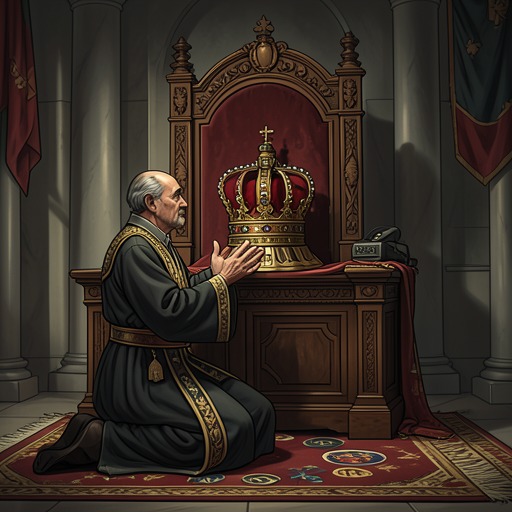
Before any patient approaches, the royal objects pass through a chain of religious and official actions. The Officer carries Duncan’s purple robe, crown, and scepter. The Monk blesses the crown and places it on Duncan’s head while Duncan kneels. He confirms Duncan’s sovereign power in the name of Almighty God; after the robe is placed around Duncan’s shoulders, the Monk renews the healing gift as something transmitted by God through his own unworthy service. The scepter is then blessed and assigned its practical ritual use: Duncan is to touch the sick with it.
This sequence presents sacred legitimacy as something enacted, not merely asserted. Duncan receives crown and robe through the Monk’s consecrating gestures, and the healing power is described as passing through religious mediation before becoming his royal instrument. Once the ceremony is complete, Duncan mounts the throne and calls for the patients. The placement is significant: the ruler who has just knelt for investiture now sits elevated, while those seeking aid approach and kneel before him. The solemn staging binds religious blessing, political rank, and bodily cure into one public image of rule.
The patients and the represented cures
The first petitioner describes a long journey from a damp, sunless valley beyond an ocean, a continent, seven countries, another sea, and mountains. He says the damp has eaten into his bones and describes scrofula, tumors, pustules, and a body covered in sores. His illness has also separated him from his family: his wife and children cannot bear to have him near. Duncan promises a cure and touches his head with the scepter. His words connect bodily healing to spiritual absolution, declaring the petitioner released from sin staining both soul and body. The stage direction then presents an unmistakable transformation: the man stands upright, drops his stick, raises his hands, and leaves with a clear, smiling face, shouting for joy.
The second patient brings a different kind of suffering. He describes being unable either to live or die, unable to sit, lie down, stand still, or run. The world feels like a prison; light, shade, other people, and solitude all distress him. His account ranges across trees, sheep, dogs, grass, stars, and stones, but none offers relief. He longs to cry and to know joy. Instead of answering with the first patient’s language of absolution, Duncan commands him to forget that he exists and remember that he is. The stage directions make the limit of that instruction visible: the man’s shoulders twitch, showing that compliance is impossible. Duncan then orders him to obey. The man’s back relaxes, his face clears, and he leaves almost dancing. In this instance the healing is represented not through an explanation of disease but through a royal command that alters the sufferer’s visible condition.
The ceremony broadens beyond these two cases. A third patient is cured in the same way, followed in quick succession by patients numbered fourth through eleventh. Before each entrance the Officer calls for the next. Some arrive on crutches or in wheelchairs, and each leaves after Duncan touches them with the scepter. The sequence makes the rite a sustained public spectacle: individual suffering is repeatedly brought before the throne, answered by the same royal gesture, and carried away as apparent recovery.
Repetition, order, and the image of rule
The different cures give the ritual both variation and a stable form. The first petitioner narrates a distant journey and a visible bodily affliction; the second describes an inward and existential torment. Duncan answers the first through a promise, a touch, and absolution, but answers the second through a stark imperative. The patients’ accounts differ, yet the ceremony absorbs both into the same structure of petition, royal intervention, and departure. Its form implies that Duncan’s authority can address suffering that has no single outward appearance or simple description.
The Officer’s repeated call of Next! is more than a practical signal. It sets the pace and makes the royal gift appear administratively orderly as well as sacred. The changing patients pass through a consistent sequence, while Duncan remains at the center of the performance with the scepter. The rapid movement from the third patient to the eleventh emphasizes scale and continuity: healing is not confined to one exceptional encounter but is displayed as a recurring capacity of the crown.
At the same time, the scene makes the cures dependent on Duncan’s person and position. Patients come to him, kneel at the throne, and are touched by an object identified with royal authority. The ceremony thus fuses care with hierarchy: relief is offered, but it is offered through the sovereign’s body, insignia, and command. The healing touch presents kingship as sacred service and as an impressive power to transform the condition of those who approach it. Its repeated spectacle gives that claim public force, making the monarch’s authority appear not only blessed but effective in the bodies of his subjects.