Tyranny Under Macbett's Rule
The KillerTyranny Under Macbett's Rule takes shape not through a detailed account of laws or policies but through scenes of command, withheld reward, intimidation, and public reversal. Macbett first appears within Duncan's chain of command, where obedience to royal orders is the language of military authority. Once king, he demands that others confirm his superiority, but their silence exposes the coercion beneath his claim to rule. His reign ends when Lady Duncan announces Macol's return and the country openly rallies against him; Macbett turns toward the advancing forest and is stabbed from behind.
From Duncan's commands to Macbett's rule
Before Macbett rules, his exchange with Duncan establishes the hard, practical form of authority in the kingdom. Macbett reports that a prisoner has been taken, and Duncan asks why he has not been killed. Macbett answers that he is waiting for his sovereign's orders. Duncan immediately authorizes the execution and demands to know what has happened to Glamiss, even asking whether he has been torn limb from limb. Macbett replies that Glamiss is surrounded and may soon be captured. The exchange shows a system in which the king's command determines the treatment of enemies, while Macbett presents himself as a subordinate carrying out that command.
That moment does not itself depict Macbett as king, but it establishes the political language he will later inherit and redirect. Authority is expressed through orders, capture, and threatened violence; obedience is made visible in the subordinate's answer. Under Duncan, Macbett insists that he acts on command. As ruler, he will demand not simply that others obey orders but that they validate his right to give them. The shift is from the soldier who cites his sovereign's authority to the king who tries to compel recognition of his own.
Rewards, loyalty, and pressure
The conflict over Banco's promised reward reveals another weakness in the bonds holding this political world together. Banco expects Duncan to grant the title or lands he had been promised, if not both. When the promise appears impossible to secure, Banco protests that Duncan cannot do this to him. The grievance is specific: a reward once anticipated has become a point of conflict between sovereign and soldier.
Macbett tells Banco that he and Lady Duncan have already intervened on his behalf with the Archduke. When those efforts fail, however, Macbett proposes using arguments that are more forceful, and then stronger still if necessary. His language leaves the means unstated, but its progression carries a clear threat of escalation. He compares Duncan's stubbornness to that of a mule that can nevertheless be made to budge. In this exchange, advocacy for Banco shades into pressure on Duncan. The scene does not show the stronger arguments being used; it shows Macbett presenting continued escalation as the alternative to accepting the king's refusal. The denied reward thus becomes a fracture in loyalty and a glimpse of how political persuasion may give way to coercion.
Rule as a demand for acclaim
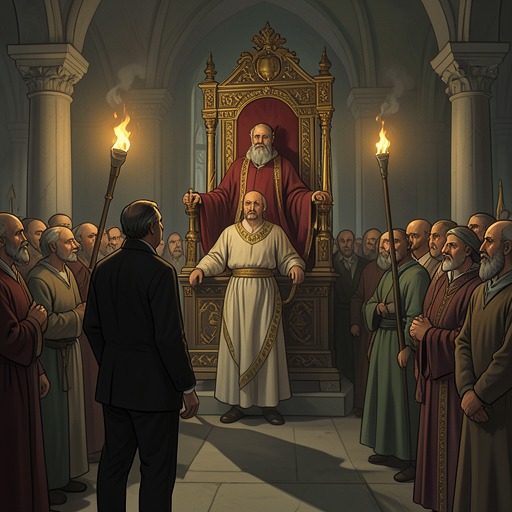
At the banquet, Macbett tries to turn his guests into witnesses for his version of the change in kingship. After releasing a servant, he tells the assembled company to sit, offers wine, and suggests that they smash a picture that might resemble either Duncan or himself. The proposed gesture would erase the awkward likeness, but it does not settle the question of what the guests think of the king. Macbett drinks and insists that he is a better ruler than Duncan, presenting youth, bravery, and energy as the reasons the country has gained from the change.
The guests respond with approving words, yet Macbett immediately treats their praise as inadequate evidence. He asks what they had thought of Duncan while Duncan was alive, whether they had called him brave and energetic, and whether they had ever said that Macbett should take his place. He then claims that Duncan seemed more suited to the role and demands that the guests answer him. The questions are not an invitation to open debate: when the guests hesitate, Macbett challenges them to identify anyone who does not consider him the best ruler, the greatest, and the most just. Their silence is the only response the scene supplies, and he interprets it as proof that they dare not disagree.
The sequence makes the performance of loyalty part of Macbett's rule. He solicits praise, discredits the guests' earlier silence about Duncan, and then makes dissent dangerous by demanding an answer in front of the company. His repeated insistence on his own greatness sits uneasily beside the guests' inability to speak freely. The banquet's wine and convivial invitations cannot soften that pressure: Macbett finally calls the guests miserable and orders them to get drunk. Acclaim appears less as a freely offered judgment than as a response shaped by the king's interrogation and command.
Revolt and the end of the reign
The appearance of Lady Duncan breaks the banquet's self-contained display of authority. She tells Macbett that Macol, Duncan's son, has returned from Carthage with a large and powerful army, that the whole country is against him, and that he has run out of friends. The news joins military opposition to political isolation: Macbett is not merely facing a rival claimant but has lost the support that might have sustained his rule.
The shouts outside make that opposition public. Voices call for Macol and against Macbett, while fanfares accompany Macol's entrance. Later, Macol tells Macbett to look behind him because the forest is on the march. Macbett turns and reacts with a curse; Macol stabs him in the back, and Macbett falls. Macol orders the body removed as carrion. The cries that follow declare the tyrant dead and acclaim Macol as the beloved sovereign. The change of ruler is therefore staged as both a military defeat and a sudden reversal in public allegiance: the same country that had been governed by Macbett now voices his overthrow and welcomes the next king.
The shape of the tyranny
The evidence defines Macbett's tyranny through dramatic contrasts rather than a catalogue of administrative measures. Duncan's authority appears in direct orders to punish enemies; Macbett first answers those orders as a subordinate, then claims the throne and tries to secure verbal recognition from his guests. His handling of Banco's grievance likewise places negotiation beside the prospect of increasingly forceful arguments. Across these scenes, authority depends on more than formal rank: it is tested in the responses of soldiers, allies, and subjects.
The banquet is the clearest image of that test failing. Macbett can command the guests to sit and can demand that they speak, but his questions expose the gap between public praise and genuine freedom to answer. Lady Duncan's warning and the crowd's shouts then make that gap politically consequential: Macbett's claims of strength and justice cannot prevent his isolation or defeat. His final turn toward the marching forest precedes his killing, while the crowd's acclamation of Macol supplies a new public voice for the regime. The ending does not suggest that the structures of rule have disappeared; it shows Macbett's kingship giving way to another sovereign's accession.