
Truth Against Political Convenience
The Killing RoomThis thread traces how official image management and powerful relationships repeatedly obstruct the investigation, while evidence and persistence force the truth into public view.
increasing Bearing strength in each event
 decreasing
Bearing strength in each eventdecreasingA Public Story Before the Facts

Reassurance Before Knowledge
An official explanation
Before a full investigation has begun, the Commissioner of Police tells the press that the recovered women probably died naturally and may have been used for student practice or research. The account promises to contain the scandal and calm concern about the bodies discovered at a prominent construction site.
The cost of a convenient claim
Margaret Campbell recognizes that the statement outruns the evidence. At the mortuary, she finds indications that at least one victim underwent surgery while alive, directly undermining the public explanation. Her objection is not merely a professional disagreement: an early, comforting narrative could shape every later decision and discourage investigators from asking harder questions.
The conference establishes the conflict between truth and political expediency. The authorities want a story that protects the city’s reputation and investment, while the medical evidence points toward murder. Once the official position has been announced, correcting it will threaten the face and credibility of those who issued it.
A Convenient Suspect
Suspicion Without Proof
The easy explanation
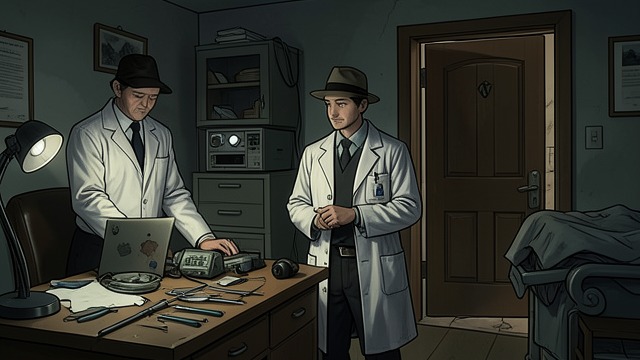
Jiang Baofu is a medical student with surgical training, an odd manner, unexplained possessions, and a night-watchman job at the site where bodies were buried. Each fact makes him look more suspicious, and the investigators understandably consider whether he could have carried out the procedures.
The limit of an attractive theory
Yet the apartment search produces no decisive link, and his apparent strangeness is not evidence of murder. Margaret Campbell challenges the idea that suspicion can stand in for proof, while Li Yan recognizes that an arrest would not answer the central questions about the victims or the people behind the operation.
The case insists that a plausible culprit can become another form of political convenience: someone easy to blame, whose arrest might quiet public pressure without exposing a larger network. Resisting that shortcut is difficult, especially under demands for quick results, but it preserves the distinction between a theory and a demonstrated crime.
The Protected Clinic

Power at the Door
A request for records
Once the investigators learn that all identified victims had undergone abortions, Li Yan asks Cui Feng to allow access to clinic records that might identify the remaining women. Cui Feng initially offers cooperation through an intermediary, preserving patient confidentiality while limiting direct scrutiny of his files.
An order to look elsewhere
The investigators’ request soon becomes politically dangerous. The Commissioner tells Li Yan to stop pursuing Cui Feng, a powerful Party member with influential friends. The Procurator General refuses to issue a search warrant, although the clinic’s facilities and the scale of the killings make the claim of ignorance increasingly difficult to accept.
The obstruction reveals how institutional power can turn confidentiality and reputation into shields. The question is no longer only whether investigators can find evidence, but whether they will be permitted to follow it where it leads. Li Yan’s insistence that the records matter becomes a test of whether official authority serves justice or protects its own connections.
The Price of a Favor

Obligation as Leverage
A gift with a hidden cost
Huang Tsuo explains that Cui Feng arranged the liver transplant that temporarily saved Huang’s terminally ill wife and waived the fees. What had seemed a life-saving favor became an obligation that Cui could exploit, binding a police official to the clinic’s interests through personal debt and the expectation of reciprocity.
Complicity disguised as helplessness
Huang Tsuo says that he supplied official certifications falsely presenting exported organs as lawfully obtained from executed prisoners. He insists that he did not know the full extent of the murders, but admits that he chose not to know and helped provide cover. His wife’s illness explains the pressure he faced without erasing the consequences of his decisions.
The episode gives personal connections a darker meaning than ordinary loyalty. Guanxi can sustain people through hardship, but in the clinic’s hands it becomes a system of coercion: a gift of life creates a debt paid for by other people’s deaths. Huang Tsuo’s tragedy is not simply that he was trapped; it is that he helped the trap hold.
The Warrant and the Banquet

Justice in Public
Choosing the difficult route
After discovering the clinic’s role and learning where Xinxin may be held, Li Yan has strong reasons to seek immediate vengeance against Cui Feng. Instead, he obtains an arrest warrant and confronts Cui at a banquet attended by powerful officials. The setting makes the arrest a public challenge to the very hierarchy that had previously tried to shield him.
Law over revenge
Li Yan raises a gun but does not fire. He presents the warrant and arrests Cui Feng on suspicion of murder, announcing a count that begins with the known victims and may rise. The choice does not make the political obstacles disappear, but it denies Cui the excuse to portray the case as a private act of retaliation.
The scene resolves the thread by making lawful accountability an action rather than an abstraction. Political status has delayed the investigation and enabled concealment, yet the evidence ultimately gives Li Yan grounds to act. His restraint matters: justice is not identical to revenge, even when the anger behind it is fully justified.
At the first Shanghai press conference
During the first interviews with Jiang Baofu
After the abortion pattern is uncovered
During Huang Tsuo’s confession near the climax
On the final night of the investigation
