Cui’s Suzhou Safe House
The Killing RoomCui’s Suzhou Safe House is a clinic and covert holding site where abducted women were kept before being taken for operations. Hidden below ground and accessible by canal, it makes Suzhou’s famed waterways part of the machinery of concealment. When Li Yan and Margaret Campbell reach the building, its rooms reveal both the practical organization of the scheme and the immediate human stakes: the women are not distant evidence but captives held behind locked doors, including Xinxin.
Identity and Setting
Huang Tsuo identifies the safe house as the place where women were taken after being abducted. They remained there until a transplant patient had flown in and been prepared, after which they were taken to the clinic for an operation. The account establishes the house not as an isolated hideout unrelated to the medical enterprise, but as one stage in a sequence connecting abduction, confinement, and surgery. Cui Feng has a clinic in Suzhou, roughly sixty kilometres outside Shanghai, and the basement belongs to the operation conducted through that facility.
The location acquires particular force from its contrast with the city around it. Suzhou is associated with beauty and is described as the Venice of the East; Li Yan remembers Mei-Ling Nien’s saying that Heaven is above, while Hangzhou and Suzhou are on earth. Against that idealized reputation, Huang’s disclosure places women awaiting surgery beneath a clinic, out of public view. The contrast is not simply between a picturesque city and a criminal building: the waterways that help define Suzhou’s beauty also provide the route by which the captives can be moved without attracting attention.
Concealment and Operation
The basement lies at the rear of the building and can be reached only by canal. Huang explains that women were brought in and taken out by boat at night, a method intended to keep their movement from being noticed. This access arrangement gives the site a double character: above or beyond the hidden rooms stands a clinic, while the waterway supplies a discreet approach to the place where the women are held. The concealment is built into the location rather than dependent only on secrecy or the absence of witnesses.
The basement’s use follows the timetable of the organ operation. Women were confined there while the intended patient travelled to the site and was prepared; they were then transferred to the clinic. This sequence makes the safe house a logistical link between kidnapping and surgery. Its function is therefore both spatial and temporal: it keeps victims out of sight while the perpetrators coordinate the arrival of the person for whom the operation is intended. The place’s hidden position supports a system in which the people being held are treated as movable parts of a process.
Police Approach and Interior
After leaving Huang’s apartment building, Li Yan and Margaret travel to Suzhou. The procurator general has refused Li’s request for an arrest warrant for Cui Feng, citing insufficient evidence, but local public-security officers are arranged to meet them. Near Loumen Gate, five police vehicles and roughly a dozen uniformed officers wait. The plan is to approach the basement in a small sampan, since a motorboat might alert a guard. Some officers remain at the landing stage while others cover the building from the road; the clinic appears locked and unoccupied, with no lights visible.
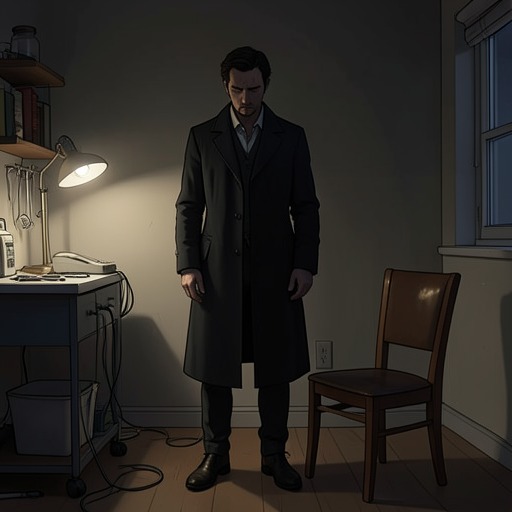
The police approach follows the site’s geography: the canal is not incidental scenery but the route into the basement. At the rear, the group reaches a locked door. Once it is forced open, a long corridor leads past six doors set at regular intervals. The first two stand open. Inside are freshly made cot beds with sheets and blankets, small bedside cabinets, and rush matting. These modest furnishings show that the rooms are arranged for repeated use, not merely for a brief, improvised stop. Yet the barred openings and locked doors mark the difference between a place prepared for occupants and a place in which people can leave freely.
Captives and Narrative Significance
The search discovers a young woman alone in one of the locked rooms, frightened and dressed in a thin cotton smock. Li Yan identifies himself as a police officer and frees her; Margaret Campbell is present as the search moves from the corridor into the room. The discovery makes the basement’s purpose concrete. The cots and orderly furnishings might initially suggest ordinary accommodation, but the locked room and captive occupant disclose what that arrangement has been made to serve.
The search continues because the officers believe Xinxin may also be inside. At the end of the corridor, Li reaches another locked room and finds her on a cot, bound, gagged, and blindfolded. Margaret and Li’s search for the child brings the safe house’s function into its sharpest focus: a site used to hide women taken for the organ trade has also become the place where Cui Feng’s scheme holds Xinxin. Li finds that she is not breathing, leaving the rescue at an immediate crisis rather than a settled resolution. The basement thus concentrates the investigation’s larger conflict into a physical space: a carefully concealed route and a series of prepared rooms that had enabled the crime now provide the evidence and setting for the effort to save the people trapped within it.