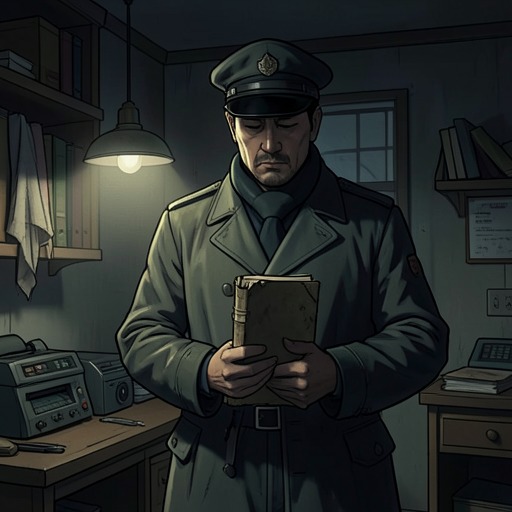
Li Arrests Cui Feng at the Banquet
The Killing RoomLi Yan’s arrest of Cui Feng at the banquet is the moment when a confrontation poised to become personal violence turns back toward legal process. Li enters armed and visibly shaken, but, with Dai’s quiet intervention behind him, he lowers the prospect of revenge into a formal arrest: the warrant names Cui as a murder suspect and begins a count of fifty-four victims, with more likely. The choice does not resolve the case, but it determines how Li will act at its most volatile point.
Approach to the banquet
The scene follows a radio message from Dai: airport officers have picked up the American surgeon Daniel F. Stein as he tries to board an Air India flight to Delhi. Stein carries a briefcase full of computer disks that may contain important material. Li gives no response to the report. The narrative leaves the possible significance of the disks open; their discovery forms a parallel investigative lead, not an explanation of what Li is about to do at the banquet.
At the Xiaoshaoxing Hotel, Li rises in one of the green glass elevator tubes and looks down on traffic, bicycles, pedestrians, lanterns, and the steam from food shops along Yunnan Nan Road. Yet the bustle seems unreal to him. He retraces the corridor where he had walked with Margaret Campbell and Nien Mei-Ling less than a week earlier, passing banquet rooms as gatherings break up. Waitresses carrying away the remains of meals stare at the bloodstained, wild-eyed detective. His steady progress contrasts with the alarm his appearance creates.
The confrontation
In the largest banquet room, laughter stops as Li appears in the doorway. Cui is seated beside Director Hu, whose earlier ease gives way to a glare. Li does not answer Hu’s objection to his presence. He draws Huang Tsuo’s gun from beneath his jacket and aims it at Cui. Guests rise abruptly, chairs overturn, and people shrink away as Li advances without taking his eyes off his target.
The crowded table, strewn with the remains of two dozen crabs, makes the confrontation sharply immediate. Cui stays seated until Li is within a metre of him. Director Hu remains seated too, declaring Li’s career finished and ordering him to put the gun down. Li ignores him. The exchange sets institutional authority against the armed detective’s single-minded pursuit: Hu invokes Li’s position and future, while Li’s attention remains fixed on Cui.
Cui finally stands. He meets Li’s gaze with the assurance of someone who believes himself beyond the law, then notices that Li’s hand is trembling. His confidence gives way to doubt and fear. The narration presents the danger as more than a routine arrest: Li wants to destroy what he sees as evil, and for a moment the gun makes that impulse actionable. The line between justice and revenge has become the scene’s immediate stake.
The decision to arrest
Dai speaks from the doorway, where he and Qian have arrived. His brief, softly delivered call interrupts Li’s fixation and appeals to his judgment without trying to overpower him. Li hesitates, then reaches into his jacket for folded official papers. He holds the warrant up in front of Cui rather than pulling the trigger.
Li announces that Cui is under arrest on suspicion of murder. He says the count begins at fifty-four and will probably rise. The number gives the arrest a scale beyond the charged encounter in the banquet room, while the wording preserves the distinction between suspicion and proof. Cui’s brief, almost sneering smile suggests that he regards Li’s refusal to shoot as a victory. But officers push past Li, handcuff Cui, and lead him away. The arrest, not a killing, is the immediate result.
Aftermath and significance
The guests are left in stunned silence. Li turns to Director Hu and rebukes him with a proverb about choosing one’s companions carefully, implicating Hu through his evident association with Cui without establishing further details about Hu’s role. The exchange extends the confrontation beyond the suspect: Li has ignored Hu’s command, carried out an arrest in front of Hu’s guests, and openly challenged the company Hu keeps.
The scene’s decisive reversal lies in Li’s restraint, not in the display of the gun. He has brought the weapon and stands close enough to shoot, but Dai’s intervention helps return him to the warrant and the officers waiting behind him. The book frames the alternatives as law, justice, and revenge, uneasy companions that Li must distinguish in action. His choice preserves the possibility of a public investigation and makes the arrest the beginning of accountability rather than an act of private vengeance. Cui’s arrest is on suspicion of murder; the warrant’s count is expected to grow, and the scene does not present a conviction or a completed inquiry.