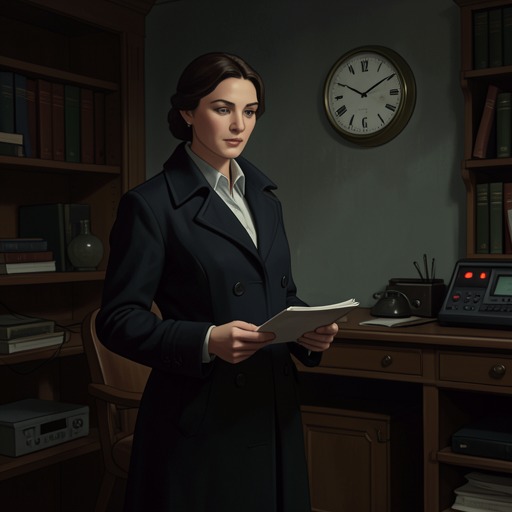
Margaret Campbell’s bereavement
The Killing RoomMargaret Campbell’s bereavement unfolds as a delayed recognition of loss, sharpened by the knowledge that she and her father had grown distant before his death. At his grave, she confronts not only the physical fact of burial but also the years of estrangement, the memories she can no longer ask him about, and the decisions his death leaves her to make alone.
Death and delayed grief
The news reached Margaret in Beijing through a brief, cold phone call from her mother. Nearly two years had passed since Margaret last saw her father, and their conversations by phone had been few. In the small apartment provided by the University of Public Security, she sat for a long time feeling empty and disturbed by her apparent lack of emotion. Grief did not arrive on command: only when she woke in the night with tears did she understand that the feeling she feared was absent had, in fact, been there.
At the funeral in Chicago, she stooped to take a handful of earth and let it fall into her father’s grave. Her mother had done the same. The first snow and the cold wind made the burial a bodily experience, but Margaret’s response was also intellectual and professional. Having seen many bodies in her work, she found the burial ritual difficult to accept: a person placed in a box and left underground to decay. She had already decided that she wanted to be cremated, which seemed to her simpler and more final. Her knowledge of what happens to a body after death did not make her father’s death easier to contemplate; it made the thought of his remains harder to bear.
Margaret had not viewed him in the coffin. She could not bring herself to do so, and the mortician’s attempt to restore the appearance of life would not have changed her sense that the person she knew was no longer there. For her, her father persisted in other people’s memories and in old home movies made before the family had a video camera. The distinction between the body and the person is central to her mourning: the remains could be seen, but they could not restore the presence she had lost.
Home, distance, and avoidance
His death forces Margaret to break her already fragile ties with China. Those ties had been held in place largely by a man she thought she loved; once her father is gone, she is left to face decisions about where her future lies, decisions she had postponed. Returning to Chicago does not immediately settle the question. She has been back nearly three days without going to her apartment in Lincoln Park, which neighbors have been looking after by collecting the mail and watering the plants. She has been away for more than eighteen months and fears what she will find there, as well as the memories associated with the man she lived with for seven years and married.
Instead, she stays in her childhood bedroom in Oak Park. Its familiarity offers comfort and recalls a time before adult responsibilities, when life still seemed full of promise. Margaret recognizes that this refuge is also a way of hiding. Her father’s death therefore becomes more than a loss she must mourn: it brings her back to the places and choices she has avoided, without yet telling her what to do about them.
The funeral does not draw Margaret and her mother closer. They have barely spoken in the three days since Margaret returned, and their brief embrace lacks warmth. Their exchanges remain polite and practical; the relationship, as Margaret understands it, has long been sterile and loveless rather than openly broken by a single quarrel. After the burial, her mother calls her over to help serve food at the house. The ordinary request sits beside the enormity of the death, while the emotional distance between mother and daughter remains unresolved.
Memory and unfinished regret
Margaret struggles with the Irish tradition of a wake, which treats a gathering as a celebration of the life that has ended. She cannot make that celebration fit her experience of death. Her work has repeatedly exposed her to bodies after animation is gone, and the contrast between a once-living person and what remains makes celebratory language feel inadequate to her. She does not reject her father’s importance; rather, she cannot find him in the physical arrangements meant to represent him after death.
In his study, material traces of his life give her memories a more particular shape. His shelves hold hundreds of marked and annotated books, including works by Steinbeck, Faulkner, Fitzgerald, and Hemingway, and a copy of Sherwood Anderson’s Winesburg, Ohio opens to a story she remembers from childhood. At his desk, his pipe and the objects he used remain where they were, but his intention to return to them can no longer be fulfilled. These things preserve habits and personality more vividly for Margaret than the coffin does, though they cannot answer what he thought of her.
A photograph of Margaret in her graduation gown brings that question into focus. She wonders whether her father had looked at it and whether he had felt pride or disappointment. As a child she adored him, and she remembers the time and love he gave her. Since her teenage years, however, they had not been particularly close. Margaret attributes part of that distance to herself: she had been busy building a life apart from her parents, a life she now judges to have ended in failure and disappointment. The regret is not simply that they were distant, but that she can no longer apologize or tell him that she loved him. She turns the photograph face down, unable to remain with the question it raises.
The limits of professional knowledge
Margaret’s later forensic work provides a measured contrast to her private encounter with death. At an autopsy, she records that a woman’s body has been mutilated and examines the amputation wounds; their pale, bloodless appearance leads her to distinguish injuries inflicted after death from the cause of death itself. In a later re-examination, she identifies both a point of continuity with the Shanghai victims and important differences: some organs remain, and the bones have been sawn rather than chopped. She nevertheless judges that the same person may have committed the murder under different circumstances.
These observations show Margaret applying forensic knowledge to the limits of what physical evidence can establish. That expertise offers no equivalent way to recover her father’s thoughts, reconstruct their lost conversations, or settle whether he was proud of her. Her bereavement remains unfinished at the point where memory, professional certainty, and personal regret diverge: she can examine the evidence left by death, but she cannot return to the living relationship and change what went unsaid.