Professor Lu
The Killing RoomProfessor Lu is a professor at Shanghai Medical University who assesses Jiang Baofu as an exceptionally gifted student but an unsettling prospective doctor. His interview with Li Yan and Nien Mei-Ling turns a question about Jiang’s training into a conflict over what medical skill is for: technical mastery alone, Professor Lu argues, cannot substitute for care of the living. He also gives the investigators a route to the next witness, Jiang’s pathology lecturer, Dr MacGowan.
Identity and Introduction
Professor Lu receives Li Yan and Nien Mei-Ling in his small office at Shanghai Medical University, where they have come to ask about Jiang Baofu’s student record and character. The campus outside is set behind high grey walls along Dong’an Road, its modest buildings connected by tree-lined private roads. In the office, sunlight passes through Venetian blinds and falls across the smoke from Professor Lu’s cigarette. These details establish a meeting that is both an official inquiry and a personal exchange: Professor Lu is a source of professional knowledge, but his judgments arrive in an atmosphere of impatience and visible distaste.
He is described as broad, with a wide, flat face and narrow, slanted eyes; his thick accent points to origins in northwest China. His white coat hangs open over a dusty cardigan and baggy trousers. He handles his cigarettes with nicotine-stained fingers, at times waving one as he speaks and later lighting a fresh one from the remains of the old. The portrait makes him physically distinctive without making his authority ceremonial. He is a working academic in an ordinary office, speaking plainly and with little effort to soften his opinions.
Judgment of Jiang Baofu
Professor Lu first calls Jiang a brilliant student and praises his natural ability. In his assessment, Jiang handles a scalpel with an ease that suggests he could become one of the country’s leading surgeons. The praise is not a recommendation. Professor Lu immediately makes clear that he hopes Jiang will not choose that profession, because, as he sees it, the student is more absorbed by the dead than by the living.
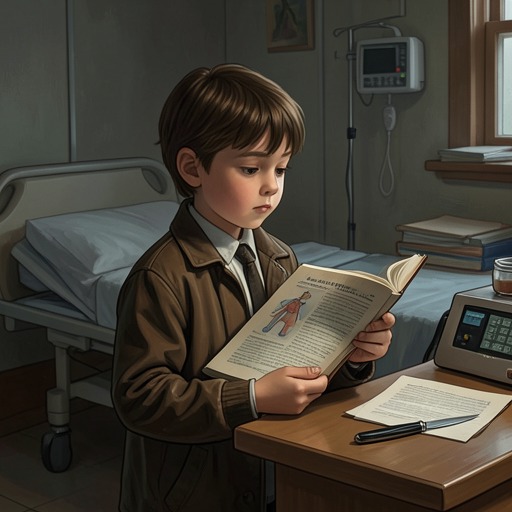
He explains the distinction in terms of medical responsibility. The university tries to teach students to care about patients and feel an obligation toward their well-being; Jiang, in contrast, is interested in the body’s mechanics and surgical technique, not in the patient. Professor Lu says Jiang spends hours in pathology cutting up bodies donated for research. He believes Jiang’s talents may be better suited to forensic pathology, where the study of bodies after death would fit the student’s evident interests. Yet even that prospect remains unresolved: Jiang has not decided on a path.
The professor’s challenge to Li Yan sharpens the disagreement. He asks whether a patient would be better served by an impeccably skilled doctor or by one who cared whether the patient lived or died, then answers the question himself. His point is not that Jiang lacks ability; the interview makes the opposite clear. It is that ability, separated from concern for the person on the operating table, may be inadequate or even dangerous as a model of medicine. Professor Lu’s reservations therefore give the investigators more than a biographical detail: they frame Jiang’s technical brilliance alongside a serious question about his relation to human life.
Temperament and Relationships
Professor Lu’s account is openly personal as well as professional. He says he cannot stand being near Jiang and describes the student as persistently unlikeable. According to him, neither staff nor students seem to like Jiang; he is never seen in company and sits alone in the canteen. Professor Lu turns these observations into a harsh summary of Jiang’s character, calling him abnormally brilliant before suggesting that abnormality alone would describe him sufficiently. The vehemence makes clear that this is not a neutral evaluation, even as the professor provides specific observations about Jiang’s isolation and behavior.
His manner toward Nien Mei-Ling likewise carries an edge. When she asks whether he dislikes Jiang, her tone is sarcastic, and Professor Lu answers without attempting diplomatic restraint. Earlier, he gives her a cold glance while discussing the university’s efforts to instill care in its students. Li Yan notices a familiarity between them beyond what he expected from the telephone call that arranged the meeting, but Nien Mei-Ling remains impassive and the nature of that familiarity is not explained. The scene thus marks a tension Li Yan detects without resolving it; Professor Lu’s remarks should be read as testimony colored by his own strong feelings, not as an uncontested account.
Narrative Role
Professor Lu’s assessment helps redirect the investigation from Jiang’s general academic record to the specialized setting in which his interest in bodies is most apparent. He suggests that the investigators consult Dr MacGowan, a visiting lecturer from the United States who teaches pathology and whom Jiang idolizes. The recommendation is complicated by Professor Lu’s claim that Dr MacGowan may dislike Jiang almost as intensely as he does. This characterization supplies a reason to seek another perspective, not proof of what that perspective will be.
When Li Yan asks to speak with Dr MacGowan, Professor Lu agrees, then pointedly asks whether the investigators can speak English. The question ends the exchange on a note of dry provocation. His role in the scene is consequently double: he gives concrete information about Jiang’s skill, habits, isolation, and undecided career, while his bluntness and apparent personal antagonism invite the investigators—and the reader—to distinguish observable details from judgment. By placing extraordinary surgical talent beside an alleged absence of patient-centered feeling, Professor Lu makes Jiang’s professional potential itself a source of unease.