Shanghai World Clinic in Shanghai
The Killing RoomShanghai World Clinic in Shanghai is Cui Feng’s private medical facility, set behind the discreet frontage of a former French Concession villa. First presented as an opulent clinic serving foreign patients, it becomes a key investigative location when detectives trace one suspect’s employment there and search the building. The contrast between its polished, hotel-like amenities and the evidence discovered inside turns the clinic into a meeting point between respectable medical commerce and the concealed crimes under investigation.
Setting and Design
The clinic stands on a quiet residential street at the edge of the consular district, behind a high gated wall and dense trees. Its villa setting, secluded avenues, and obscured windows make it outwardly private and difficult to read from the street. A brass plaque at the gate identifies the building in both Chinese and English. The former garden has been paved for parking, and a small private ambulance waits beneath a canopy at the entrance.
Inside, the setting continues to blur the line between medical institution and expensive residence. A nurse leads visitors up carpeted stairs past original Chinese scroll paintings and a patient in a wheelchair. Cui receives Li Yan and Nien Mei-Ling in a large study arranged around a fireplace, with a substantial desk set beside a bay window. The carefully appointed rooms and Cui’s warm, measured manner make the clinic appear controlled and reassuring, even as the investigation begins to associate his wider medical enterprise with the victims.
Facilities and Medical Business
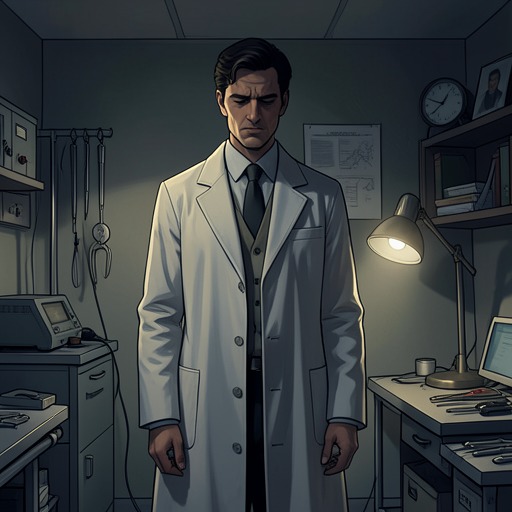
The building extends across four floors, including rooms in the roof, and has a large basement containing two operating theatres as well as preparation and recovery rooms. An elevator connects the basement operating area with recovery facilities above. The ground floor contains a four-bed intensive-care ward and luxurious single rooms; additional single-bed rooms occupy the first floor and attic. Cui says the clinic can accommodate fourteen patients, in addition to its four intensive-care beds. During the police visit, however, Li Yan sees only a handful of patients, and the facility appears far from full.
The clinic’s resources include private rooms with en-suite bathrooms and satellite television, as well as extensive surgical facilities. Cui invites the investigators to tour the premises, presenting the well-equipped building as evidence of a legitimate medical operation. Li Yan notices that Cui calls those receiving care customers rather than patients, and interprets the wording as a sign of the commercial outlook behind his practice. He also suspects that the large volume of abortions handled by Cui’s wider network could help sustain the business when the private clinic has few patients. That is Li Yan’s inference, not a confirmed accounting of the clinic’s finances.
The clinic’s role in the investigation requires an important distinction. After learning that the identified victims had undergone abortions at clinics belonging to Cui, Li Yan and Nien Mei-Ling ask to compare Cui’s records with missing-person files. At Shanghai World Clinic in Shanghai, Cui explains that this particular facility treats foreigners and handles insurance work. It is therefore connected to the abortion clinics through Cui’s organization, but is not itself identified as an abortion clinic. The distinction does not remove it from the inquiry: a medical student later found to have worked there is also connected to evidence in the murder case.
From a Lead to a Search
The clinic enters the investigation after Margaret Campbell identifies a shared medical history among the victims. Her autopsy technique reveals scarring inside several women’s uteruses; recalling observations by Dr Wang in Beijing, she connects this finding to previous abortions. The inquiry establishes that the identified women had undergone abortions, and relatives of four of the five identified victims report that those procedures took place at clinics belonging to Cui Feng. This association gives Li Yan a practical reason to request access to records, which might help identify the remaining dead women by comparison with missing-person reports.
During the visit to Cui’s clinic, Li Yan and Nien Mei-Ling ask to see files and tour the premises. Cui initially remains courteous and agrees to cooperate, while Li Yan arranges for an officer to liaise with staff. The visit also gives the investigators a detailed impression of the clinic’s capacity and operation. Later, Detective Dai notices that Jiang Baofu’s résumé lists seasonal work at Shanghai World Clinic in Shanghai. Li Yan learns that Jiang spent two summer vacations there, a connection that sharpens the investigation’s focus on the clinic and on how Jiang came to be involved in disposing of bodies.
Li Yan eventually tells the Procurator General that he will take detectives and forensic officers to search the clinic, with or without a warrant, and warns that he will pursue charges and corruption investigations if obstructed. He subsequently obtains a warrant. By the time the convoy arrives, however, the building is dark, its gates chained and padlocked, and its occupants have gone. The officers cut the chain and enter. In reception, filing-cabinet drawers stand open, records have been removed, and a half-finished mug of tea is the only obvious sign of the hurried departure. Li Yan orders investigators to establish who worked there and seek arrest warrants for them.
Theatres and Evidence
Margaret Campbell and Nien Mei-Ling descend to the basement operating suite while officers search the floors above. The warning sign at the surgical entrance and the access button mark a controlled threshold. Inside, the changing rooms and stores are open, and the operating schedules that had been written on a whiteboard have been wiped away. The procedure has been stripped of its ordinary administrative traces as well as its staff and patients.
In one operating room, Margaret recognizes the setting as the place where the victims were killed. The room still contains covered surgical equipment, storage cupboards, an operating table, and an electrocautery machine. She connects the cautery equipment to the charred material previously observed around the victims’ surgical incisions. Her recognition gives the space evidentiary significance: it is not merely a clinic theatre, but a location that helps explain how the victims’ injuries were produced. The sequence also turns the apparent sterility of the room into a practical obstacle; Margaret cautions that the perpetrators have been careful and that little forensic evidence may remain.
The clinic’s walk-in freezer is large enough to hold as many as twenty bodies in parts, but it is empty when the search team finds it. Li Yan orders that it be defrosted so forensic officers can examine the meltwater. The absence of its contents, like the cleared records and blank operating schedule, indicates that the premises have been emptied before the search rather than simply abandoned in working order. Together, these absences complicate the investigation even as the remaining equipment helps locate the operation.
Computer and Significance
In the administrative office, Li Yan examines files on a Macintosh PowerPC G4 computer. Margaret Campbell helps him inspect a page that has been recovered from the computer’s memory. It belongs to Transplants Online and presents Dr Al Gardner, identified as chief executive of the New York Transplant Co-ordination Clinic, as a transplant coordinator connecting donors and recipients internationally. Links for organs lead to pages listing recipient requirements, including age, sex, blood type, and HLA information. The interface supplies a stark contrast to the physical rooms below: the clinical work of matching recipients is represented as orderly information, while the missing records and empty freezer conceal the human cost of the enterprise.
When Li Yan asks whether the women were killed for their organs, Margaret reluctantly agrees that this is what the evidence suggests. The clinic’s full role is not resolved by the search itself, and its emptied state leaves important questions unanswered. Yet its rooms, equipment, computer, and connection to Jiang Baofu bring separate lines of inquiry into a single place. The building’s movement from polished private clinic to abandoned crime scene gives that discovery its force: the same walls that first advertised professional care become the setting where the investigators identify the suspected killing site and encounter evidence of an international organ trade.