Tiananmen Square
The Killing RoomTiananmen Square appears as a place where ordinary childhood play unfolds against a powerful historical backdrop. Children fly kites across its vast open space, while the square’s association with the 1989 Tiananmen Square crackdown remains part of its meaning for older generations. In Margaret Campbell’s encounter with Xinxin, the setting also becomes a space for reunion and shared play.
An Open Space Marked by History
The square’s scale is first registered through the children who use it: its broad expanse means open ground and sky in which to fly simple wire-and-plastic kites. The narrative places their play beside the memory of the tanks that once entered the square, emphasizing that these children were born after that rupture. A site shaped by a century of change has become, for them, an ordinary place to fly a kite; the contrast makes both the persistence of history and the distance between generations visible.
The late-afternoon scene retains signs of the square’s public and political character. Mei Yuan explains that the kindergarten often brings children there to fly kites when the sky is clear and cold winds come from the north. Armed police march past in formation, while tourists visit and a street seller offers kites. Margaret, conspicuous among the visitors because she is a Western foreigner, draws curious attention from groups of tourists from the countryside. Everyday recreation, state presence, and public spectacle occupy the same space without dissolving its historical associations.
Xinxin and the Kite
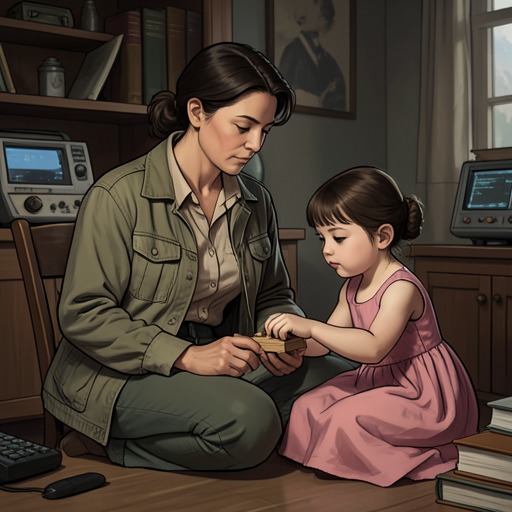
When Xinxin sees Margaret, she wants to run to her but is still holding her kite line. Mei Yuan solves the small dilemma by taking the line, leaving Xinxin free to rush into Margaret’s arms. Margaret crouches to embrace her, and their reunion gives the public square an intimate focus: affection becomes an action amid the open, busy surroundings.
The meeting continues through play rather than conversation alone. Xinxin has learned a few English words and greets Margaret formally; Margaret answers in Chinese, making Xinxin and her classmates laugh. She then asks to fly the kite. With Mei Yuan translating, Xinxin agrees, and Margaret takes the line, adjusting it until the box kite rises. The children and teachers gather around, applaud, and share in Margaret’s laughter. For a moment, the square’s remembered political history recedes behind the immediate pleasure of a kite in the sky.
A Setting for Release and Connection
The kite scene is connected to loss as well as joy. As she holds Xinxin, Margaret briefly wonders what her own child might have been like, then puts the thought aside to join the children’s activity. The narrative does not make the square a cure for grief; instead, its open space permits a moment of attachment and play to coexist with what remains unresolved. Margaret’s laughter as the kite rises marks a temporary release, while her participation helps make the meeting between her and Xinxin an active bond rather than a formal reunion.
The square’s other appearance in the supplied scenes is indirect: Mei Yuan poses a bus-driver height riddle about a number-one route through Beijing, naming the Friendship Store, Wangfujing, the Forbidden City, and Xidan as stops. The puzzle shifts attention from the city’s landmarks and changing passenger counts to the driver’s identity. Together, these references place Tiananmen Square within a wider Beijing landscape, but its defining image remains the children’s kites above a site where historical memory and ordinary life meet.