Boris Yvain's petrification discovery
The King in YellowBoris Yvain's petrification discovery is the revelation of a violent mineral process that can transform a living object into stone within seconds. Demonstrated in the presence of Alec, the discovery joins scientific curiosity to artistic ambition, but its beauty is inseparable from its threat: the solution does not merely preserve nature, it destroys organic life in order to reproduce its form. Boris therefore treats the discovery as a secret whose social and artistic consequences are too dangerous to release.
Discovery and Demonstration
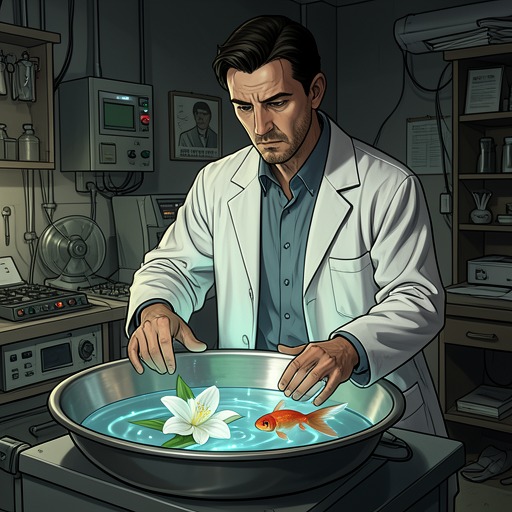
The discovery is presented during an experiment in which Boris takes an Easter lily that Geneviève had brought that morning from Notre Dame and drops it into a basin of liquid. The solution immediately loses its crystalline clarity. A milk-white foam envelops the flower, vanishes, and leaves the fluid opalescent, while orange and crimson tints move across its surface. A ray resembling pure sunlight then appears beneath the lily. Boris plunges his hand into the basin at that precise moment and removes the flower, explaining that there is no danger if the correct instant is chosen and that the golden ray serves as the signal.
The result is not a rough mineral shell or a damaged specimen. The lily has become pure marble, white as snow, without a flaw. Its delicate internal structure survives as part of the transformation: the veins are tinged with pale azure, and a faint flush remains deep in the heart of the stone. Boris presents this object as a challenge to sculpture itself, asking what sculptor could reproduce it. The experiment thus makes the material process visible while also producing an artifact whose exactness appears to exceed ordinary artistic imitation.
Scientific Principle and Material Power
Alec understands little of chemistry, but he connects Boris's process with mineral springs saturated with silica, where leaves and twigs can gradually become stone. In that familiar explanation, silica replaces vegetable matter atom by atom, producing a stone duplicate over a long period. Boris's achievement is a far more aggressive version of the same process: his solution attacks the immersed object with extraordinary speed and accomplishes in a second what nature would take years to do.
The experiment also introduces an unresolved element of mystery. Alec asks where the apparent sunbeam comes from, and Boris admits that it always appears when he immerses a living thing. He speculates that it may be the creature's vital spark escaping toward the source from which it came, though his smile makes clear that he is mocking or evading the question. The liquid therefore occupies an unstable position between chemical mechanism and metaphysical suggestion. Its visible transformation can be described scientifically, but the golden ray gives the act the appearance of a ritual passage from life into matter.
Boris Yvain's Secrecy and Fear
Boris tells Alec that he intends to make no use of the discovery beyond satisfying his own curiosity and that the secret will die with him. His restraint is not simple modesty. He explicitly calls the discovery vicious and says that it would corrupt the world of art, because a process capable of reproducing living forms perfectly would threaten the distinction between artistic creation and mechanical or chemical replication.
His fear extends beyond aesthetics. Boris says that scientists would go mad over the discovery, especially because the principle is so simple and because the formula produces a new element in metallic scales. He has not named this element and does not believe he ever will, remarking that the world already contains enough precious metals for people to kill one another over. The comment links the solution to greed, violence, and the uncontrolled circulation of knowledge. What begins as an artist's private investigation could become a technology of exploitation if its formula were disclosed.
Artistic and Ethical Stakes
The petrified lily is both a beautiful sculpture and evidence of death. Its flawless marble preserves the flower's veins and color, but the preservation depends on the destruction of the living organism. The object therefore unsettles the ordinary hierarchy between nature and art. Boris can create a perfect likeness without carving, yet the process does not simply imitate nature; it forces nature into another state and makes its transformation the source of the artwork's beauty.
Alec's response is shaped by his identity as a painter. He observes that painters have lost more than they have gained from photography and recognizes that a still more powerful reproductive process could further diminish the role of artists. Boris's concern is sharper: the solution would not merely compete with sculpture but could corrupt the entire world of art. The discovery exposes a conflict between technical mastery and artistic responsibility, with Boris choosing concealment rather than public triumph.
Narrative Significance and Aftermath
The discovery is important because it establishes a material vocabulary of transformation that recurs elsewhere in the surrounding narrative: living forms become objects, beauty is preserved through violence, and visible surfaces conceal a decisive loss. Its central image is not simply a flower turned to stone but the instant in which the change occurs, marked by foam, shifting colors, and the golden ray. That concentrated moment makes the boundary between life and death appear both measurable and uncanny.
The scene also gains force from its position beside religious imagery and ceremonial spaces in the broader story. An Easter lily from Notre Dame enters a basin, passes through a luminous threshold, and emerges as a marble relic. Later scenes invoke vespers, the Church of St. Barnabé, a shrine to the Mother of Sorrows, and prayers for the dead, while other passages depict cups of welcome, sacrifice, and prayers for France. Against that pattern, Boris's experiment reads as a secular counter-ritual: the living object is immersed, a sign announces the moment of passage, and the transformed body is withdrawn as an object of contemplation. The discovery's decisive consequence is therefore not only that it creates stone, but that it makes creation itself resemble an act of consecration whose hidden cost is death.