Brittany
The King in YellowBrittany is presented as a landscape whose apparent simplicity conceals overwhelming scale and danger. Its moors, cliffs, streams, and fortified households form a remote Breton world where an outsider can lose all ordinary bearings, while local legends and inherited customs give the terrain an atmosphere that is at once physical, historical, and nearly enchanted.
Landscape and Spatial Deception
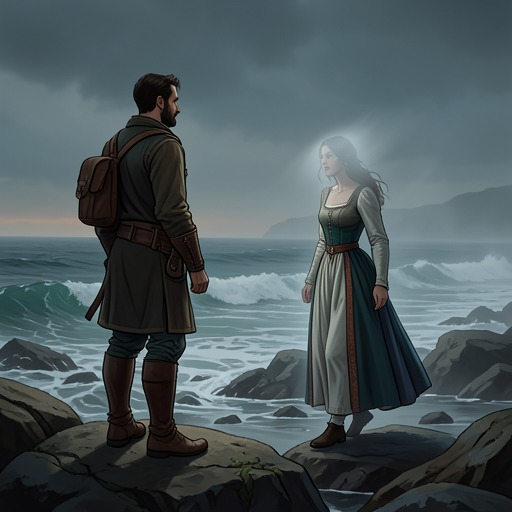
Brittany first appears through the traveler’s experience of the moorland below Kerselec. From the cliffs, the downs had seemed level, meadow-like, and open to the horizon; once entered, however, the same country revealed itself as a broken expanse of great valleys, gorse, heather, and enormous granite cliffs. The landscape therefore defeats the eye before it defeats the traveler: what appears from a distance to be a shallow hollow is in fact a deep valley, and what resembles a scattered stone is an imposing cliff.
The traveler’s disorientation is intensified by the absence of human landmarks. He hopes that finding the ocean will restore his sense of direction, since the island of Groix can be seen from the cliffs, but the inland streams offer no reliable route. Instead of running toward the sea, they lead to reedy pools, swamps, and silent ponds. By late afternoon, with the sun sinking across yellow gorse and moorland water, Brittany has become a place without a visible settlement, tree, or road capable of returning him to safety.
Isolation and the Stranger
Brittany’s remoteness governs the traveler’s first social encounter as decisively as the terrain governs his movements. Old Goulven had warned him that the country was a bad place for a stranger and advised him to take a guide; the traveler had confidently rejected the warning, only to recognize later that he had genuinely lost himself. His American identity further marks him as an outsider. When he meets Jeanne d’Ys, she repeats that he is an American and says that she has never seen one before, making his nationality as strange to her as her isolated world is to him.
The meeting occurs while the traveler is armed and searching for a way off the moor. He finds a falcon standing on a dead hare, its talons fitted with a leash from which hangs a round piece of metal like a sleigh-bell. A girl arrives, hooding the bird, collecting the hare, and fastening the animal’s cord to her girdle. The falconry scene identifies Brittany with an older social and material order, while the traveler’s dependence on the girl reverses the expected relation between the armed visitor and the secluded inhabitant. He must recover his speech and ask for help; she is the person who possesses the practical knowledge of the country.
A Secluded Breton World
The Brittany inhabited by Jeanne d’Ys is not merely sparsely populated; it is socially enclosed. She has spent nineteen years in a little fortified farm with her nurse Pelagie, Glemarec René the piqueur, and four falconers: Raoul, Gaston, Hastur, and the Sieur Piriou Louis. Her parents are dead, and she has never been outside the moorland. Apart from the falconers and Pelagie, she has never seen another human being, although she has watched ships from the cliffs.
Her education and amusements reinforce the sense of historical enclosure. Pelagie taught her to read from books hundreds of years old; Jeanne embroiders and spins flax, while hawks and hounds provide her principal distraction. She knows the legends of Loup Garou and Jeanne la Flamme through her nurse, but has little direct knowledge of the wider world and shows no eager curiosity about it. Brittany consequently functions as a living enclosure in which old books, oral legends, falconry, domestic craft, and inherited household roles have remained insulated from modern society.
Legend, Fear, and Enchantment
The moorland’s physical danger is accompanied by a local belief that the country is enchanted. Pelagie has told Jeanne that anyone lost in the unexplored moors might never return. Jeanne does not claim certainty that the legend is true, yet she had not considered it seriously until meeting the traveler who had become lost there. The story’s uncertainty is important: Brittany is not explicitly declared supernatural at this point, but its geography makes supernatural explanations emotionally plausible.
That atmosphere also shapes Jeanne’s response to the traveler. Though accustomed to the moors and their animals, she is frightened by the sound of his voice and almost drops the falcon when he first speaks. Her musical, unfamiliar voice seems to the traveler like something remembered from an old song, linking the Breton setting with an experience of recognition that cannot be explained by ordinary acquaintance. Brittany thus becomes a threshold between the known and the uncanny, where a chance meeting can feel older and stranger than the immediate circumstances allow.
Brittany and Historical Conflict
Brittany also carries a strong political and military identity. In a later street scene, a Breton child confronts an American and declares that she is a Bretonne, that her father is above with the cannon of the marine, and that he will shoot a spy. Her words establish Brittany as a place where local belonging is asserted against foreign presence and where the surrounding conflict has entered domestic consciousness. The child’s warning is not abstract patriotism: it is grounded in the authority of a father serving the defense of France.
The encounter ends in a striking mixture of suspicion and compassion. After the American identifies himself, he kisses the child and asks her to pray for France; she answers by praying for France and for him. Brittany therefore joins intimate feeling to national danger. The region is at once a landscape that strands strangers, a refuge for archaic customs, and a contested frontier in which foreign identity can invite suspicion. Its decisive narrative function lies in making place itself an active pressure: the moors conceal routes, the household preserves the past, legend governs fear, and political violence turns nationality into a matter of immediate survival.