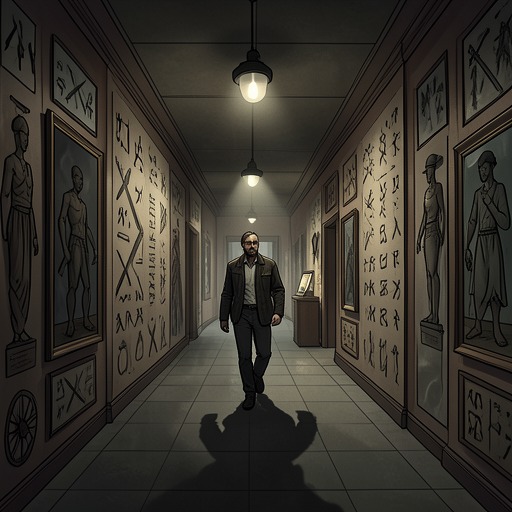
Cassilda's Song
The King in YellowCassilda's Song is the song attributed to Cassilda in The King in Yellow, Act I, Scene 2. Its compact lyric moves from a strange landscape to the image of the King, then turns inward toward the death of song itself. By naming Carcosa as both a place of vanished splendor and a destination for unheard voices, it provides one of the central poetic keys to The King in Yellow.
Text and Attribution
Cassilda's Song is identified as a passage from The King in Yellow, Act I, Scene 2, rather than as an independent poem detached from the drama. The attribution gives the lyric a theatrical and potentially prophetic force: Cassilda's voice is presented within a play whose imagery exceeds ordinary realism, while the song's repeated references to Carcosa make the setting feel like a world already marked by loss.
The poem is also framed by a dedication to the narrator's brother. That placement gives the lyric an intimate address before its vision opens outward into remote cosmic and geographical imagery. The contrast between private dedication and public, almost mythic lament makes the song function both as a personal offering and as an invocation of a place beyond ordinary human experience.
Imagery of Carcosa
The opening image presents waves of cloud breaking along a shore while twin suns sink beneath a lake. The landscape is recognizable in outline but uncanny in its details: the plural suns and the lake beneath which they disappear make the scene feel governed by a different cosmology. As the shadows lengthen, the poem moves from spectacle toward encroaching darkness.
Carcosa is then named as stranger still. The adjective does not explain the city; it intensifies its distance from the world of ordinary description. Carcosa appears not as a fully mapped location but as a place whose very name carries the pressure of the unknown. The paired expressions Lost Carcosa and Dim Carcosa turn geography into condition: the city is at once absent, obscured, and remembered through fragments.
The King and Unheard Song
The poem's middle movement invokes songs that the Hyades shall sing, linking Carcosa to stars or celestial powers. Yet even these songs must die unheard. The image establishes a decisive contrast between the grandeur of the singers and the failure of reception. What is lost is not merely a voice but the possibility that voice, however exalted, will reach an audience.
The King appears through the image of tatters that flap in the surrounding darkness. The figure is not described through a complete portrait; the torn fabric is the visible remnant of a presence associated with sovereignty and decay. The King therefore enters the lyric as an emblem of broken majesty. His ragged signs of power belong to the same world as the sinking suns, lengthening shadows, and silent songs: a world in which splendor survives only in damaged or vanishing form.
Death of the Voice
The final movement converts the landscape's silence into a statement about the speaker's own art. The song of the soul is declared dead, and the speaker's voice is likewise dead. The lyric thus folds its external imagery back into the speaking subject: the lost city is not only somewhere beyond the scene, but also the symbolic destination of expression that cannot be heard.
The closing comparison joins unshed tears to the unsung song. Tears that are never released dry and die, just as a voice that is never heard perishes without completing its movement into the world. This gives the poem a double extinction, emotional and artistic. Grief remains present, but because it cannot become either tears or song, it hardens into silence.
Function in The King in Yellow
Cassilda's Song establishes the imaginative vocabulary surrounding The King in Yellow: Carcosa, the King, cosmic skies, deep water, lengthening shadows, and the collapse of communication. Its repeated return to Carcosa creates a refrain-like structure in which each stanza approaches the same destination through a different form of loss: landscape darkens, celestial song goes unheard, and finally the speaker's own voice disappears.
The song's importance lies less in narrative exposition than in tonal and symbolic concentration. It offers no explanation of Carcosa and resolves none of the mystery associated with the King. Instead, it makes obscurity itself memorable. The lyric's power comes from the tension between its precise images and its withheld meaning: the reader can see the sinking suns, the lake, the tatters, and the drying tears, while the larger truth of Carcosa remains dim and inaccessible.