Château d'Ys
The King in YellowChâteau d'Ys is the central threshold-space of Philip and Jeanne d'Ys’s story: a fortified Breton residence that first appears as a living household of hospitality, love, and ritual, then vanishes to reveal itself as a crumbling ruin. Its decisive significance lies in the collapse of ordinary historical time. Within its walls Philip is dressed as a medieval huntsman, welcomed by a girl who has never encountered another human being, and drawn into a love that seems to restore an entire lost world; outside them, after a viper’s bite, he finds only ivy-covered stones and a memorial to Jeanne’s soul.
Appearance and Entrance
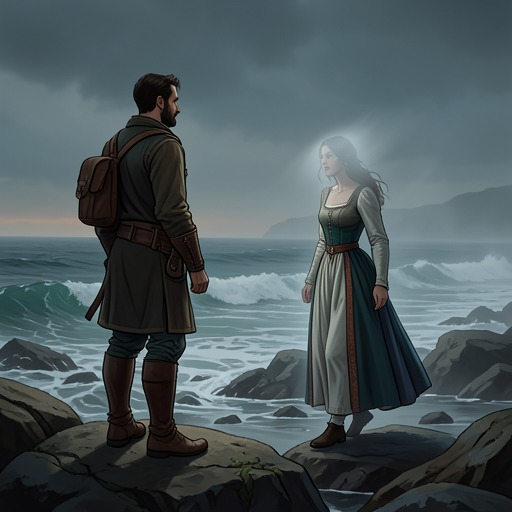
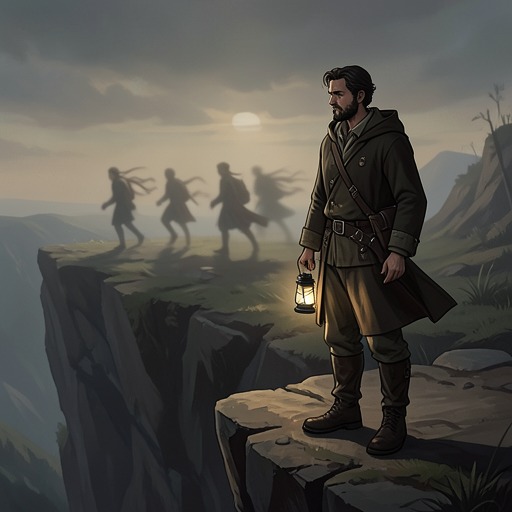
Philip reaches Château d'Ys after moving through an unsettling landscape accompanied by Jeanne d'Ys, the tumult of hounds, and the ringing of a hunting horn. A grey mass gathers before him, a torch shines at a gate, and an opening door casts light into the darkness. He crosses a wooden bridge that trembles beneath his feet and rises creaking behind him over a moat, entering a small stone court enclosed on every side. The approach makes the château both a refuge and a trap: its architecture offers protection from the threatening wilderness while cutting the visitor off from the ordinary world.
The arrival is marked by formal gestures that resemble an old hospitality rite. A man emerges from the doorway and presents a cup to Jeanne. She touches it with her lips before turning to Philip and welcoming him. A falconer then brings another cup, first offering it to Jeanne to taste; after hesitating, she gives it to Philip herself. Her act establishes the château as a place governed by ceremonial trust, but it also introduces an atmosphere of testing and initiation. Philip does not immediately drink, uncertain what the ritual demands, until he realizes that delay would offend his hostess.
Jeanne leads him through the doorway and repeatedly assures him that he is welcome to Château d'Ys. The welcome is intimate as well as formal: she takes his hand and brings him into the house. Yet the repeated invitation, surrounded by the moat, gate, bridge, armed or equipped falconers, and old customs, has a double force. It sounds like protection, but it also resembles the language by which a visitor is claimed by an enclosed and unfamiliar order.
The Living Medieval Household
The next morning, Château d'Ys appears fully inhabited. Philip wakes to the remembered music of the horn and looks down into the court through a curtained window whose small, deep-set panes admit the sunlight. His modern clothes have disappeared, while a complete set of garments has been placed for him: cap, shoes, and a hunting doublet of silvery-grey homespun. The close-fitting costume and seamless shoes belong to another century, and Philip recognizes that he looks more like a young huntsman of the Middle Ages than a Breton of his own day.
The château’s interior confirms this displacement. In the large room at the foot of the stairs, an old Breton woman, Pelagie, sits spinning with a distaff. Jeanne appears in a hunting gown edged with silver, her dark curly hair crowned by a head-dress that settles the question of the costume’s historical period, while one of her hawks rests on her gauntlet-covered wrist. The scene joins domestic labor, aristocratic ceremony, falconry, and medieval dress into one coherent social world. Philip’s own clothes dry outside by the garden wall, visibly reduced beside the elegance of the clothes provided by the house.
Jeanne treats the borrowed costume as a natural extension of hospitality and proposes that Philip’s modern clothes be thrown away. Philip objects that he cannot accept clothing from another person and would look impossible if he returned to France dressed as he is. The exchange exposes the incompatibility between Château d'Ys and modern social reality. Within the château, the older world is not a masquerade but the governing reality; Philip’s concern about returning to France belongs to the external world that the house temporarily excludes.
The court contains a garden and fruit trees, and Jeanne leads Philip there to sit beside a table. The fortified residence therefore has an unexpectedly gentle center: the enclosed garden becomes the setting for conversation, courtship, and shared attention. At the same time, its walls, drawbridge, and moat keep that intimacy physically separate from the surrounding moorland. The château’s beauty depends on enclosure, and that enclosure is inseparable from its mystery.
Jeanne d'Ys and the Château’s Isolated Time
Château d'Ys is inseparable from Jeanne d'Ys’s unusual history. She tells Philip that her father and mother are dead and that she has spent all nineteen years of her life in the little fortified farm with Pelagie, the piqueur Glemarec René, and four falconers: Raoul, Gaston, Hastur, and the Sieur Piriou Louis, all of whom served her father. She has never gone beyond the moorland and has never seen another human soul apart from the falconers and Pelagie. The château is thus not merely her home; it is the complete boundary of her known humanity.
Her education and amusements reinforce the sense that the household exists outside ordinary historical development. Pelagie has taught her to read from books hundreds of years old. Jeanne embroiders and spins flax, while her hawks and hounds provide her only distraction. She has seen ships from the cliffs, but the moors over which she rides appear empty as far as the eye can reach. The house’s old books, inherited servants, traditional crafts, and hunting rituals create a closed culture preserved from modern time.
The legends associated with the surrounding moorland deepen the château’s isolation. Pelagie has told Jeanne stories of the Loup Garou and Jeanne la Flamme, as well as a legend that anyone lost in the unexplored moors may never return because they are enchanted. Jeanne has not known whether the legend is true and had not seriously considered it until meeting Philip. Château d'Ys therefore stands at the center of a geography in which memory, folklore, and physical separation make disappearance plausible. Its household does not simply shelter Jeanne from the world; it may be the form taken by a world already lost.
Love, Violence, and Disappearance
The château’s enclosed garden becomes the place where Philip and Jeanne’s relation changes from hospitality to mutual love. While they sit facing one another in silence, Philip understands that their souls have answered each other without human speech. He feels youth and joyous love coursing through him, while Jeanne seems awakened from a dream, her questioning gaze making him tremble with delight. They then break their fast and exchange their names, with Jeanne identifying herself as the Demoiselle Jeanne d'Ys.
The emotional force of the house is therefore double. It produces a moment of extraordinary recognition, giving Philip a sense that love can cross the barriers of speech, age, and historical reality. But the same idealization makes the château vulnerable to a catastrophic reversal. The place appears to promise continuity: a home, a hostess, a garden, and a beloved woman. Instead, its promise ends at the instant of physical danger.
When Jeanne declares her love for Philip, he takes her in his arms and kisses her. Something strikes his foot in the grass, then strikes his ankle again; he discovers a viper and tears it away before crushing its head beneath his heel. The bite leaves him weak and numb, and he falls while Jeanne bends over him. As his vision slowly closes, he still feels her arms around his neck and her cheek against his lips. The château’s garden, previously a scene of courtship and abundance, becomes the site where love is joined to poison, bodily vulnerability, and death.
Ruin and Memorial
When Philip opens his eyes, Château d'Ys has disappeared. Jeanne is gone, as are the hawks and the surrounding domestic world. The stream and flat rock remain, along with the crushed viper in the grass, but the garden, fruit trees, drawbridge, and walled court have vanished. In their place stands a heap of grey, ivy-covered ruins through which great trees have pushed. Philip drags his numbed foot forward and sees a falcon rise from the treetops, climb in narrowing circles, and disappear into the clouds.
The transformation changes every preceding feature of the château. The bridge is no longer a functioning passage but part of an absent architecture; the walled court is no longer a protected home but a memory imposed upon ruins; the hawk, once carried by Jeanne as a sign of her living household, becomes a final image of departure. The location’s historical depth is revealed not through explanation but through the sudden substitution of ruin for habitation.
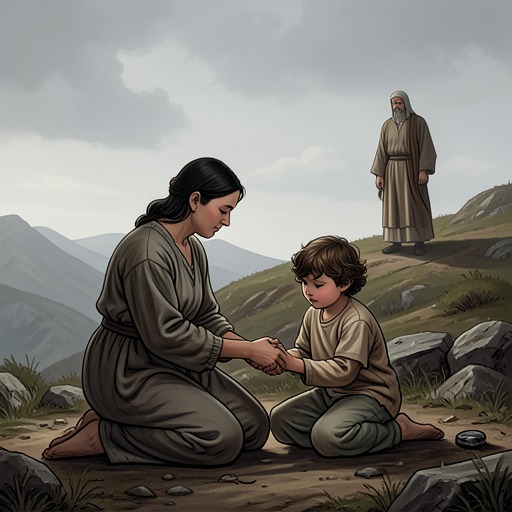
Philip calls Jeanne’s name and falls on his knees among the weeds. He has unknowingly knelt before a crumbling stone shrine to the Mother of Sorrows. The carved Virgin, cross, and thorns establish a sacred memorial within the profane remains of the château, and the inscription begins with a prayer for the soul of the Demoiselle Jeanne d'Ys. The shrine confirms that Jeanne’s apparent present life belongs to the past and converts Château d'Ys from a place of arrival into a place of mourning.
Narrative Significance
Château d'Ys functions as a Gothic threshold between modern France and an archaic, possibly supernatural Breton past. Its beautiful surfaces—torchlight, music, silver-edged homespun, hawks, fruit trees, and ceremonious welcome—are inseparable from the fear generated by enclosure, silence, vanished clothing, unexplored moors, and a house that cannot survive the protagonist’s return to consciousness. The château makes terror aesthetically seductive before turning that seduction into grief.
The location also embodies a violent break between incompatible temporal orders. Inside it, Philip can enter medieval costume, participate in old hospitality, and love a woman who has lived her whole life beyond the reach of modern society. Outside it, the material evidence is a viper, a numb foot, ruins, and a shrine. Château d'Ys is consequently less a stable building than a temporary manifestation of an inaccessible past: a place that can receive Philip, alter his identity, and give him love, but cannot remain present in the world to which he awakens.