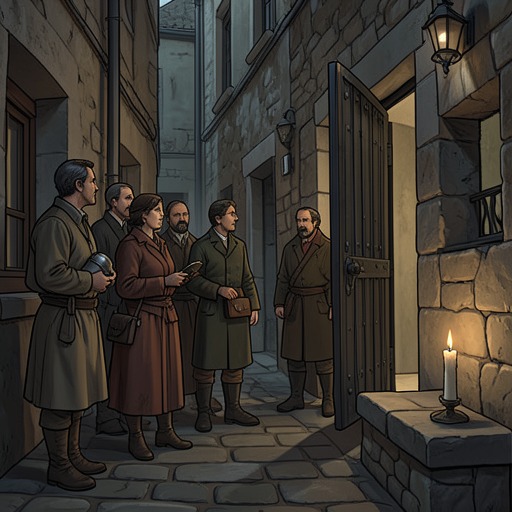
Colette (Latin Quarter)
The King in YellowColette (Latin Quarter) is a young woman whose brief appearances in the Paris episodes give the social world of the Latin Quarter its active, selective energy. She is not merely one of the women whom the men entertain: she chooses her company, states her preferences plainly, and becomes an unwitting center of jealousy when Selby’s attention appears to attract her more than Foxhall Clifford’s long, respectful devotion. Her character is defined less by exposition than by decisive gestures and social ease, especially during the excursion to the River Ept and the later emotional disturbances surrounding Rue Barrée.
Identity and Social Setting
Colette (Latin Quarter) appears among the young women welcomed into the party gathered by Richard Osborne Elliott, Stanley Rowden, and Foxhall Clifford. At the Hôtel Terminus near the Gare St. Lazare, Rowden finds Hastings and brings him into a private dining-room where Elliott introduces him to Colette, Cécile, and Jacqueline. The three women greet Hastings warmly and support Rowden’s insistence that he join their projected excursion to La Roche. Colette therefore enters the narrative as part of a mobile, sociable group whose friendships are formed through invitation, improvisation, and shared outings rather than through formal introductions alone.
Her presence also helps establish the contrast between Hastings’s homesickness and the Parisian ease of the people around him. While he is delighted by the welcome and returns the encouragement offered by Colette and the others, Colette behaves as though participation in the party is a natural matter of choice. She belongs to a circle in which meals, travel, flirtation, artistic acquaintances, and changing alliances overlap. The evidence does not give her a full biography, but it presents her as socially confident enough to speak for herself and to determine how the men should divide their attention.
The Excursion to the River Ept
During the excursion, Colette joins Cécile and Jacqueline in resisting the unpleasant practical work of fishing. When Cécile declares that she will never touch the worms, Colette and Jacqueline hasten to support her. Hastings offers to serve as the group’s general baiter and to remove the fish, but Colette’s response is more specific than a simple refusal of participation: she prefers gudgeons and tells Elliott and Rowden that they may leave when they please, asking Jacqueline to confirm the decision. Jacqueline agrees, and Elliott is left uncertain as he examines his rod and reel.
This scene gives Colette a small but unmistakable authority. She does not wait for the men to organize the outing on her behalf; she identifies the kind of fishing she wants and dismisses unwanted supervision. Her preference for gudgeons, together with her willingness to let Elliott and Rowden depart, makes her an agent within the party rather than a passive object of its attention. The excursion’s comic leisure is consequently shaped by the women’s choices as much as by the men’s arrangements.
Later, when Elliott returns after eluding Rowden, he sits beside Colette and prepares to sleep. She asks where his trout are, and he answers that they are still alive before falling asleep. Her question keeps the excursion tied to its practical amusement, while Elliott’s exhausted indifference turns the promised sport into another episode of companionable idleness. Colette remains at the center of that relaxed scene even when the men’s plans have dissolved into diversion.
Connections and Romantic Tensions
Colette’s most important narrative effect lies in her relation to the men’s competing perceptions. The evidence shows that Hastings responds happily to her encouragement during the Hôtel Terminus gathering, and that she later shares the riverside scene with Elliott. More sharply, her presence is linked to Selby’s jealousy and to Clifford’s wounded self-consciousness. Selby’s emotional distress is described through his fixation on Rue Barrée, while Clifford, after observing a pretty girl blush at Selby, asks why she reacts to Selby and never to him. The girl is not explicitly identified as Colette in that street encounter, so the episode should not be treated as a confirmed meeting between them; nevertheless, it belongs to the same social world in which Colette’s choices and the men’s interpretations continually unsettle one another.
Colette’s role is consequently different from that of a conventional romantic heroine whose interior life governs the plot. She is seen primarily through social action: joining the excursion, choosing gudgeons, authorizing the men to leave, and answering Elliott’s presence with an ordinary question about the fish. Yet these apparently minor actions reveal a world in which desire is distributed through glances, invitations, exclusions, and casual preferences. The men’s emotional intensity is not matched by any evidence that Colette has made a comparable declaration, and that imbalance is central to the comedy of the episode.
Narrative Function and Limits of the Portrait
Colette (Latin Quarter) helps make the Paris material episodic and socially interconnected. She appears in a gathering that joins Hastings to Elliott, Rowden, Clifford, Cécile, and Jacqueline, then reappears in the outdoor excursion where the group’s arrangements break into smaller pairings. Her presence allows the narrative to move from public hospitality to private preference without requiring a dramatic confrontation. A remark about bait, a choice of fish, or a question about trout becomes enough to show how quickly companionship can reorganize itself.
The portrait remains deliberately partial. The supplied narrative identifies Colette as a young woman in the Paris circle and records her social behavior, but it does not establish a detailed origin, profession, sustained romance, or final fate for her. What it does establish is more precise: Colette is active rather than ornamental, frank rather than ceremonially compliant, and capable of altering the emotional balance of a group without openly seeking power over it. Her importance comes from the pressure her ordinary freedom places on the men who try to read, pursue, or possess the meanings of her attention.