Constance Hawberk
The King in YellowConstance Hawberk is the daughter of Hawberk, the armourer, and the beloved of Louis Castaigne. Her appearances are brief, but she is central to the emotional and social structure surrounding the Castaigne family: she loves Louis, is expected to marry him, and becomes an unwilling witness to the violent destruction produced by Hildred Castaigne’s delusion. At the end, she stands weeping while Hildred is restrained, a silent figure whose ordinary human attachment contrasts with his imagined throne and empire.
Identity and Introduction
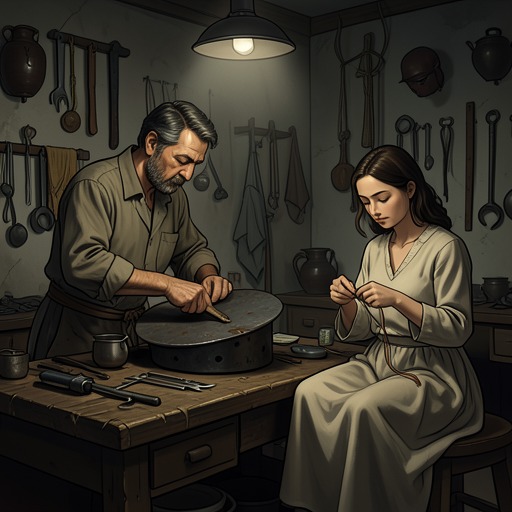
Constance is introduced in Hawberk’s armourer’s shop on Bleecker Street, where Hildred visits because he is fascinated by the sounds of repairing ancient armour. Hawberk is riveting the worn greaves of an old suit, while Constance rises from her work embroidering a banner from a coloured plate. She offers Hildred her hand, but the blush of disappointment on her cheeks shows that she had expected his cousin Louis instead. This small gesture establishes her emotional allegiance before she says anything about it: her attention belongs to Louis, not to the narrator who has entered the shop.
The setting also places Constance within a world of tangible craft and inherited material objects. Her father works with mail, greaves, rivets, and steel, while she embroiders a banner; their surroundings are defined by physical labour and visible history. Against this concrete environment, Hildred’s fascination with armour is already bound to his unstable imagination. He claims that the music of the hammer is the reason for his visits, but he also admits that Constance matters to him because she is in love with Louis and because he imagines himself arranging their future.
Love for Louis Castaigne
Hildred explicitly identifies Constance as Louis’s beloved. When Mr. Wilde asks how Constance and Louis are getting along, Hildred replies that she loves Louis. The answer is presented as simple fact, yet Hildred treats the relationship as something subject to his management. He imagines arranging the couple’s future in the same way that he expects to arrange the future of his doctor, John Archer. Constance’s love therefore enters the narrative through a double perspective: it is a genuine attachment between her and Louis, but it is also material that Hildred attempts to incorporate into his own grand designs.
Louis later announces that he is married to the sweetest girl on earth, and Hildred immediately names Constance as the bride. Louis’s astonishment indicates that the marriage had not yet been openly settled in the form Hildred assumes, although Louis says he had only discovered his own intention on an evening stroll to the embankment the previous April. Constance thus occupies the point where affection, expectation, and social commitment converge. Her relationship with Louis is sufficiently evident to Hildred that he can identify her without being told, but the scene also shows that Hildred’s confidence exceeds the secure knowledge available to him.
Exposure of the Hidden Identity
Constance becomes visibly involved when Hildred begins to suggest that her father is not merely the armourer Hawberk but the Marquis of Avonshire. Hildred links this claim to Mr. Wilde’s repeated references to Hawberk as the marquis and to Constance by implication as the marquis’s daughter. He does not finish the accusation. Constance starts to her feet with terror written on every feature, while Hawberk looks at Hildred and slowly smooths his leather apron.
Her reaction is one of the clearest indications that Hildred has touched a dangerous secret or, at minimum, a subject that the household is determined to conceal. Unlike Hildred’s later proclamations, the scene gives Constance no opportunity to explain herself. Her fear is bodily and immediate; it interrupts the conversation before the alleged identity can be fully articulated. Hawberk answers with denial and invokes Mr. Wilde’s knowledge, while Hildred presses the connection by mentioning Wilde’s apparent expertise in armour and the Prince’s Emblazoned. Constance is therefore positioned between two forms of hidden history: her family’s guarded past and Hildred’s increasingly intrusive interpretation of it.
Witness to Hildred’s Collapse
Constance’s final appearance occurs after Hildred has entered Mr. Wilde’s rooms, taken the diadem, put on the white silk robe embroidered with the Yellow Sign, and proclaimed himself King. In Hildred’s account, Mr. Wilde is found with his throat torn open and dies while Hildred is bent over him. Policemen then seize and bind Hildred as he rages, bites at them, and struggles against restraint. The scene is narrated through Hildred’s disordered consciousness, but Constance’s presence supplies a stark external image of the consequences.
Hildred sees old Hawberk first, then Louis’s ghastly face, and finally Constance in the corner, weeping softly. Her grief is not directed into a speech or an act of revenge; it is the restrained response of someone confronted with violence, madness, and the collapse of the people around her. Hildred interprets the intervention as a seizure of his throne and empire, accusing those present of taking the crown of the King in Yellow. Constance’s tears silently oppose that interpretation. Where Hildred sees political usurpation, she witnesses catastrophe.
The editor’s final statement reports that Mr. Castaigne died in the Asylum for Criminal Insane. Constance’s fate is not supplied, and the text does not describe the marriage to Louis as completed. Her unresolved position reinforces the damage caused by Hildred’s breakdown: the narrative closes not with the fulfilment of the romantic future he claimed he could arrange, but with Constance reduced to a grieving witness beside the wreckage of that imagined order.
Narrative Role and Significance
Constance functions as a measure of reality within a narrative dominated by Hildred’s unreliable perceptions. She is associated with blushes, terror, love, and tears—visible responses that do not require the reader to accept Hildred’s explanations. Her affection for Louis provides a grounded human relationship against which Hildred’s possessive plans and fantasies of kingship appear increasingly alien. Even when Hildred speaks of arranging the couple’s future, Constance remains a person whose own desires are represented by her attachment to Louis rather than by Hildred’s schemes.
Her connection with the armourer’s shop further intensifies this contrast. The shop contains old armour and the sounds of hammering, riveting, and polishing, objects that Hildred experiences with almost unbearable physical pleasure and then folds into his fantasy of power. Constance, by contrast, is shown embroidering a banner and reacting to the social realities around her. The banner may belong to the same symbolic world that fascinates Hildred, but her presence keeps it attached to family, courtship, labour, and fear rather than allowing it to become merely an emblem of imperial delusion.
At the conclusion, Constance’s silent weeping becomes the human counterpoint to Hildred’s last political cry. She neither confirms his vision nor enters the imagined struggle for the throne. Her importance lies precisely in that refusal, imposed by circumstance rather than declared as a manifesto: she remains attached to the ordinary emotional world of love, family, and mourning while Hildred’s language converts murder and restraint into a failed revolution.