Death
The King in YellowDeath in the stories is not merely the final condition of a body. It is a public policy, a private catastrophe, a weapon, a sacrifice, and an encounter with forces that ordinary language cannot contain. The book repeatedly places human beings before death while asking whether the ending is chosen, imposed, understood, or made meaningful only afterward.
Death as Public Institution
The clearest institutional form of Death appears when the Governor announces that the laws prohibiting suicide and punishing attempts at self-destruction have been repealed. The Government presents this change as an acknowledgment of a person's right to end an existence made intolerable by physical suffering or mental despair. It also gives the policy a utilitarian justification: removing such people from the community is said to benefit society, while the reported absence of any increase in suicides is offered as evidence that legalization has not produced the feared result.
That argument becomes architecture when the Government establishes a Lethal Chamber in every city, town, and village. The Governor declares the white marble chamber open before a silent crowd and describes it as a place where a painless death awaits anyone who can no longer bear life's sorrows. The ceremony turns private despair into a regulated civic service. Hussars, lancers, and mounted police surround and follow the procession, so the language of individual relief is inseparable from military display and state authority. Death is officially compassionate in rhetoric but carefully organized as power.
Violent Death and the Collapse of Ambition
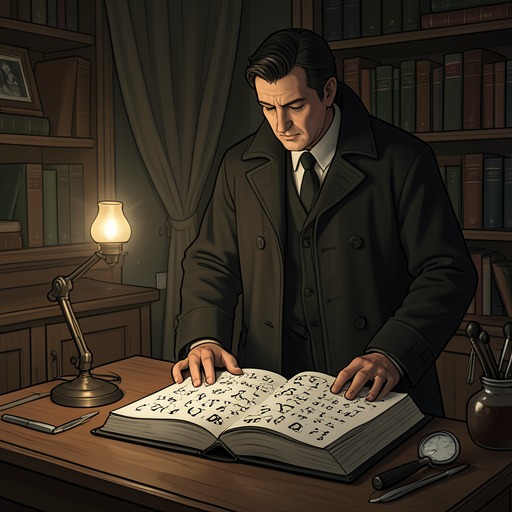
Death also destroys the political and personal fantasies of Hildred Castaigne. After taking the diadem and the white silk robe embroidered with the Yellow Sign, Hildred believes himself to be King, entitled by his imagined knowledge of Hastur, the Hyades, and the Lake of Hali. His triumph depends upon Mr. Wilde, the master whom he expects to guide or confirm his sovereignty. Instead, he finds Mr. Wilde lying on the floor with his throat torn open.
The scene refuses a simple boundary between murder and the supernatural. Hildred kills a cat in the darkness after hearing a groan, then discovers the wounded Mr. Wilde. A green sparkle enters the dying man's sunken eyes; his mutilated hand trembles; his mouth stretches in a final spasm before he dies. Hildred's hope briefly returns when the apparent corpse shows signs of life, but that hope vanishes with the death itself. The dead master takes Hildred's crown, empire, ambitions, and sense of purpose with him.
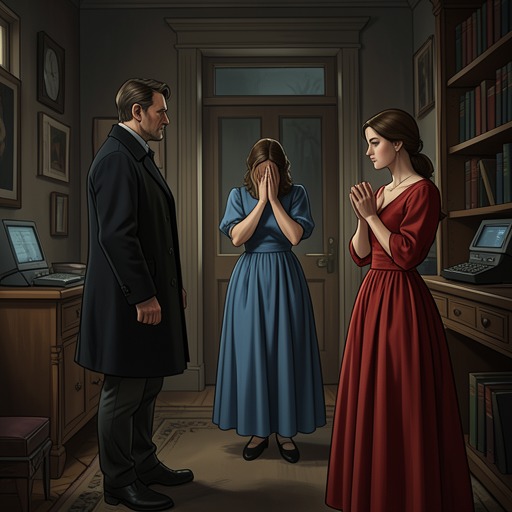
The consequence is immediate confinement rather than coronation. Policemen seize Hildred from behind and bind him while he rages and bites at them. Old Hawberk appears, Louis Castaigne stands behind him with a ghastly face, and Constance Hawberk weeps in the corner. Hildred interprets the scene as a seizure of his throne and cries that those around him have been crowned with the crown of the King in Yellow. Death therefore exposes the gap between his political vision and the social world that restrains him: what he experiences as dynastic overthrow is treated by others as the aftermath of violence and madness.
Suicide, Concealment, and the Unexplained
In the account given by Jack Scott, Death follows the discovery of Boris Yvain's work on The Fates. Geneviève has been drugged because she has been out of her mind, while Boris continues working in silence. The sculpture's third figure, looking straight ahead over the world, bears Boris's face as it appears in that disturbed period and afterward, an image that Jack cannot explain and never expects to explain.
Near midnight, a sudden opening door and a rush in the next room bring the crisis to its conclusion. Boris and Jack arrive too late to prevent Geneviève's death: she lies at the bottom of the pool with her hands across her breast. Boris then shoots himself through the heart. The paired deaths bind romantic loss, artistic obsession, and the destructive secret of Boris's experiment into a single sequence. Geneviève's body is recovered from the water, while the fluid that has made the pool horrific is drained away and the marble is washed clean.
Jack responds not by seeking public truth but by erasing the conditions under which the truth could be recovered. He empties the solution into the waste-pipe, pours every jar and bottle after it, burns Boris's papers, notebooks, and letters, smashes the empty bottles, and carries the fragments to the cellar furnace in six journeys. Servants are sent into the country with a false story about Boris's and Geneviève's travels, and Boris is buried in the little cemetery of Sèvres. A doctor supplies a certificate of heart disease and asks no questions. Death thus becomes administratively manageable through secrecy: the bodies remain, but the evidence, formula, documents, and official explanation are deliberately removed.
The Yellow Sign and Death's Intrusion
In the episode centered on the Yellow Sign, Death arrives as an approaching presence before it becomes a visible fact. The narrator and Tessie Reardon speak of the King in Yellow, the Pallid Mask, Hastur, Cassilda, and the mystery of the Hyades while fog presses against the windows. Tessie urges the narrator to throw the black onyx clasp into the fire because it bears the Yellow Sign, yet the narrator cannot bring himself to discard it even while wishing to do so. The object functions as a material link between their conversation and the death that follows.
A black-plumed hearse stops outside the house. The unseen visitor advances through the hall, and the bolts on the door rot at his touch. The narrator does not see the intruder when he enters the room; he knows him first through the cold, soft grasp that envelops him. The visitor tears the onyx clasp from the narrator's coat and strikes him in the face. As the narrator falls, Tessie cries out and her spirit flees. The threat moves from anticipation to physical contact without becoming fully knowable, making Death both an event and an invasion from beyond ordinary explanation.
The aftermath preserves uncertainty rather than resolving it. The household finds one living person and two dead, while the doctor identifies a decomposed corpse on the floor as the watchman from the church and states that the man must have been dead for months. The outside world can know that Tessie is dead and that the narrator is dying, but it cannot obtain the final account because the narrator intends to leave it within confession. Death therefore defeats both medical certainty and journalistic possession: bodies are visible, yet the decisive cause remains inaccessible.
Love, Illusion, and Irreversible Loss
In Jeanne d'Ys, the movement toward Death is entwined with an apparent return to love. Jeanne d'Ys tells Philip that she loves him, and he embraces and kisses her. A viper strikes his ankle twice; he tears it away and crushes its head, but the venom has already weakened and numbed him. He falls while Jeanne's arms remain around his neck, and his fading perception preserves her face and touch at the edge of consciousness.
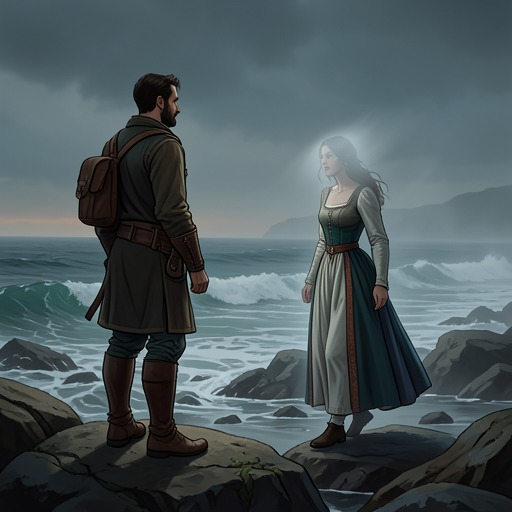
When Philip awakens, Jeanne has vanished. The stream, rock, and crushed viper remain, but the hawks, blocks, garden, fruit trees, drawbridge, and walled court have disappeared. The court has become ivy-covered ruins through which great trees have grown. A falcon rises from the treetops and vanishes into the clouds as Philip calls Jeanne's name and falls before a shrine to the Mother of Sorrows. Death here is not presented as a simple medical consequence alone; it marks the destruction of an entire perceived world and leaves Philip confronting a ruin that makes the lost beloved inseparable from historical and spiritual absence.
The final recurrence is stranger still. In another scene, a man carries Sylvia Trent through silent corridors, down five flights, across a moonlit court, and up worm-eaten stairs to a closed room. He lights a candle and finds clothing, shoes, stockings, and a garter arranged near a bed, then draws back the curtains. The pale woman inside has untroubled eyes and hair heavy as gold; she is revealed through the recognition that she is Sylvia. The encounter suspends Death between disappearance and return, showing how the book repeatedly makes mortality uncertain without making its consequences less absolute.
Narrative and Thematic Significance
Across these episodes, Death changes value whenever characters believe they have mastered it. The Government claims to make death painless and voluntary, but its ceremony surrounds that promise with armed forces. Hildred imagines himself at the summit of power, yet the death of Mr. Wilde converts triumph into restraint. Boris attempts to end both suffering and dangerous knowledge, while Jack's destruction of the evidence ensures that the deaths cannot be fully interpreted. The narrator marked by the Yellow Sign resists surrendering the clasp, and that refusal makes the object a vehicle for the death of Tessie and for his own approaching end.
Death also exposes the limits of the witnesses who survive. Hildred turns a corpse into proof of dynastic betrayal; Jack converts two deaths into a secret requiring elaborate concealment; the doctor can certify a body while admitting that he has no theory; Philip wakes into ruins where the beloved has become impossible to recover; and the final appearance of Sylvia unsettles the distinction between a dead person, a vanished person, and a person returned from an impossible past. The recurring state is therefore epistemic as well as physical. Death ends lives, but it also breaks the systems of explanation that the living use to contain them.