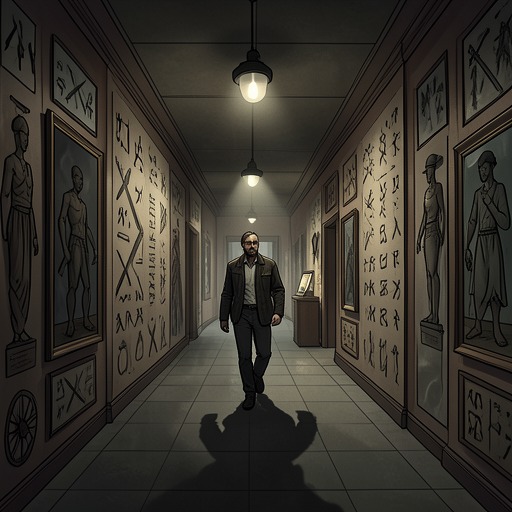
Delirium
The King in YellowDelirium is not merely a medical symptom in these narratives: it is a threshold state in which suppressed truths become speakable, perception becomes radically unstable, and the body registers forces that ordinary reason cannot contain. Feverish speech reveals Geneviève’s hidden love for Alec; Alec’s illness releases visions of Carcosa and the King in Yellow; and Tessie’s encounter with The King in Yellow produces a shared, monotonous absorption in its language. Across these scenes, delirium functions both as affliction and disclosure, making private knowledge visible while undermining confidence in what the narrator sees, remembers, or understands.
Fever and the Release of Hidden Truth
Delirium first appears as the outward sign of Geneviève’s sudden illness. After spraining herself, she develops a high fever that the doctor cannot explain, becomes intermittently light-headed, and repeatedly says that her heart is broken and that she wants to die. The symptoms alarm Boris Yvain precisely because they contradict her ordinary character as a gay, carefree young woman. Her fever therefore does not simply weaken her; it gives physical form to a sorrow that her waking self has concealed.
The decisive disclosure occurs when Geneviève sits upright with crimson cheeks and glittering eyes, babbling while Boris tries to restrain her gently. When Alec touches her, she briefly sighs and sinks back, only to open her eyes again and speak his name as her fever drives her to pour out the burden of her hidden grief. The revelation changes the structure of all three lives at once. The long-standing bond among Alec, Boris Yvain, and Geneviève is broken and replaced by a painful new knowledge: Geneviève loves Alec, while Alec has spent two years concealing his own love because she had said that she loved Boris Yvain best.
Her delirium thus releases a truth that Alec’s self-discipline had kept buried even from himself. He had maintained outward loyalty to Boris Yvain and Geneviève, while nights of inward conflict exposed an attachment he refused to acknowledge during the day. Once Geneviève speaks, Alec experiences shame, sorrow, physical paralysis, and an inability to meet Boris Yvain’s eyes. Boris Yvain’s response is compassionate rather than accusatory: he tells Alec that Geneviève’s love is not his fault, though the doctor’s arrival interrupts him before he can finish. Delirium makes the secret explicit, but it does not resolve the emotional damage created by its disclosure.
Delirium as a Fevered Storyworld
Alec’s subsequent illness intertwines emotional collapse with visions drawn from The King in Yellow. As he lies sick, the strain of his concealed suffering becomes entangled with images of white creatures heavy as stone crawling through Boris Yvain’s basin, a wolf’s head foaming and snapping at Geneviève, and the King in Yellow wrapped in the fantastic colours of his tattered mantle. The vision does not remain a single nightmare. It expands into a cosmology containing the lake of Hali, the towers of Carcosa behind the moon, and Aldebaran, the Hyades, Alar, and Hastur moving through torn clouds like fragments of the King’s mantle.
The instability of this perception is intensified by the narrator’s insistence that one sane thought survives every other disturbance. Alec believes that his chief reason for existing is to satisfy some requirement of Boris Yvain and Geneviève, although he cannot determine whether that requirement involves protection, support, or help during a great crisis. The uncertainty of the obligation contrasts with the absolute force it exerts. Delirium destroys ordinary clarity while preserving a single emotional command, suggesting that the mind may lose its ability to organize events without losing its capacity for loyalty.
Alec also believes that Boris Yvain bends over him at least once, touching him and allowing him to hear a faint echo of his voice, even though others later say that this could not have happened. The detail establishes a central epistemological problem of delirium: the experience may be unverifiable, yet it remains subjectively certain. The narrator’s confidence does not restore factual reliability; instead, it makes the distinction between memory, vision, and emotional truth more troubling. Boris Yvain may not have been physically present, but Alec’s conviction that he was there expresses the persistence of their bond at the point when illness has stripped away nearly everything else.
Objects, Bodies, and the Material Form of Disturbance
The text repeatedly gives delirium a material vocabulary. Boris Yvain’s experiment with the pink-tinted basin turns a goldfish rigid and marble-like, producing a blue-veined, rose-tinted object covered in opalescent drops. Alec encounters the scene while already under emotional and physical strain, and the transformation of living matter into stone becomes one of the images that later invades his fever. The basin’s experiment provides delirium with a concrete visual grammar: warmth becomes rigidity, life becomes sculpture, and beauty is inseparable from death.
The King in Yellow produces a related disturbance through reading. When Tessie Reardon secretly opens the book at its second part, Alec finds her crouching silent and dazed, and he recognizes that the damage has already been done. He reads the book through beside her, after which they speak for some time in a dull, monotonous strain before realizing that their conversation concerns the book. Their response presents delirium not as incoherent noise but as a shared alteration of language and attention. The book’s words are described as clear, musical, dazzling, poisonous, and capable of fascinating and paralyzing both ignorant and wise readers.
Their absorption continues into the night. Tessie Reardon begs Alec to throw away the black onyx clasp inlaid with what they now know to be the Yellow Sign, yet Alec cannot bring himself to remove it, even though he believes he wishes to destroy it. They murmur about the King, the Pallid Mask, Hastur, and Cassilda while fog presses against the windows. Their minds seem to communicate thought upon thought without ordinary speech, and they conclude that they have understood the mystery of the Hyades and that the Phantom of Truth has been laid bare. The scene makes delirium a condition of contagious interpretation: the object, the book, and the two readers form a closed circuit in which knowledge feels complete precisely as external reality becomes most threatening.
Bodily Difference and the Social Meaning of Insanity
The narrative also places delirium beside bodily difference, showing how unusual bodies are read as evidence of abnormal minds. Mr. Wilde has no ears, supports wax ears with displaced silver wires, and has a completely fingerless left hand. His small body is contrasted with magnificently developed arms and unusually thick thighs, while his flat, pointed head leads many people to call him insane. The narrator rejects that judgment, insisting that Mr. Wilde is as sane as anyone else, even while acknowledging his violent eccentricity, including his habit of provoking a vicious cat until it attacks his face.
This contrast separates impairment from the social label of insanity, though the narrative also uses both bodily damage and mental disturbance to generate horror. Mr. Wilde’s intelligence and knowledge coexist with missing ears, a mutilated hand, and a body that conventional observers interpret through fear. His artificial ears are treated as a visible weakness, while the absent fingers apparently cause him little inconvenience. The emphasis falls not only on what his body lacks but on the mismatch between bodily appearance, practical ability, and social judgment. Delirium belongs to this same field of interpretation: it may be an actual physiological crisis, but it is also a condition that others use to decide whether a person is trustworthy, dangerous, or beyond ordinary human understanding.
The episode involving Vance makes that danger explicit. Vance emerges from the shadow in Mr. Wilde’s study and collapses before the table, pleading for help and forgiveness while begging Alec to keep a certain man away. He recalls having been in a madhouse and fears that he will go mad again after remembering the King in Yellow. Mr. Wilde then attacks him, encircling his throat until Vance falls, and immediately returns to his chair to consult a ledger that records Vance’s name. Delirium here is connected to confinement, terror, and administrative classification: the distressed man’s account of institutionalization is followed by physical coercion and by the impersonal confirmation of his identity in a written register.
Perception, Fear, and the Limits of Interpretation
Not every disturbed perception in the book belongs to fever alone. Philip’s encounter with Jeanne d’Ys shows how an intense emotional and bodily crisis can also fracture the apparent continuity of the world. After Jeanne d’Ys declares her love, Philip embraces and kisses her, only to be bitten by a viper. He kills the snake, becomes numb and weak, and loses consciousness while seeing Jeanne’s face close to his own. When he awakens, the garden, drawbridge, walled court, fruit trees, and other figures have vanished; only ruins, the crushed viper, and a departing falcon remain. The sequence resembles delirium in its collision of tenderness, pain, fading consciousness, and radically altered surroundings, though the evidence does not identify it as the same medical state as Alec’s fever.
A similar instability shapes Hastings’s perception while walking with Reverend Joel Byram through the Street of Our Lady of the Fields. Hastings finds the street pleasant in bright June weather and begins to hope that it will be selected, but Reverend Joel Byram recoils at the cross on the convent opposite and mutters about Jesuits. Hastings’s ordinary assessment of the place is immediately opposed by Byram’s anxious reaction. The scene demonstrates that perception is never purely visual: religious fear, social suspicion, and prior expectations transform the same street into different kinds of evidence.
Taken together, these episodes show why delirium matters beyond the diagnosis of a single character. It is a narrative pressure that makes hidden feeling visible, converts symbolic objects into agents of terror, and exposes how quickly observers confuse difference with madness. Fevered speech may tell the truth that self-control suppresses; fevered visions may preserve the emotional reality of a relationship while falsifying external fact; and shared absorption in a text may feel like revelation while leading toward catastrophe. Delirium therefore occupies the unstable border between illness and knowledge, where the mind’s loss of ordinary order becomes the form through which the story’s most dangerous truths emerge.