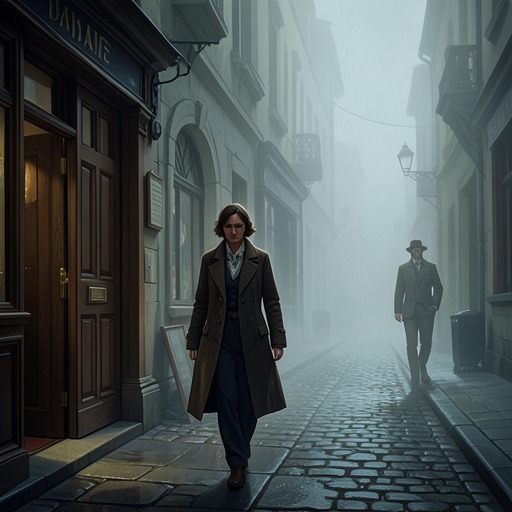
Foxhall Clifford—Rue Barrée
The King in YellowFoxhall Clifford—Rue Barrée is a relationship whose decisive movement runs from collective admiration to personal pursuit and finally to refusal. Rue Barrée is first known not by a personal name but by the barrier-marked street where she lives, while Foxhall Clifford converts the ritual of her public salutes into the hope of private intimacy. His proposal exposes the distance between romantic fantasy and the precarious reality she describes; her refusal is firm, grateful, and final, yet it produces an altered tenderness that continues to unsettle Clifford and his companions.
Anonymous Figure and Public Ritual
Rue Barrée enters the relationship as a mystery shared by the artistic community of the Latin Quarter. She passes students with a music-roll and a grave return of their bows, but no man is known to have obtained more than that formal acknowledgment. Her profession is inferred to be that of a pianist, and her residence is a small, humble street kept in perpetual repair by the city authorities. The black letters on the barrier defending the street from traffic supply the name by which the students know her: Rue Barrée. The name is therefore both a place-name and a collective invention, created because her real identity remains unavailable.
The first sight that matters to Clifford is not presented as a private meeting. At the corner near the École de Médecine, a hurried girl passes the men; Clifford smirks, while Elliott and Rowden become agitated and bow. Selby, lagging behind at a shop window, looks up and meets her exceptionally blue eyes before she immediately lowers them. When he tells the others that he has seen the prettiest girl, their gloomy response, Rue Barrée, reveals that she is already an object of anxious fascination. Clifford’s later explanation to Selby makes clear that the relationship begins under the pressure of this communal legend rather than through personal knowledge.
Clifford’s Infatuation and Proposal
Clifford’s interest becomes serious enough to alarm Elliott. When Clifford admits that the matter troubling him is Rue Barrée, Elliott treats the confession as a recurrence of the same symptoms associated with Colette. He nevertheless tests the feeling directly: Clifford declares that he believes Rue Barrée is pure, insists that he loves her honestly rather than merely pursuing another pretty woman, and answers yes when asked whether he would marry her. The proposed marriage thus marks a sharp escalation from ceremonial salutes to a social and moral commitment.
The encounter in which Clifford proposes is staged as a collapse of his cultivated composure. Rue Barrée appears in a spotless gown and a large straw hat casting a shadow across her eyes. Elliott bows; Clifford removes his head-covering with such a plaintive and humble air that she smiles, and her second smile follows when he nearly loses his balance. The pigeons later provide an accidental image of his behavior: their bows, bobbing, and strutting resemble his own exaggerated homage, and the resemblance makes her laugh. Her amusement briefly transforms the severe public figure known to the Quarter into a woman capable of spontaneous pleasure, while Clifford mistakes the warmth of the moment for an opening into intimacy.
Rue Barrée explicitly resists that mistake. She tells him that returning the students’ salutes does not make him a friend and warns him against vanity, promising only to be punctilious in returning his salute. Clifford nonetheless sits down and offers himself, in effect, without reserve. The narration emphasizes that he knows he is behaving foolishly, knows that infatuation is not love, and understands that each word binds him in honor. His pursuit is therefore not innocent misunderstanding alone: he recognizes the danger of his own romantic projection but continues because recklessness has displaced restraint. Elliott watches with growing fury and tries to prevent the dogs from rushing to Clifford’s aid, as though the proposal were a humiliating spectacle requiring rescue.
Rue Barrée’s Refusal
Rue Barrée’s response is delayed, allowing Clifford’s ardor to cool into regret before he renews his protestations. She interrupts him to thank him gravely, explaining that no man has ever offered her marriage. Her answer gives the proposal real weight rather than dismissing it as an amusing performance. She understands that Clifford offers her a great deal, but she also states the terms of her own vulnerability: she is alone, possesses nothing, and considers herself nothing within the social world available to her.
Her refusal is grounded in experience rather than coyness. Looking out over Paris, she describes the hardship of working always and alone without a friend whom she can honor. She distinguishes the love offered to women like herself from the idealized language of courtship: when passion dies, what remains is the street and the boulevard. Her account suggests that an apparently protective marriage may merely redirect a woman’s exposure and dependence, especially when love is surrendered unquestioningly by those who have no one and nothing. The proposal therefore confronts not only individual feeling but the economic and social conditions that shape what intimacy can mean for her.
After touching the rose at her breast, Rue Barrée thanks Clifford again and expresses gratitude. She opens her book, plucks a petal from the rose, and drops it between the leaves before looking up to state gently that she cannot accept. The gesture combines sentiment with closure: the rose and its petal preserve a trace of the encounter, but the spoken decision leaves no ambiguity about marriage. Her refusal is neither cruel nor theatrical. It acknowledges the value of what Clifford has offered while protecting her from accepting a future whose implications she understands more clearly than he does.
Aftermath and Altered Distance
Clifford takes a month to recover completely, though Elliott considers him convalescent after the first week. His recovery is aided by Rue Barrée’s cordial acknowledgment of his solemn salutes. This change is emotionally double-edged. Clifford repeatedly blesses her for refusing him and thanks his lucky stars that she did so, yet he simultaneously suffers the tortures of a blighted lover. The relationship thus survives as an unresolved contradiction: the refusal is recognized as fortunate, but it remains painful precisely because the feeling that produced the proposal has not disappeared.
Rue Barrée’s conduct also changes in ways that confuse the men around her. When she passes Clifford and his companions on the rue de Seine while they are heading toward the Café Vachette, she colors and smiles as the group respectfully uncovers. Elliott notices an unexplained thaw in the woman previously associated with reserve and becomes suspicious, but he cannot discover its meaning. Clifford, who had expected either triumph or permanent humiliation, receives instead a warmer form of acknowledgment that keeps the emotional bond alive without converting it into romance or marriage.
The relationship also generates secondary jealousy. Selby, initially reluctant to admit his own reaction, leaves the studio for a day in the country, only to find that the woods, fields, brooks, and distant calls of the mowers intensify his fixation on Rue Barrée. His resulting anger lasts for a week, and his restless Sunday walk carries him from the flower-market on the Pont au Change to the morgue and back toward the marble bridge. The episode shows how completely Rue Barrée’s image has circulated through the male artistic community: even Clifford’s private proposal becomes part of a wider field of rivalry, curiosity, and frustrated desire.
Significance of the Relationship
Foxhall Clifford—Rue Barrée is built around the conflict between a man’s idealizing pursuit and a woman’s guarded self-knowledge. Clifford reads salutes, smiles, and laughter as possible signs of personal access, while Rue Barrée repeatedly separates public courtesy from private admission. Her language gives her a distinct position within the relationship: she does not merely reject Clifford from a distance but explains how isolation, labor, poverty, and the social consequences of passion condition her choice.
The proposal also carries an element of comic reversal. Clifford imagines himself as a heroic lover, yet his humility resembles the bobbing pigeons and leaves him physically unsteady. Elliott’s scorn reduces the grand romance to an alarming social embarrassment, while Rue Barrée’s calm refusal restores proportion. The scene’s humor does not erase its seriousness; instead, it exposes the instability of romantic adoration when it is built on an unknown woman’s public image rather than on sustained knowledge of her life.
The ending deliberately withholds the conventional reward of courtship. There is no marriage and no confirmed mutual love, only a refusal followed by cordiality, smiles, and continued uncertainty. Rue Barrée’s decision remains the relationship’s governing fact, while Clifford’s convalescence reveals that emotional recognition does not require acceptance. Their connection becomes memorable because it stops at the point where fantasy would normally claim fulfillment: her refusal preserves her autonomy, yet the warmth that follows prevents the episode from ending in simple hostility or indifference.