Government Lethal Chamber policy
The King in YellowThe Government Lethal Chamber policy is the United States government’s program for replacing laws against suicide with publicly administered facilities for painless self-destruction. Its decisive significance lies in the policy’s reversal of the state’s former moral and legal position: instead of punishing attempts at self-destruction, the government acknowledges a person’s right to end an existence made intolerable by physical suffering or mental despair, while simultaneously claiming that removing such people benefits the community.
Origins and Political Context
The policy emerges from a broad program of state consolidation and social engineering. The agitation for repealing the laws prohibiting suicide began in the winter after 1900 and reached its first institutional culmination in April 1920. In the same imagined national history, the United States has expanded its military and administrative capacity, increased the regular army to 300,000 men with a territorial reserve of a million, strengthened coastal defenses, rebuilt cities, widened and illuminated streets, demolished elevated structures, and centralized executive power. The Lethal Chamber therefore appears not as an isolated reform but as one expression of a government confident in its ability to organize nearly every sphere of public life.
The policy is also framed against international disorder. While the United States enjoys apparent calm and prosperity, Germany, Italy, Spain, and Belgium are described as suffering under Anarchy, with Russia binding them one by one. The contrast gives the domestic reform an unsettling political atmosphere: national stability depends upon the state’s capacity to classify, manage, and remove sources of disturbance. The Lethal Chamber extends that administrative logic into the most private boundary of human existence.
Establishment and Physical Design
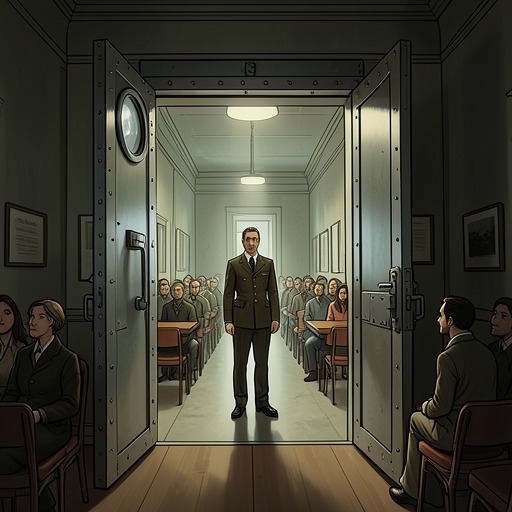
The first Government Lethal Chamber opened on April 13, 1920, on the south side of Washington Square, between Wooster Street and South Fifth Avenue. The government had acquired the block in the winter of 1898. It demolished the shabby buildings that had housed cafés and restaurants for foreigners, enclosed the entire site with a gilded iron railing, and converted it into a garden of lawns, flowers, and fountains. At its center stood a small white building in severely classical architecture, with six Ionic columns and a single bronze door, concealed among thickets of flowers.
The setting makes death appear orderly, beautiful, and civic rather than clandestine. The former commercial quarter is remade as a cultivated public garden, while the building’s classical proportions and marble surface give the institution an air of permanence and authority. Before the door stood a marble group of The Fates, made by Boris Yvain, who had died in Paris at the age of twenty-three. The sculpture joins the government’s modern administrative intervention to an older symbolic language of destiny, suggesting that the policy does not merely permit death but gives state architecture to the ancient power of mortality.
Inauguration and Institutional Procedure
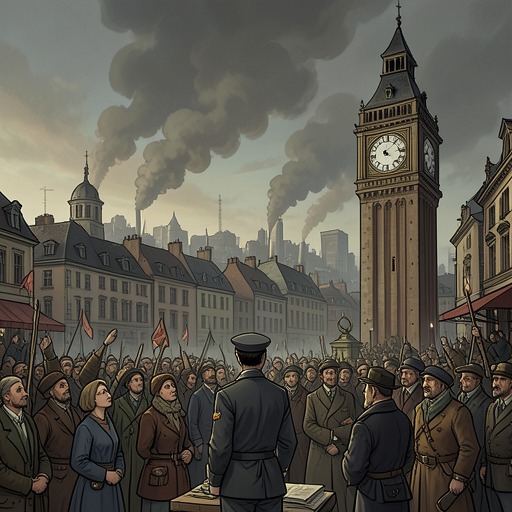
The opening ceremony was conducted as a major public and military event. As the narrator crossed University Place and entered Washington Square, a cordon of police stopped the crowd. A regiment of United States lancers formed a hollow square around the building, while the Governor of New York stood on a raised tribune facing Washington Park. Behind him were the mayors of New York and Brooklyn, senior police and military officers, Colonel Livingston, General Blount, Major-General Hamilton, Admiral Buffby, Surgeon-General Lanceford, representatives of the National Free Hospital, Senators Wyse and Franklin, and the Commissioner of Public Works. A squadron of National Guard hussars surrounded the tribune.
The ceremony’s military arrangement turns a facility for private death into a display of sovereign power. The lancers, hussars, police, governors, generals, admirals, surgeons, and civic officials establish that the policy belongs simultaneously to law, medicine, administration, and force. The institution’s apparent compassion is therefore inseparable from surveillance and command. The death it offers may be painless, but access to it is introduced through the pageantry of the state.
The Governor declares that the laws prohibiting suicide and punishing attempts at self-destruction have been repealed. He states that the government recognizes the right of a person to end an existence rendered intolerable by physical suffering or mental despair, and that the community may benefit when such people are removed from its midst. He further reports that the number of suicides has not increased since the law was passed. The government then announces its intention to establish a Lethal Chamber in every city, town, and village, leaving open the question of whether those who regularly become victims of self-destruction will accept the officially provided relief.
The opening is completed by a formal declaration that a painless death awaits anyone who can no longer bear the sorrows of life. The Governor then turns to the military representative of the President’s household and declares the Lethal Chamber open before the assembled crowd. Once the proclamation ends, the ceremonial hush breaks into commands and movement: the hussars follow the Governor’s carriage, the lancers reform along Fifth Avenue, and the mounted police follow. Public authorization thus passes immediately into disciplined departure, leaving spectators to stare at the white marble Death Chamber.
Social and Ethical Consequences
The policy changes the meaning of suicide by placing it within an official infrastructure. Death is no longer represented solely as a forbidden act committed against religious, legal, or social order; it becomes a service that the government can announce, house, and extend throughout the nation. The language of relief gives sufferers recognition, yet the phrase about removing them from the community exposes a second function. Compassion and exclusion operate together: the state offers an escape from intolerable life while defining certain lives as burdensome presences within the social body.
This duality makes the policy an example of administrative power over life and death. The same government that builds fortifications, manages cities, regulates immigration, reorganizes military institutions, and centralizes authority now supplies a controlled threshold beyond which citizens may pass. The policy appears liberal because it acknowledges individual choice, but it is also disciplinary because the choice is relocated from private desperation to a public institution governed by official standards and ceremony.
The policy’s first opening is narrated beside other institutions that classify and control human beings. The narrator has just visited Dr. John Archer, who once placed him in a private asylum after a fall from a horse because the doctor judged his brain affected. Although the narrator was later declared well, the episode demonstrates how medical authority can define a person’s mental status and confine him under the name of treatment. The Lethal Chamber extends this institutional pattern in a darker direction: the state does not merely decide whether a person is sane or ill, but presents itself as capable of authorizing the final consequence of suffering.
Narrative and Thematic Significance
The policy’s polished public appearance intensifies its unease. The garden, fountains, Ionic columns, bronze door, marble sculpture, military cordon, and official speech create a spectacle of rational civilization. Yet the spectacle gives an ordinary civic square the atmosphere of a death site. The policy’s horror does not depend on disorder; it arises from the possibility that death can be made orderly, aesthetic, painless, and nationally reproducible.
Its temporal framing is equally important. The first chamber opens on April 13, 1920, at the beginning of a period in which the United States is described as prosperous, defended, architecturally improved, and apparently tranquil. The date and ceremony place the policy within a confident modern future rather than a collapsing society. That contrast unsettles the assumption that institutional progress necessarily produces humane life. A society may eliminate visible disorder and still perfect a system for disposing of despair.
The policy also establishes a stark contrast with the supernatural and dynastic claims elsewhere in the narrative. Hildred Castaigne’s fantasies of empire and execution invoke the authority of Hastur, Carcosa, and hereditary succession; the government’s Lethal Chamber invokes law, medicine, public welfare, and civic ceremony. Both systems claim power over life and death, but one speaks through imperial myth and the other through bureaucratic rationality. The juxtaposition suggests that sovereignty can become terrifying whether it wears the crown of the King in Yellow or the institutional uniform of the modern state.