Grief
The King in YellowGrief is not a single episode in the narrative but a recurring state that converts hidden feeling into bodily crisis, confession, rage, and self-judgment. It governs the movement from unspoken love to irreversible loss: Geneviève’s fever exposes what she has concealed, Alec’s suppressed sorrow erupts after the deaths of Geneviève and Boris Yvain, Sylvia Trent’s fear of abandonment turns love into a desperate confession, and Jack Trent’s reflection transforms shame into an apprehension of a ruined future.
Hidden Love and Delayed Suffering
Alec’s grief begins before anyone else can recognize it, because Geneviève has already told him that she loves him but loves Boris Yvain more. He nevertheless remains beside Geneviève and Boris, preserving the outward form of their intimate friendship while concealing the inward conflict that returns night after night. His sorrow is therefore delayed rather than absent: morning temporarily restores him, and he goes back to them believing that the emotional tempest has washed his heart clean. The restraint is presented as loyalty, but it also becomes a form of self-deception, since Alec has never admitted even to himself how much the arrangement costs him.
Geneviève’s illness turns this private grief into a visible and collective crisis. She suffers from a high fever, becomes intermittently light-headed, and repeatedly says that her heart is broken and that she wants to die. The contrast between the gay, care-free girl remembered by those around her and the fevered patient declaring emotional ruin makes grief appear as a force capable of disfiguring an identity that had seemed secure. Boris can explain neither the fever nor its emotional source, and his uncertainty leaves the household waiting helplessly for her to regain consciousness.
Fever, Confession, and Emotional Transmission
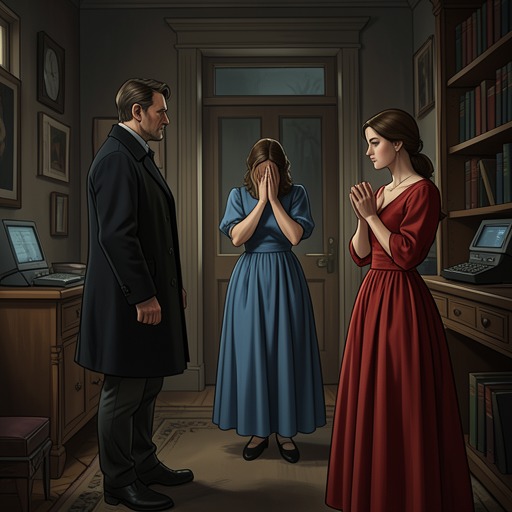
When Geneviève sits upright with crimson cheeks and glittering eyes, her delirium breaks the silence that Alec has maintained for two years. She resists Boris’s gentle restraint, but Alec’s touch makes her sigh and sink back before she opens her eyes again and speaks his name. Her confession changes the structure of all three lives at once: the old bond among the friends snaps, while another bond is formed through the revelation of her concealed sorrow. Grief here is not merely described as an inward feeling; it passes between bodies through touch, gaze, fever, flushed skin, and the inability to speak.
Alec’s response is shame as much as sorrow. He bows his head, feels his face burn, and becomes incapable of movement or speech while Geneviève’s feverish words expose the love he had tried to keep invisible. He cannot silence her and cannot look at Boris. Boris’s arm upon Alec’s shoulder briefly converts the scene from a revelation of betrayal into an act of compassion: Boris tells Alec not to grieve if Geneviève loves him, though he cannot finish the sentence before the doctor arrives. The unfinished consolation is important because it shows that recognition does not resolve the pain; it only makes the pain shared.
The revelation is followed by physical collapse. Alec becomes seriously ill, and the strain of the two years since Geneviève’s earlier declaration finally overwhelms the composure he had mistaken for endurance. His delirium is associated with thoughts of The King in Yellow and The Pallid Mask, linking personal suffering with the book’s larger atmosphere of psychological disturbance. Grief thus operates both as a moral wound and as a bodily condition whose consequences cannot be contained by willpower.
Bereavement and the Destruction of Hope
During convalescence, Alec imagines that life might resume its earlier arrangement. He expects that he and Boris could meet without rancour, cowardice, or mistrust, and he plans to withdraw quietly from the couple so that Geneviève will never have to know the full cost of what has happened. This imagined retreat is his last attempt to give grief an orderly shape: he will preserve Boris’s dignity, spare Geneviève, and remove himself. His request that Jack Scott bring Boris immediately and carry his dearest greeting to Geneviève shows that he still believes reconciliation, or at least a controlled separation, remains possible.
Instead, Jack tells him that both Geneviève and Boris are dead. The news produces not quiet mourning but a wild rage that consumes Alec’s fragile convalescent strength and causes a relapse. Bereavement therefore reverses his expectation of recovery: the future he had planned disappears before he can act upon it, and the prospect of returning to ordinary relations becomes impossible. He emerges weeks later feeling like a twenty-one-year-old who has already lost his youth and who has passed beyond the capacity for further suffering.
Jack’s later account deepens the grief by making it inseparable from mystery. He gives Alec a letter and the keys to Boris’s house, then explains that Boris had continued working on The Fates while Geneviève slept under drugs. The third figure in the group, looking straight ahead over the world, bore Boris’s face as it appeared in his final condition. The artistic work becomes a memorial object and an enigmatic record of suffering: Boris’s grief is not simply reported but fixed in sculpture, where his altered face survives beyond his death and remains resistant to explanation.
Grief as Fear of Abandonment
In the story of Sylvia Trent and Jack Trent, grief appears before an actual loss as the fear of separation. Sylvia cannot accustom herself to Jack’s departure and begs him not to be late for dinner, insisting that he must be patient with her because of what she suffers. She clings to him silently after he prepares to leave, and her distress makes his courage dependent upon hers. The domestic scene gives grief a quieter form than Alec’s fever and relapse, but the underlying structure is similar: love becomes unbearable when its object moves beyond immediate reach.
Sylvia later reveals that the fear has been intensified by an older wound. She tells Jack that she loved him from the first day he found her weeping in the Luxembourg Gardens, yet concealed the feeling because she feared he would go away. She says that, since meeting him, she has been faithful to him in every thought and deed, while also referring to another man who was cruel to her. Her confession therefore contains both present devotion and remembered injury. Grief has accumulated across relationships, and the act of speaking it threatens the security that silence had temporarily preserved.
Shame, Marriage, and the Future of Sorrow
Jack Trent’s grief is intertwined with shame after he confronts Hartman. As he walks beneath the Arc de Triomphe, the prisoner’s fearful face repeatedly returns before him, and solitude fails to quiet the scene. He questions whether his shame comes from having married a girl whom chance had made a mother, whether he truly loves her, and whether their impoverished bohemian existence is the end toward which his life has been moving. These questions do not produce an answer; instead, they force him to read the past as an evil story and the future as a story of shame and disgrace.
The imagery makes grief a state of entrapment rather than a passing emotion. In the fog, Jack is surrounded by phantoms that touch him, crowd him, and carry him through streets and alleys until they reach a barred gate, a wall, bayonets, and a great gun. The movement from private self-accusation to a massed military vision expands his personal misery into a threatening historical landscape. His grief is therefore both intimate and haunted by forces larger than the household: memory, violence, social judgment, and the possibility that the future has already been determined by the past.
Across these episodes, grief repeatedly marks the point where concealed truth becomes unavoidable. Geneviève’s fever exposes forbidden love; Alec’s rage reveals that apparent recovery was only suspended suffering; Sylvia’s confession shows that domestic attachment rests upon fear of abandonment; and Jack’s shame turns marriage and poverty into evidence in a private indictment. The state is consequential because it changes relationships rather than merely coloring them. Love produces loyalty, silence, confession, illness, and loss, while grief preserves the emotional facts that the characters tried to bury. Its final significance lies in this belatedness: what is denied in thought returns through the body, through repeated images, and through the dead whose absence makes every earlier compromise newly intelligible.