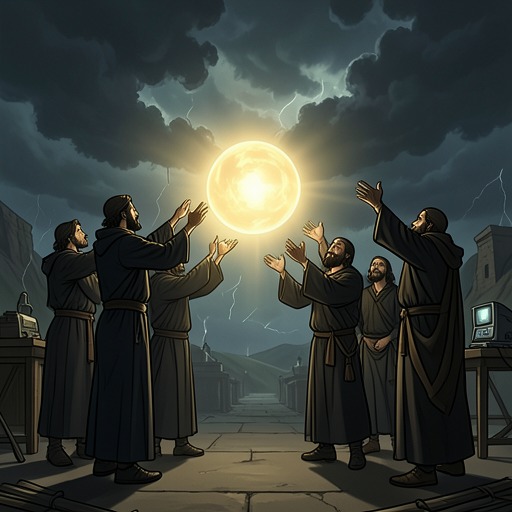
Hastur
The King in YellowHastur is the remote but decisive supernatural and genealogical authority behind the manuscript titled “THE IMPERIAL DYNASTY OF AMERICA.” Although Hastur does not appear bodily in the supplied scenes, his name connects Carcosa, the Hyades, Aldebaran, the Lake of Hali, and the imagined succession that Hildred Castaigne uses to justify seizure of the crown. The figure functions simultaneously as a legendary ancestor, an imperial source of legitimacy, and a terrifying power whose influence reaches into political ambition and human identity.
Mythic Identity and Cosmic Setting
Hastur belongs to the manuscript’s dense mythology, where Carcosa, the Hyades, Aldebaran, and the Lake of Hali form a chain of hereditary and cosmic associations. The text recalls the phrase “When from Carcosa, the Hyades, Hastur, and Aldebaran,” placing Hastur among the names that define the manuscript’s opening genealogy. The same tradition invokes Cassilda, Camilla, Demhe, Uoht, Thale, Naotalba, the Phantom of Truth, and Aldones, but Hastur remains the central ancestral name around which the dynasty’s authority is organized.
The opening song associated with the lost Carcosa also places Hastur within a world of suppressed or unheard revelation. Its songs are imagined as being sung by the Hyades where “the tatters of the King” flap, binding the cosmic geography to the figure of the King in Yellow. Hastur is therefore not merely a conventional ancestor in a family record: the name carries the atmosphere of a hidden kingdom, a dangerous revelation, and a sovereignty that exceeds ordinary human history.
Authority and Imperial Succession
The manuscript identifies Louis Castaigne through an elaborate dynastic form, recording him as “Castaigne, Louis de Calvados, born December 19th, 1877,” and presents Hildred Castaigne as the first successor in the line. This genealogy turns Hastur into the remote foundation of a political claim. Hildred reads the manuscript repeatedly and dwells on the statement that he is the only son of Hildred Castaigne and Edythe Landes Castaigne and is “first in succession,” treating the written record as proof that his imagined inheritance is historically and cosmically ordained.
Mr. Wilde makes the scale of this ambition explicit by distinguishing it from the ambitions of ordinary conquerors. When Hildred identifies the subject as the King in Yellow, Mr. Wilde answers, “He is a king whom emperors have served.” The statement places Hastur’s associated sovereignty above Caesar and Napoleon rather than alongside them. Hildred’s reply, “I am content to serve him,” shows that his political project is not simply personal advancement: it is represented as service to a superior power whose authority legitimizes the imperial order he wishes to establish.
Hastur in the Conspiracy
Hastur’s mythology becomes an instrument of persuasion when Mr. Wilde reads the complete history of the Imperial Dynasty of America to Osgood Oswald Vance. Vance is described as standing stunned and listening with blank, vacant eyes while Mr. Wilde explains the manuscript’s claims. Using volumes on heraldry to substantiate his researches, Mr. Wilde links the establishment of the dynasty in Carcosa to the lakes connecting Hastur, Aldebaran, and the mystery of the Hyades. The effect is to give the supernatural genealogy the outward appearance of documented scholarship.
The recitation proceeds through the imagined ramifications of the imperial family, from Uoht and Thale to Naotalba, the Phantom of Truth, and Aldones, before Mr. Wilde turns to the story of the Last King. His performance has a theatrical force: his head rises, his long arms stretch in a gesture of pride and power, and his eyes blaze as he speaks. When he points to Hildred and calls him “The cousin of the King!”, Hildred experiences the declaration as confirmation of his rank. Hastur’s absence from the room is thus overcome by rhetoric, genealogy, gesture, and the manuscript’s authority.
Hildred then converts the lineage into a practical program. He tells Vance that he alone deserves the crown and that his cousin must be exiled or die. Even renunciation would not permit the cousin to marry, especially not the daughter of the Marquis of Avonshire, because such a marriage could bring England into the succession dispute. Hildred also displays a list of thousands of names, claiming that every person listed has received the Yellow Sign and that the city, the state, and the whole country are ready to rise before the Pallid Mask. Hastur’s name therefore supports a conspiracy that joins family inheritance, mass political mobilization, occult allegiance, and the threat of violence.
Meaning and Narrative Function
The phrase “the son of Hastur” gives Hildred a sacred-political identity that competes with ordinary law, family obligation, and national institutions. It allows him to reinterpret a manuscript as a revelation, a cousin as an obstacle, and a personal desire for power as the fulfillment of an ancient succession. The mythology’s force depends on its ability to pass between registers: it appears as poetry, heraldic research, family history, imperial doctrine, and supernatural truth without being reduced to any one of them.
At the same time, the supplied scenes filter Hastur through compromised human perception. Hildred is intensely convinced, while Vance is hypnotized or stupefied and the narrator watches with mounting excitement. The reader receives Hastur not through direct manifestation but through repeated names, genealogical assertions, and the psychological effects produced by those assertions. That indirection makes Hastur the organizing absence of the episode: a figure never seen, yet powerful enough to govern the manuscript, shape Hildred’s self-conception, and turn an imagined dynasty into a demand that “the whole world bow” to the black stars over Carcosa.