Hildred Castaigne
The King in YellowHildred Castaigne is the first-person narrator of a descent from privileged idleness into violent imperial delusion. Once a lazy young man about town, he attributes his transformation to a fall from a horse, which led Dr. John Archer to diagnose him as mentally affected and confine him for treatment. Although Hildred insists that his mind was always as sound as the doctor’s, his later conduct steadily converts that claim of sanity into the central irony of his story: the more fervently he explains his political destiny, the more completely his judgment collapses.
Identity and Background
Hildred Castaigne presents himself as a man whose life was interrupted by medical error. After being found unconscious on the pavement beside his dying horse, he was taken to Dr. John Archer, who placed him in a private asylum for insanity. Four years later, when the pains in the back of his head and neck had disappeared, Dr. John Archer declared that nothing remained to be cured and released him. Hildred resented the original diagnosis more than the expense of treatment, joking that he had paid his tuition and promising to settle the account. His resentment therefore has both a personal and a symbolic dimension: the physician who claimed authority over his mind becomes, in Hildred’s imagination, an enemy who must eventually be punished.
Hildred describes the accident as a fortunate turning point. It supposedly changed him from an inactive man about town into someone energetic, temperate, and ambitious. This self-portrait is persuasive only within his own account. The narrative gives no independent confirmation that the accident produced genuine moral improvement; instead, ambition soon becomes inseparable from obsession, hereditary fantasy, and violence. His insistence on lucidity functions less as proof of health than as a defensive refrain against the institutional judgment that has already marked him.
Imperial Delusion and the Manuscript
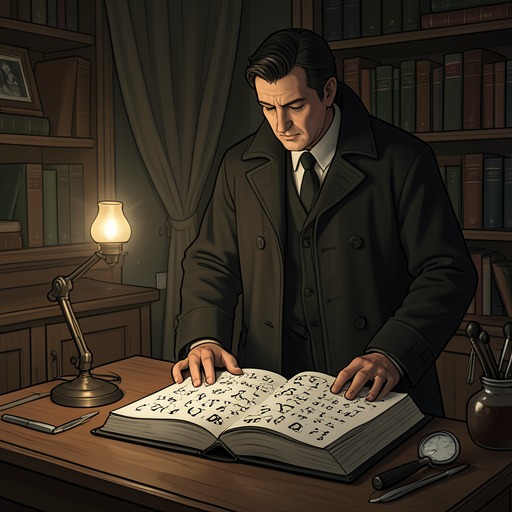
Hildred’s grandest identity is supplied by the manuscript entitled “THE IMPERIAL DYNASTY OF AMERICA.” He reads the worn pages repeatedly, although he knows them by heart, lingering over a genealogy that links Carcosa, Hastur, Aldebaran, the Hyades, Cassilda, Camilla, and the Lake of Hali to the Castaigne family. The document gives his private ambition the appearance of historical research. Its elaborate names, dates, heraldic reasoning, and dynastic succession transform a delusion into a system that can be consulted, recited, and imposed upon others.
The manuscript places Hildred above his cousin Louis Castaigne. Hildred concentrates especially on the claim that he is the first in succession, and Mr. Wilde later reinforces this interpretation by calling him “The cousin of the King!” Hildred adopts the title as a political fact rather than a metaphor. His chosen signature, Hildred-Rex, makes the transformation explicit: a family name becomes a royal style, and an imagined inheritance becomes a warrant for command.
Mr. Wilde is essential to the construction of this identity. Though physically diminutive, disfigured, and equipped with artificial wax ears, Mr. Wilde possesses the intelligence and knowledge Hildred regards as authoritative. Hildred distinguishes him from those whom society confines as weak-minded, asserting that Mr. Wilde is as sane as himself. Their shared belief in their own rationality creates a closed interpretive world in which bodily difference, eccentric behavior, and supernatural genealogy are not warnings but signs of exceptional insight.
Power, Violence, and Political Objective
Hildred’s objective is not merely to imagine a crown but to clear the way for its possession. He argues that Louis must be exiled or die and must never marry, particularly not the daughter of the Marquis of Avonshire, because such a marriage would bring England into the succession dispute. He also treats thousands of people as already subject to his authority because they have received the Yellow Sign, which he claims no living person can disregard. In his vision, the city, the state, and the entire country are ready to rise before the Pallid Mask.
The decisive conversion of fantasy into action occurs when Mr. Wilde recruits Vance. Vance, who has been in a madhouse and fears renewed madness associated with The King in Yellow, enters in terror and begs Hildred to protect him. Mr. Wilde attacks him by the throat, then renders him obedient through the manuscript’s dynastic explanation. Hildred participates in the process, explaining his own right to the crown and the fate intended for Louis. Vance’s submission gives Hildred a human instrument, while the ledger, the family history, heraldic volumes, and the rough plan of Hawberk’s rooms provide the bureaucratic and logistical forms of a conspiracy.
Hildred then signs his first writ of execution. The act is both ceremonial and practical: the name Hildred-Rex appears on an order directed against Hawberk’s household, while Mr. Wilde supplies the plan and seal. Hildred’s imagined monarchy thus imitates the procedures of a state. It has succession rules, enemies, lists, intelligence, decrees, and executions, even though its authority exists only within the narrator’s disordered interpretation of events.
Relationships and Conflict
Hildred’s relationship with Louis Castaigne is defined by dynastic rivalry and personal hostility. Louis is not simply a relative who occupies an opposing political position; he is the living obstacle against whom Hildred measures his identity. Hildred’s claim to be “the cousin of a king” depends upon Louis’s place in the family, yet he simultaneously seeks to erase Louis’s future through exile, prohibition of marriage, or death. The relationship therefore exposes the unstable basis of Hildred’s sovereignty: his imagined legitimacy requires the existence of the rival he wants to destroy.
His connection with Mr. Wilde is more intimate and more dangerous. Mr. Wilde’s intellectual authority gives structure to Hildred’s ambition, while Hildred provides the conviction and social objective that make the older man’s schemes consequential. Mr. Wilde’s physical abnormalities are treated by Hildred as irrelevant to his reason, but the same narrative repeatedly makes the body a source of horror: absent ears, a fingerless hand, scratches, and violent encounters with his cat. Hildred’s faith in Mr. Wilde’s sanity mirrors his faith in his own, even as both men use knowledge to rationalize coercion.
Hildred’s hostility extends to Dr. John Archer, whom he blames for the asylum confinement. He imagines revenge as a settling of accounts and later tells Louis that Dr. John Archer will be found in the cellar with his throat open. His threat reveals that the earlier medical episode has been absorbed into the imperial narrative: the doctor is no longer a mistaken physician but an enemy whose elimination confirms Hildred’s power.
The evidence also places Hildred beside other figures whose bodies and minds are marked by social fear. Vance is terrified of psychiatric relapse and is physically subdued before being instructed in the dynasty. Mr. Wilde’s missing ears and fingerless hand become objects of grotesque fascination. Even an unrelated recollection of Thomas’s horror at a man whose finger comes off during a struggle echoes the book’s recurring association between bodily difference, revulsion, and perceived monstrosity. These parallels do not establish that Hildred shares their physical conditions; they show instead how his narrative world converts injury, institutionalization, and disfigurement into signs through which authority and danger are judged.
Collapse and Ending
Hildred’s final confrontation with Louis displays the complete fusion of royal fantasy and personal violence. He declares that Louis may be a king but that he himself will become King, then claims the right to rule over the habitable earth. When Vance runs into the Government Lethal Chamber, Hildred interprets the scene as proof that Hawberk and his daughter are no longer obstacles. He tells Louis that Louis will never marry Constance Hawberk and threatens to visit him as he visited Dr. John Archer.
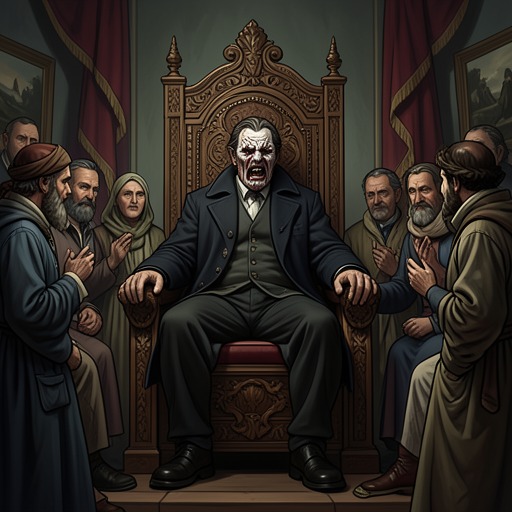
The pursuit ends at Hawberk’s shop. Hildred flees upstairs while Louis follows, and the family whose destruction he had planned becomes the scene of his capture. Policemen seize and bind him; he continues to rage, bleed, and bite at them. Old Hawberk appears, Louis stands behind him, and Constance Hawberk weeps in the corner. Hildred interprets this reversal not as arrest but as the usurpation of his throne, crying that his enemies have seized the empire and are crowned with the crown of The King in Yellow.
The narrative supplies a blunt external conclusion after Hildred’s increasingly unreliable account: an editorial notice states that Mr. Castaigne died the previous day in the Asylum for Criminal Insane. His death closes the gap between his claim to be a sovereign and the institution that defines him as criminally insane. The imperial identity survives only as a voice, a manuscript, and a signed name—Hildred-Rex—whose authority ends in confinement rather than coronation.
Narrative Role and Significance
Hildred’s narration makes the reader experience the seduction of a complete explanatory system while also watching that system fail against observable events. He presents himself as rational, ambitious, and wronged, but his account repeatedly converts medical care into persecution, genealogy into law, and frightened or coerced people into political subjects. The reader must therefore separate Hildred’s interpretation from the consequences his actions produce.
His story also makes bodily difference and institutional judgment part of the book’s larger structure of uncertainty. Hildred defends Mr. Wilde’s sanity despite his grotesque appearance and eccentric violence, just as he defends his own despite confinement, threats, and murder. The narrative does not simply offer a neutral medical explanation; it shows how diagnoses, stigma, fear, and self-definition compete to determine what counts as a person’s true identity. Hildred’s tragedy lies in the fact that his demand to be recognized as uniquely sane and destined for power becomes the mechanism by which he loses all credible authority.