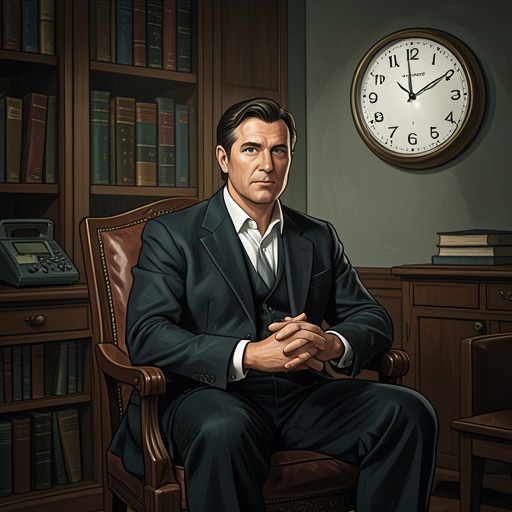
Hildred Castaigne—Dr. John Archer
The King in YellowHildred Castaigne—Dr. John Archer begins as a medical relationship and ends as an imagined conspiracy. After Hildred Castaigne’s fall from his horse, Dr. John Archer diagnosed his brain as affected and placed him in a private asylum for treatment of insanity. Although Dr. John Archer eventually judged him well enough to leave, Hildred interpreted the original confinement as an intolerable wrong and made repayment, rather than reconciliation, the governing purpose of their association.
Diagnosis, Confinement, and Recovery
Hildred’s account begins with the accident itself. He was found unconscious on the pavement after the fall, while someone mercifully shot the injured horse. He was carried to Dr. John Archer, who concluded that his brain had been damaged and confined him in a private asylum. Hildred later insists that his mind had always been as sound as the doctor’s, if not sounder, turning the medical judgment into the first act of an adversarial drama rather than an ordinary response to trauma.
Four years afterward, Hildred visited Dr. John Archer’s house on Madison Avenue as a mere formality. The pains in the back of his head and neck, which had troubled him intermittently since the accident, had been absent for months, and Dr. John Archer told him that there was nothing more to cure. Hildred did not resent paying the fee, but he did resent what he regarded as the doctor’s initial mistake. Dr. John Archer’s final declaration of recovery thus confirms Hildred’s preferred version of events only partially: it releases him, yet cannot undo the confinement or the humiliation attached to the diagnosis.
Hildred describes the accident as having changed his character for the better. He claims that he emerged from convalescence active, energetic, temperate, and ambitious rather than merely a lazy young man about town. This self-portrait makes recovery a source of confidence, but it also leaves one uneasiness unresolved: his reading of The King in Yellow during convalescence has burdened him with memories of Carcosa. The narrative consequently places medical recovery beside a continuing disturbance that Hildred does not recognize as evidence against his own judgment.
The Grievance Becomes a Theory of Persecution
After leaving the asylum, Hildred paid what Dr. John Archer jokingly called his tuition. Hildred smiled and told him that he would get even for the mistake, and Dr. John Archer laughed and invited him to call from time to time. Hildred did return, but not in the spirit of the doctor’s invitation. He hoped for an opportunity to settle accounts, found none, and decided to wait. The exchange establishes the relationship’s central asymmetry: Dr. John Archer treats the past as an error that has been closed, while Hildred preserves it as an unpaid debt.
Mr. Wilde later tells Hildred that Dr. John Archer can be dealt with whenever Hildred wishes. The remark strengthens Hildred’s tendency to convert personal resentment into a larger program. In the political and dynastic fantasies surrounding the Imperial Dynasty of America, medical authority is no longer neutral; it becomes one of the obstacles to Hildred’s supposed right. The old diagnosis is absorbed into a theory of succession, and Dr. John Archer is recast from mistaken physician as conscious usurper.
Hildred eventually states that theory directly. He claims that Dr. John Archer obtained the secret of the Imperial Succession and then attempted to deprive him of his right by alleging that the fall had made him mentally deficient. He further alleges that the doctor placed him under restraint in his own house in the hope of driving him insane or poisoning him. Hildred declares that he has not forgotten this treatment and that his recent interview with Dr. John Archer was final. The speech reveals less about an objectively verified plot than about the way Hildred’s grievance has hardened into certainty: the contested diagnosis supplies both the alleged motive and the moral justification for retaliation.
Violence and the Breakdown of Medical Authority
Hildred’s relationship with Dr. John Archer culminates in threatened or completed violence. He tells Louis Castaigne that Dr. John Archer will be found in the cellar with his throat open, while also referring to Vance, a knife, and an order signed by Hildred. In the same breath, he presents himself as the rightful ruler who has been obstructed by enemies. The medical dispute has therefore crossed into criminal action and political fantasy; the doctor is no longer someone to answer for a diagnosis but an enemy whose destruction clears the way to empire.
The account is deliberately unstable because Hildred speaks from a state in which ordinary categories of doctor, patient, crime, and succession have fused. Dr. John Archer’s earlier diagnosis may be wrong, cruelly applied, or accurately concerned with Hildred’s condition; the text gives the reader Hildred’s accusations but does not independently validate his conspiracy. Hildred’s insistence that he is as sane as Dr. John Archer becomes especially consequential beside his later conduct. His rejection of the label “lunatic” is not merely a dislike of vocabulary: it is a defense against the institutional power that the word represents, and it is also part of the rhetoric by which he makes violence appear rational.
Power, Stigma, and the Final Reversal
The relationship exposes the danger of treating diagnosis as either unquestionable truth or absolute persecution. Dr. John Archer’s authority determines Hildred’s confinement, but Hildred’s counter-narrative turns that authority into the origin of a vendetta. His body and history remain central to the conflict: the fall, the head and neck pains, the asylum, and the disputed mental deficiency are repeatedly invoked as evidence, yet each fact is interpreted through competing frameworks of care, stigma, ambition, and revenge.
The final irony is that Hildred’s retaliation does not establish his independence from medical authority. After his confrontation with Louis Castaigne, Hildred is restrained and taken to the asylum for criminal insanity. The editor’s closing notice states that Hildred died there the previous day. Dr. John Archer’s initial institutional judgment is therefore echoed by the ending, though in a more severe form: the man who believed himself wronged by psychiatric confinement ultimately dies inside an institution for the criminally insane. Whether that ending confirms Dr. John Archer or demonstrates the destructive consequences of his original mistake remains unresolved, but the relationship’s decisive pattern is clear. A diagnosis meant to close a medical crisis becomes, in Hildred’s imagination, the founding injury of a lifelong war.