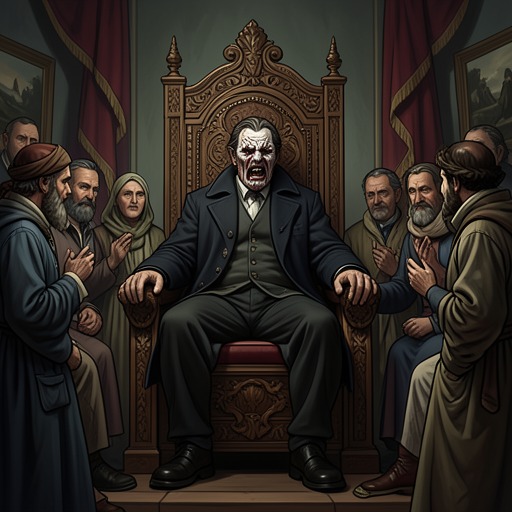
Hildred Castaigne—Mr. Wilde
The King in YellowHildred Castaigne—Mr. Wilde is the central conspiratorial alliance behind Hildred Castaigne's attempt to establish the Imperial Dynasty of America. Mr. Wilde transforms genealogical speculation, occult mythology, and dossiers on compromised citizens into a program for mass obedience; Hildred receives that program as both political strategy and personal revelation, becoming convinced that he alone has the right to the crown. Their relationship is therefore not an ordinary partnership between equals: Mr. Wilde is the planner, archivist, recruiter, and manipulator, while Hildred becomes the ecstatic claimant and eventual instrument of the scheme's violence.
Identity and Basis of the Alliance
Mr. Wilde is presented as physically abnormal, secretive, and intensely intelligent. He has no natural ears, relies on wax ears supported by fine wires, and has a fingerless left hand, yet his bodily mutilations do not prevent him from exercising extraordinary intellectual authority over Hildred. His small stature contrasts with his magnificently developed arms and thighs, while his flat, pointed head contributes to the suspicion that he is insane. Hildred nevertheless insists that Mr. Wilde is as sane as himself. The judgment is revealing: Hildred recognizes Mr. Wilde's methodical intelligence because he shares, or has surrendered himself to, the same distorted system of belief.
Mr. Wilde's eccentricity is also enacted through his treatment of the cat he keeps confined in his study. He deliberately provokes the animal until it attacks his face, and Hildred witnesses the two of them rolling across the floor, scratching and clawing, before the cat flees and Mr. Wilde lies contracted like a dying spider. The scene establishes a relationship between Mr. Wilde and violence that is intimate, experimental, and ritualized rather than merely strategic. His study is at once an archive, a laboratory, and a private theatre in which domination is repeatedly tested.
The Manuscript and Political Objective
The partnership is organized around a manuscript entitled “THE IMPERIAL DYNASTY OF AMERICA.” Hildred has handled its worn pages so often that he knows them by heart, but he continues to read them with eager, rapt attention. The document begins with Carcosa, the Hyades, Hastur, and Aldebaran and proceeds to the genealogy of the Castaigne family, identifying Hildred Castaigne as the only son of Hildred de Calvados and Edythe Landes Castaigne and placing him first in succession. Mr. Wilde's power lies partly in making this fantastic succession appear documentary: the manuscript's physical age, its repeated handling, its genealogical detail, and its supporting notes give the imagined dynasty the outward form of historical evidence.
The conspiracy is not confined to symbolic or private belief. Mr. Wilde reports that they are already in communication with ten thousand men, expects one hundred thousand within the first twenty-eight hours, and predicts that the state will rise en masse within forty-eight hours. He declares that the country will follow the state and excludes California and the Northwest from his projected movement, saying that he will not send them the Yellow Sign. Hildred answers with the slogan “A new broom sweeps clean,” accepting political upheaval as purification rather than questioning the means by which obedience will be produced.
Mr. Wilde describes the ambition behind the project as greater than the ambitions of Caesar and Napoleon because it seeks not merely territory or institutions but the minds of men and even their unborn thoughts. The partnership thus imagines power as total mental possession. Its intended empire depends less on ordinary administration than on the circulation of a sign, the Yellow Sign, and on the terror associated with the Pallid Mask. Political authority is presented as something that can be installed by controlling belief before it is secured by controlling bodies.
Recruitment and Psychological Control
Mr. Wilde's method becomes clearest in the recruitment of Vance. After Hildred has read the manuscript once more, Mr. Wilde summons the crouching figure from the dark passage leading to his bed-chamber. Vance has embezzled thirty thousand dollars since March 20, 1919, and has obtained his position through family influence; the dossier records that his father is president of Seaforth Bank. Mr. Wilde therefore approaches him not as an unknown convert but as a compromised man whose private misconduct can be converted into political leverage.
Vance rises as if hypnotized. Mr. Wilde reads the entire history of the Imperial Dynasty of America to him, then patiently explains the part he is expected to play. Vance's blank, vacant eyes make him seem almost half-witted, but Mr. Wilde treats that condition as irrelevant. His objective is not intellectual agreement in the ordinary sense. It is submission sufficient for action. The manuscript is supplemented by volumes on heraldry, allowing Mr. Wilde to give his claims an apparatus of learned authority while Hildred participates in the explanation.
The presentation moves through Carcosa, the lakes connecting Hastur, Aldebaran, and the mystery of the Hyades, then invokes Cassilda, Camilla, Demhe, and the Lake of Hali. Mr. Wilde mutters that the scolloped tatters of the King in Yellow must hide Yhtill forever before leading Vance through the imperial family to Uoht, Thale, Naotalba, the Phantom of Truth, and Aldones. He finally abandons the notes and tells the story of the Last King. Hildred watches in fascination as Mr. Wilde raises his head, stretches out his long arms in a gesture of pride and power, and lets his eyes blaze like emeralds. The performance turns scholarship into spectacle and genealogy into enthrallment.
Hildred then supplies the conspiratorial conclusion. Pointing to himself as “the cousin of the King,” he explains why he alone deserves the crown and why his cousin Louis Castaigne must be exiled or die. Even renunciation would not make Louis safe: Hildred insists that Louis must never marry, especially not the daughter of the Marquis of Avonshire, because such a marriage could bring England into the political question. Mr. Wilde has prepared a list of thousands of names, and Hildred claims that every person on it has received the Yellow Sign, which no living human being dares disregard. In this division of labor, Mr. Wilde constructs the machinery of ideological terror and Hildred translates it into a program of dynastic elimination.
Mutual Dependence and Conflict
The alliance depends on an unstable exchange between Mr. Wilde's control and Hildred's conviction. Mr. Wilde possesses the records, the occult narrative, the heraldic confirmations, and the network of names; Hildred possesses the personal claim and the willingness to make it violent. Hildred's objective cannot become politically actionable without Mr. Wilde's dossiers and recruitment, while Mr. Wilde's dynasty requires Hildred's status as claimant and his readiness to remove obstacles. Their intimacy is consequently practical and theatrical at once: they study together, repeat the manuscript together, and instruct recruits together, but Hildred also remains the person whose ambition the entire structure is designed to serve.
The relationship becomes more dangerous when Hildred dismisses warnings that the people around them may assassinate Mr. Wilde. Mr. Wilde responds by rubbing his mutilated ears and treating the possibility without apparent alarm. Hildred then reads the manuscript for what he believes will be the last time in Mr. Wilde's study. The scene marks a threshold: the conspiracy is no longer merely being assembled, yet it has not achieved public victory. Its promised mass movement remains dependent on secrecy, persuasion, and the continuing presence of the man who interprets its records.
Collapse and Ending
Hildred's accession appears to occur immediately after the obstacles represented by Louis Castaigne, Constance Hawberk, and Hawberk's daughter have been neutralized. He reaches Mr. Wilde's open study proclaiming that the deed is done and calling on the nations to behold their King. Finding Mr. Wilde absent, he takes the diadem from its case, puts on the white silk robe embroidered with the Yellow Sign, and places the crown on his head. The costume completes what the manuscript began: Hildred converts genealogical assertion into visible sovereignty and experiences himself as king by right in Hastur, through knowledge of the Hyades and the Lake of Hali.
The coronation is destroyed almost at once. As Hildred stands awaiting the dawn and the imagined tempest that will shake two hemispheres, the cat passes through the dark passage. His knife strikes it, and when he raises a lamp he finds Mr. Wilde on the floor with his throat torn open. For a moment Mr. Wilde's green eyes seem to sparkle and his mutilated hand trembles, giving Hildred a brief hope that the master may live; then Mr. Wilde dies. The death is more than the loss of an accomplice. Hildred sees his crown, empire, ambitions, and life itself as lying prostrate with the dead master, acknowledging that his identity as king was materially and psychologically dependent on Mr. Wilde.
The conspiracy ends through ordinary physical containment rather than the apocalyptic uprising Mr. Wilde predicted. Police seize Hildred from behind and bind him while he screams and bites at them. Old Hawberk appears, Louis Castaigne stands behind him, and Constance weeps in the corner. Mr. Wilde's death removes the organizer and interpreter of the dynasty, while Hildred's capture exposes the gap between imagined sovereignty and institutional power. Their relationship leaves no functioning empire behind; it leaves a murdered conspirator, a captured claimant, and a political fantasy whose elaborate machinery collapses when its central keeper is gone.