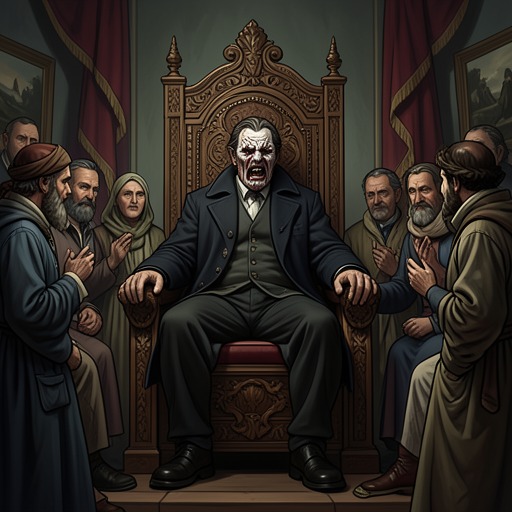
Hildred Castaigne's fall and confinement
The King in YellowHildred Castaigne's fall and confinement begins with a riding accident that places him under Dr. John Archer's authority and becomes the disputed origin of his later transformation. Found unconscious after his horse was shot, Hildred was judged to have an affected brain and confined in Dr. John Archer's private asylum for treatment for insanity. Although the confinement is presented through Hildred's retrospective and increasingly unreliable account, the episode decisively alters his life: it releases a new ambition while binding him to resentment, self-justification, and the disturbing imaginative world of The King in Yellow.
The Accident and Medical Confinement
Hildred recalls that the fall occurred four years before his visit to Dr. John Archer, after which he suffered occasional pains in the back of his head and neck. By the time Dr. John Archer dismissed him, those symptoms had been absent for months, and the doctor declared that there was nothing more to cure. Hildred regarded the consultation as a formality and believed he already knew himself to be well, yet the doctor’s earlier mistake remained the injury that mattered most to him.
The circumstances of the accident were violent and uncertain. Hildred had been picked up unconscious from the pavement, while someone had mercifully sent a bullet through his horse’s head. Dr. John Archer interpreted the condition of the injured rider as evidence that his brain was affected and placed him in a private asylum. The confinement therefore followed not from a demonstrated act of madness in the surviving account, but from a medical judgment made at the scene of catastrophe. That gap between diagnosis and proof becomes central to the event’s later ambiguity.
Release, Resentment, and Transformation
Dr. John Archer eventually decided that Hildred was well enough to leave. Hildred describes the doctor’s treatment as an education for which he had already paid, adopting Dr. John Archer’s joking phrase about having paid his tuition. He smiled while promising to get even for the mistake, and Dr. John Archer laughed and invited him to call occasionally. Hildred did return, ostensibly hoping for an opportunity to settle the account, but Dr. John Archer gave him no such opening, so Hildred continued to wait.
Hildred insists that the fall produced no harmful consequence. In his telling, it changed his whole character for the better: the formerly lazy young man about town became active, energetic, temperate, and ambitious. The assertion is both a claim of recovery and a claim of superiority over the physician who had confined him. It also establishes the accident as a reversal rather than a simple decline. The event gives Hildred a new purpose, but it does not free him from the question of whether the change is genuine health, a defensive self-narrative, or the first stage of a more dangerous instability.
The Diagnostic Dispute and Its Echoes
Hildred’s insistence that his mind had always been as sound as Dr. John Archer’s, if not sounder, conflicts with the social language surrounding him. At the Hawberk household, old Hawberk casually refers to Mr. Wilde as a lunatic, a word Hildred says he loathes because it awakens feelings he refuses to explain. He visits Mr. Wilde repeatedly, presenting himself as a sane observer who can recognize intelligence where others see insanity. His response suggests that the asylum experience has made psychiatric labeling personally charged, even when he directs the label at someone else.
The same conflict appears when Mr. Wilde introduces Osgood Oswald Vance. Osgood Oswald Vance is physically mutilated and has been confined in a madhouse, and he begs Hildred to keep Mr. Wilde away, warning that remembering The King in Yellow may drive him mad again. Hildred is positioned as the person who might judge or rescue him, yet the scene also reflects Hildred’s own history of confinement. The distinction between recovered patient, sane witness, and returning victim is therefore unstable: Osgood Oswald Vance recognizes Hildred as different, but his desperate appeal also places Hildred within the same orbit of psychiatric terror.
Consequences and Ending
The later record of Hildred’s life confirms that release from Dr. John Archer’s asylum did not resolve the crisis associated with the fall. Hildred eventually believes that he has seized a throne and empire and that others have crowned themselves with the crown of The King in Yellow. He is restrained by police while old Hawberk, Louis Castaigne, and Constance Hawberk are present, and the scene turns the earlier medical confinement into a final, criminalized confinement. An editorial notice then states that Hildred died the previous day in the Asylum for Criminal Insane.
The ending changes the meaning of the earlier release without settling the diagnosis. Hildred’s own account frames the fall as the beginning of health, discipline, and ambition; the later institutional record frames his trajectory as one ending in criminal insanity and death. The narrative offers no neutral medical examination capable of reconciling these versions. Instead, the accident remains the hinge between two incompatible authorities: Hildred’s insistence on his own lucidity and the institutions that repeatedly define, contain, and finally outlive him.
Narrative Significance
As a plot event, Hildred Castaigne's fall and confinement supplies the origin story for both his transformed ambition and his hostility toward medical judgment. It also establishes the book’s recurring uncertainty about whether madness is a bodily fact, a social designation, or a truth disclosed only after the narrator can no longer control its interpretation. The event is recalled by Hildred rather than presented directly, so its chronology is filtered through memory, self-defense, and later catastrophe.
The accident’s decisive irony is that Hildred treats confinement as proof of Dr. John Archer’s error and recovery as proof of his own exceptional strength, while the subsequent narrative makes that confidence increasingly difficult to sustain. His release becomes not a return to ordinary life but an entry into a more ambitious and perilous identity. By the time he dies in the asylum, the original fall has become less a closed medical episode than the first visible turn in a cycle of diagnosis, resistance, confinement, and collapse.