It Is a Fearful Thing to Fall into the Hands of the Living God
The King in Yellow“It Is a Fearful Thing to Fall into the Hands of the Living God” is an expression of ultimate helplessness whose meaning shifts across the book. It names the terror of surrendering personal agency to a power that may be divine, spectral, governmental, or psychological, and it reaches its fullest force when the King in Yellow whispers it to a fallen narrator at the edge of an otherworldly vision.
First Appearance and Scriptural Dread
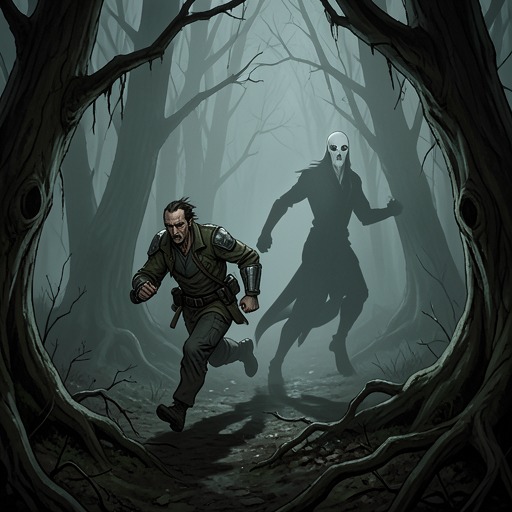
The expression appears in the story’s climactic church vision as the voice of the King in Yellow, not as an ordinary theological reflection. The narrator has entered the church believing that he has escaped the pursuer, but the apparent safety of the cheerful building proves unstable. He recognizes that the being’s power has returned from oblivion and understands that the pursuit has continued at the level of the soul, in the Court of the Dragon.
The sentence therefore converts spiritual language into an immediate threat. It is not presented as consolation or moral instruction; it is the last message heard while the narrator loses control of his body and perception. The wording gives the unseen pursuer a terrible authority, suggesting that the living God is less a source of protection than the final holder of judgment over a defenseless human being.
The Church Vision and Cosmic Displacement
The expression’s effect depends on the abrupt collapse of ordinary space. As the organ sounds, dazzling light fills the church, the altar and congregation disappear, and the narrator sees black stars, the winds of the Lake of Hali, and the towers of Carcosa rising beyond a moon covered with spray. The scene moves from a recognizable Christian interior into the mythology associated with the King in Yellow, making the sentence a verbal threshold between the everyday world and a cosmic realm.
The narrator’s perception remains uncertain even as the imagery becomes more definite. He has escaped the pursuer in a physical sense, yet the repeated recognition that he has not escaped him transforms safety into entrapment. The expression crystallizes that reversal: the threatened person is no longer merely being followed but is being delivered into a domain where ordinary resistance, explanation, and bodily security no longer apply.
Recurrence Across Death and Authority
Elsewhere, the book repeatedly stages powers that claim jurisdiction over human life. The Governor of New York announces that the laws prohibiting suicide have been repealed and that the Government will establish a Lethal Chamber in every city, town, and village. He declares that a painless death awaits anyone who can no longer bear life’s sorrows, then formally opens the chamber before the assembled citizens. In this political setting, control over death is transferred from individual prohibition to institutional authorization.
The expression forms a grim counterpoint to that policy. The Lethal Chamber promises a controlled and chosen end, while the sentence evokes the terror of an end imposed by a higher power. Both scenes concern who may decide the boundary between life and death, but they present opposite claims: the Government describes death as relief administered through public authority, whereas the King in Yellow’s whisper makes surrender itself the source of fear.
The same structure appears in Hildred Castaigne’s delusional imperial rhetoric. His manuscript traces an imagined succession through Carcosa, Hastur, and related names, and he identifies himself as the rightful heir. He declares that the world must bow to the black stars over Carcosa, signs his first writ of execution as Hildred-Rex, and sends an order, a plan of Hawberk’s rooms, and a new knife toward a projected act of violence. His fantasy turns inherited authority into a license to determine who may live, be exiled, or die.
Final Use and Meaning
At the end of the church episode, the expression is no longer simply heard; it becomes the last intelligible form imposed on the narrator’s experience. The King in Yellow whispers it to his soul as the radiance grows in waves of flame and the narrator sinks into the depths. The ending refuses to separate religious revelation from supernatural assault, leaving the phrase suspended between judgment, madness, and metaphysical truth.
Its recurrence also exposes a central contrast in the book. Characters and institutions repeatedly try to make death legible: as a legal right, an imperial prerogative, an execution order, or a consequence recorded by an asylum notice. The expression resists every such simplification. It gives death an active recipient and an overpowering hand, suggesting that the most fearful condition is not death alone but the loss of sovereignty before an authority that claims to know what the sufferer is.
The sentence’s lasting significance lies in this ambiguity. It can be read as a theological warning, a quotation heard within delirium, or a supernatural verdict, and the narrative does not settle the matter through a natural explanation. In the final vision, however, its emotional meaning is unmistakable: the individual who believed he could recognize, evade, or command the forces around him is reduced to a soul falling beyond the reach of ordinary human agency.