Jack Scott
The King in YellowJack Scott is a painter and one of the two people whom Boris Yvain addresses with unusual familiarity. His importance lies less in a separate artistic career than in his position inside the intimate circle formed by Boris, Alec, and Geneviève: he shares the artists’ daily life, moves easily between their apartments and studios, and becomes the friend who must carry unbearable knowledge when the others can no longer speak for themselves.
Identity and Place in the Artists’ Circle
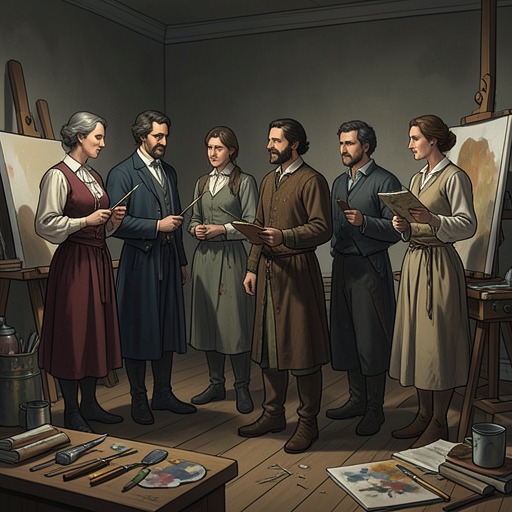
Jack Scott belongs to the artistic world of the Beaux Arts and is presented through concrete signs of a working painter’s informality. He enters the studio wearing a paint-stained jacket, helps himself to the Oriental sweetmeats, loots the cigarette case, and then leaves with Boris Yvain to visit the Luxembourg Gallery. His easy appetite and shameless familiarity make him a comic, mobile presence amid the strain surrounding Boris’s work and Alec’s concealed love for Geneviève.
Boris’s relationship with Jack is nevertheless exceptionally close. Boris was claimed by the American artists because he had been born in America, though his father was French and his mother Russian, and everyone at the Beaux Arts called him Boris. Yet only Jack Scott and Alec received the same familiar form of address from him. Jack is therefore not merely an acquaintance from the studio; he is one of Boris’s chosen intimates, trusted enough to move without ceremony through the private world shared by the three artists.
Companion in Ordinary Life
Jack’s first function is social and practical. While Boris and Alec are absorbed in artistic work, Jack interrupts the studio’s seriousness with appetite, movement, and banter. His visit occurs as Boris is considering whether to send his technically accomplished Ariadne to the Salon, while the unfinished The Fates remains the more ambitious work. Jack’s departure with Boris to see a new silver bronze by Rodin and a landscape by Monet briefly restores the ordinary rhythm of artistic Paris: exhibitions, studio visits, cigarettes, food, and the exchange of opinions.
That ordinary companionship gains retrospective weight after the disaster. Jack is present not only in the public artistic world but also at the threshold between domestic intimacy and catastrophe. When Geneviève becomes feverish and reveals that she loves Alec, Boris’s composure breaks. Alec cannot bear the shame of the disclosure, and he seizes Jack and hurries him into the street, explaining that Boris would rather be alone. Jack then returns with a doctor when Alec himself begins to fall ill. His response is immediate and practical, even though he has been drawn into a crisis that none of the three lovers can control.
Witness to the Deaths of Boris Yvain and Geneviève
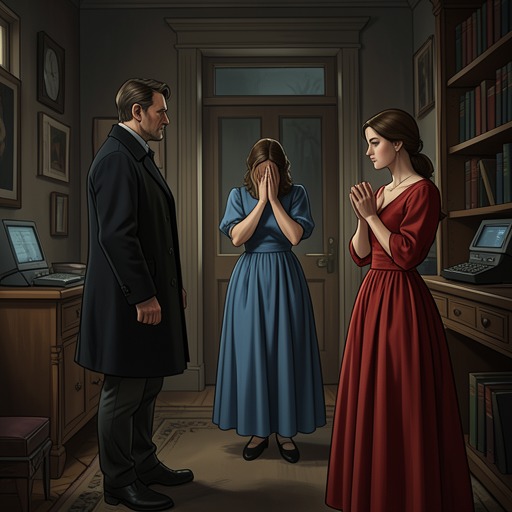
Jack becomes the only surviving eyewitness able to recount the final scene in Boris’s house. After leaving Alec in the doctor’s care, he returns to Boris and finds him working on The Fates while Geneviève sleeps under the influence of drugs. Boris says that she has been out of her mind, and he continues working in silence. Jack watches as the third figure in the sculptural group, the figure looking straight ahead over the world, takes on Boris’s face—not the face Jack had known, but the face Boris wore then and would wear to the end.
Near midnight, a door opens and shuts sharply, followed by a rush in the adjoining room. Boris springs through the doorway, with Jack behind him, but they arrive too late. Geneviève is lying at the bottom of the pool with her hands across her breast. Boris then shoots himself through the heart. Jack’s account is marked by physical strain: sweat gathers beneath his eyes and his cheeks twitch as he speaks. His testimony does not explain the mystery of the sculpted face or the motive behind the deaths; instead, it preserves the sequence of actions while emphasizing the limit of ordinary explanation.
Jack’s conduct after the deaths is governed by concealment and grim responsibility. He carries Boris to his room, releases the hellish fluid from the pool, turns on all the water, and washes the marble clean of every drop. He empties the solution from the laboratory basin into the waste-pipe and pours the contents of every jar and bottle after it. These actions destroy the material evidence of Boris’s experiment, but they also reveal Jack’s role as a protector of the dead and of the surviving friends’ fragile reality. He does not claim to understand what has happened; he tries to prevent the dangerous substance and the scene itself from producing further harm.
Messenger and Custodian of Grief
When Alec recovers enough to ask for Boris and Geneviève, Jack must tell him that both are dead. The news drives Alec into a rage and relapse, and Jack later gives him a letter and the keys to Boris’s house. Alec asks for the full account despite recognizing the cruelty of making Jack reopen a wound that can never entirely heal. Jack answers with restraint, saying that Alec cannot explain what happened unless he possesses a clue unknown to Jack, and that he will use few words. His controlled narration contrasts with the enormity of the events he describes.
Jack also gives Alec the final image by which Geneviève is remembered. She lies before the Madonna in the marble room, while the Madonna bends tenderly above her and Geneviève smiles back into the calm face that would not have existed without her. Jack’s voice breaks as he grasps Alec’s hand and urges courage. The gesture is small but decisive: he is not only transmitting facts but physically supporting a survivor who has been stripped of every sustaining relationship.
The next morning Jack leaves for the Ept to fulfil his trust. His departure shows that the burden does not end with narration. He has accepted an obligation connected with the dead and carries it away from the ruined house, while Alec enters the house only to find its silence unbearable. Jack’s role thus extends beyond witness: he is the person who handles keys, letters, bodies, chemicals, and farewell, converting private catastrophe into a guarded responsibility.
Narrative Role and Significance
Jack Scott is a grounded counterweight to the story’s artistic ambition, romantic secrecy, fever, and unexplained science. His paint-stained jacket, pilfered sweets, and theatrical studio informality establish him as a figure of ordinary companionship; his later actions place him inside a sequence of murder-like shock, suicide, chemical danger, and mourning. The contrast makes the catastrophe more credible and more terrible, because it invades a world previously organized by familiar studio routines.
He is also the narrative’s principal mediator of knowledge. Alec is incapacitated, Boris is dead, and Geneviève cannot clarify her feverish confession; Jack alone remains to reconstruct the final hours. Yet his testimony preserves rather than resolves the central mystery. He can report what he saw, including Boris’s altered face in The Fates and the destruction of the solution, but he cannot account for the uncanny correspondence between sculpture and fate. Jack’s reliability is therefore practical rather than omniscient: he is careful, restrained, and concrete, while the meaning of the events remains beyond his power to settle.
Through Jack, friendship becomes an active ethical labor. He returns for the doctor, watches over Boris, cleans the dangerous laboratory, reports the deaths, gives Alec access to the house, offers physical consolation, and fulfils his trust at the Ept. He does not prevent the catastrophe, and he cannot repair its emotional consequences, but he performs the necessary acts that allow the living to confront what remains. His apparent simplicity is consequently deceptive: beneath the genial studio companion stands the story’s indispensable bearer of memory, evidence, and grief.