Jack Trent
The King in YellowJack Trent is an American artist living in Paris during the siege, identified by the name carved on his colour-box and associated with the École des Beaux Arts. His decisive significance lies in the tension between the warmth of his life with Sylvia Trent and the public disaster pressing against their rooms: he protects domestic affection, aids friends and strangers, and finally moves toward the battlefield even while recognizing what that movement may cost.
Identity and Domestic Life
Trent is introduced through the material signs of an artist's life. His colour-box bears the inscription “J. TRENT.”, and he is connected with the École des Beaux Arts. Yet the scene that establishes him is not confined to artistic identity. In the darkening room, amid December cold and the distant sounds of bombardment, Sylvia Trent reminds him to clean his palette; he answers her from beside the stove and sits with the palette-knife glimmering in the firelight. The palette, colour-box, stove, and baby garment being sewn by Sylvia create a fragile household order inside a city whose streets and buildings are being overtaken by cold and war.
The intimacy between Trent and Sylvia is marked by ordinary care rather than grand declarations. He fills her alcohol lamp, prepares to leave, and answers her anxiety with affectionate firmness. He tells her that his courage is sustained by hers, kisses her, and urges her not to worry. His conduct presents marriage and domestic loyalty as active responsibilities: Sylvia's fear matters to him, but he also believes that he must go out into the endangered city.
Generosity and Social Responsibility
Trent's relations with his fellow Americans reveal a practical ethic of shared obligation. When Braith hesitates to accept help, Trent argues that his money creates a duty to share it, especially because the blockade has made ordinary access to money impossible and the American Minister is overwhelmed by the crisis. His offer is not framed as charity that places Braith beneath him; he insists that Braith will repay him when talent eventually brings wealth and fame, even suggesting that Braith's talent could serve as security if Trent were a usurer.
This exchange makes Trent more than a comfortable observer of suffering. He sees resources as social obligations, while Braith sees dependence as a burden that may never be repaid. Trent's impatience with that shame is part of his generosity: he wants friendship to overcome the humiliating logic of scarcity. The same impulse appears when he arranges a dinner for friends and includes Sylvia's forthcoming nineteenth birthday, preserving a ceremony of affection even as the siege narrows food, movement, and hope.
Trent also responds to suffering encountered in the street. The city is nearly deserted, women move along the frozen pavement in tattered military capes, and a badly clothed gamin searches a sewer for rats, one still warm and bleeding from the rope around his waist. Trent crosses the street and asks the boy how much he wants, treating the boy's grim discovery as an exchange that can at least provide immediate relief. The episode places his personal kindness against the siege's degradation of human life into scraps of food and precarious bargains.
The Siege and the Choice of Action
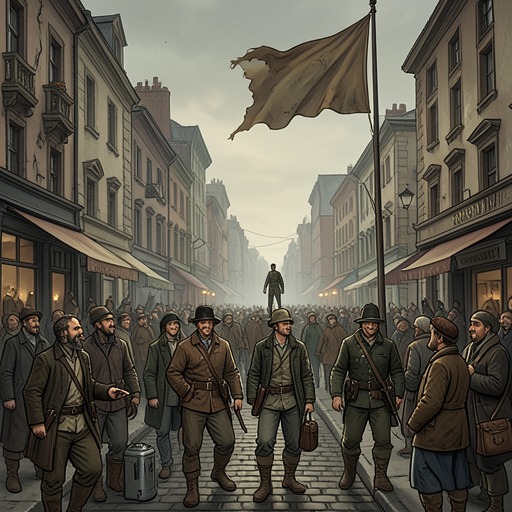
Trent's movements through Paris are governed by the war's changing soundscape. As he walks through the early winter night, Prussian cannon fire rolls continuously, the shocks from Mont Valérien strike through it, shells cross the sky like shooting stars, and rockets flare above the Fort of Issy while the Fortress of the North burns like a bonfire. Crowds gather in the streets to await signals whose meaning they do not yet know. Their waiting is described as sickness, starvation, freezing, and submission to whatever comes next: a sortie or further starvation, with no time left to think about surrender.
Although Trent initially reacts to the prospect of combat with dread, he does not remain outside the consequences of the siege. At dinner, after food has been eaten and a portion reserved for the old people below, he calls for a toast to Paris and hopes that the city will rise from its ruins and crush the invader. He then tells West that a sortie is planned and that the American Ambulance surgeon has asked for assistance. Trent intends to go out with the ambulance the following morning, while concealing the plan from Sylvia because he does not want to increase her fear.
His decision combines courage with concealment and practical service. He does not claim that the work is glorious; the earlier prospect of slaughter sickens him, and he is glad at first that he will not be part of it. Nevertheless, the ambulance offers a way to act without pretending that the violence is anything other than destructive. His choice shifts him from anxious spectator to participant in the city's emergency, while the secrecy toward Sylvia exposes the cost of that transition within marriage.
Volunteering and the Collapse of the Front
Trent's commitment becomes more direct when he tries to enter the military movement himself. After speaking with a Breton child whose father serves at the cannon and who warns that her father will shoot a spy, Trent crosses the street, passes through a gateway, and forces his way into a line of troops. A corporal identifies him as belonging to the 60th by the number on his képi, while an officer dismisses him because his black trousers mark him as a Franc-tireur rather than a regular soldier.
Trent explains that he wishes to volunteer in place of a comrade, but the officer merely shrugs and moves on. The scene emphasizes the mismatch between individual willingness and military bureaucracy. Trent is prepared to assume another man's danger, yet his identity and clothing prevent the institution from recognizing that offer. His courage therefore cannot be measured only by formal enlistment; it appears in the attempt itself and in his readiness to accept a role the army does not authorize.
The battle's aftermath makes the stakes of his choice visible. At midnight, the gates of Paris are clogged with the remnants of an army: exhausted troops, broken formations, plunging horses, jolting caissons, ambulances bearing heavy loads, and crowds silently watching the returning chaos. The city receives not triumph but fragments, and the repeated cry of “Perdus! perdus!” gives the scene its collective verdict. Trent's personal movement toward danger is thus framed by the destruction of organized military order.
Relationships, Recognition, and Narrative Role
Trent's bond with Sylvia is the emotional counterweight to his public action. He arranges her birthday dinner, sends loving messages through friends, and tries to protect her from knowledge of the sortie and ambulance work. Yet his repeated departures make the household dependent on courage from both partners. Sylvia's courage sustains him, while his secrecy protects her only temporarily from the war that surrounds them.
His friendship with Braith likewise joins affection to crisis. Trent presses Braith to accept money, refuses to let poverty become a barrier between them, and treats future artistic success as a credible form of repayment. The friendship supplies a social alternative to the siege's brutal economy, in which even a child searches sewers for food and the streets offer little shelter from cold or violence.
Trent's final reappearance after the battle intensifies rather than resolves these obligations. West and Colette witness Hartman being taken behind the barracks, hear a volley, and then see the defeated remnants pour back through Paris. Among the ragged end of a battalion, Trent suddenly calls West's name. West recognizes him and cries out; Trent seizes him, white with terror. The encounter shows that Trent has not escaped the catastrophe by remaining an American artist or by serving with an ambulance. He has been drawn into the same shattered human current as the soldiers, and his terror gives the public disaster an intimate face.
Trent consequently functions as a connective character: artist and would-be volunteer, husband and friend, American outsider and emotionally committed resident of Paris. Through him, the narrative moves between palette and cannon, birthday preparations and starvation, private promises and the spectacle of an army returning in ruins. His actions do not overcome the siege, but they demonstrate how personal responsibility persists when institutions fail, resources disappear, and courage cannot guarantee survival.