Jeanne d'Ys's death
The King in YellowJeanne d'Ys's death is the decisive tragedy of the tale of Philip and Jeanne d'Ys, converting an apparently living romance into a centuries-old memorial. The death is both a physical catastrophe, marked by a viper's bite, and a temporal rupture: Philip loses Jeanne at the instant of mutual confession and then finds himself before the ruins of her world, where a shrine records that she died young for love of a stranger named Philip.
Causes and Immediate Circumstances
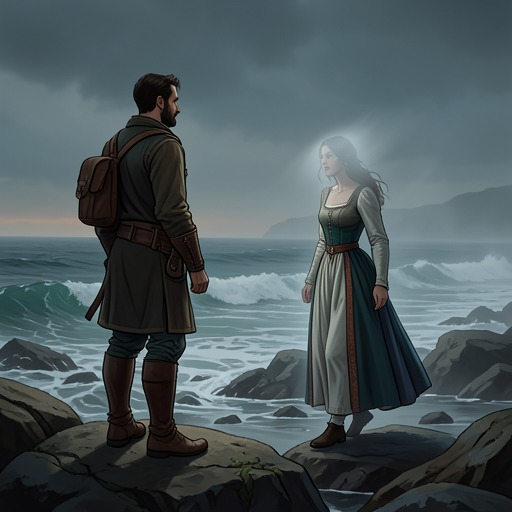
The event follows a moment of emotional revelation. When Philip asks whether Jeanne's fear is for him, she answers, "For you, Philip,—I love you." Her declaration changes their encounter from guarded intimacy into openly acknowledged love. Philip takes her in his arms and kisses her, able to repeat only her name, while she trembles against him. The scene's tenderness is immediately invaded by a bodily threat that neither character has recognized.
Something strikes Philip's foot in the grass, then strikes his ankle again. A sharp pain shoots through him, and he discovers a viper attached to his leg. He first lifts Jeanne and flings her away from him, an instinctive attempt to prevent her from remaining in danger, before bending to tear the snake loose and crush its head beneath his heel. The act saves neither the romance nor Philip from the poison. He remembers weakness and numbness, then falls as his vision gradually clouds, while Jeanne's white face bends over him and her arms remain about his neck.
The Death and the Temporal Rupture
Philip does not witness Jeanne's death directly. He loses consciousness with Jeanne still holding him, and the narrative presents her death through the world that confronts him when he opens his eyes. Jeanne has disappeared. The stream and flat rock remain, as does the crushed viper in the grass, but the hawks and the surrounding blocks have vanished. The garden, fruit trees, drawbridge, and walled court are gone as well.
In their place Philip sees a heap of grey, ivy-covered ruins through which great trees have grown. His numbed foot forces him to drag himself forward, making the physical consequences of the bite part of his investigation. A falcon rises from the treetops, circles upward in narrowing rings, and disappears into the clouds. Its departure accompanies the disappearance of the earlier world and leaves Philip with no living witness to explain what has happened.
Recognition at the Shrine
Philip calls Jeanne's name, but his voice dies away, and he falls on his knees among the weeds. By chance, or as he understands it, by divine will, he has knelt before a crumbling shrine carved for the Mother of Sorrows. The shrine's imagery gives the event a sacred and funerary setting: the Virgin's sorrowful face is cut into cold stone, with a cross and thorns beneath it.
The inscription supplies the recognition that Philip could not obtain from Jeanne. It asks prayers for the soul of the Demoiselle Jeanne d'Ys, states that she died in her youth for love of Philip, a stranger, and dates the death to A.D. 1573. The inscription therefore reverses Philip's understanding of the encounter. What seemed to be a present courtship was also an encounter with a dead woman and a long-completed history. The name Philip on the stone links the living narrator to the memorial's unknown stranger, making personal love the bridge between two incompatible times.
Evidence, Absence, and Aftermath
The transformation is not sealed by the inscription alone. Upon the icy slab lies a woman's glove that is still warm and fragrant. This tangible remnant contradicts the apparent finality of the ruin and keeps Jeanne's presence materially active after her disappearance. The glove is neither a spoken farewell nor an explanation; it is a fragment that makes the loss more intimate and more mysterious.
Philip's physical survival intensifies rather than relieves the tragedy. He remains beside the crushed viper, weak and numbed, while the woman who loved him is absent and the entire setting of their intimacy has become archaeological remains. His kisses and repeated cries of Jeanne's name establish attachment through touch and sound, but neither gesture can restore her. The event thus moves from confession to attempted protection, from poisoning to unconsciousness, and from awakening to bereavement.
Narrative Significance
As a plot event, Jeanne d'Ys's death combines love, discovery, and sacrifice. Jeanne's recorded death is explicitly caused by love of Philip, while Philip's near-death is caused by the viper that interrupts their confession. The value of the scene turns from mutual love and physical closeness to irreversible separation, then to a form of uncanny continuity preserved by the shrine and glove.
The episode also makes time itself an antagonist. The garden and court disappear not through an ordinary change of place but through a collapse between the living present and the year 1573. The ruins expose history beneath immediate experience, while the inscription converts private feeling into public memorial. Yet the warm, fragrant glove prevents the past from becoming merely inert. Jeanne d'Ys's death is consequently both an ending and a residue: the person is gone, the world has decayed, and love survives only as writing, memory, and an object that still seems to carry her presence.