Jeanne d'Ys
The King in YellowJeanne d'Ys is the nineteen-year-old Demoiselle of Château d'Ys, a secluded young woman whose tenderness, dignity, and unworldly isolation make her the emotional center of Philip’s encounter on the Breton moor. She receives him as a stranger rescued from dangers he cannot understand, welcomes him into her ancestral house, and answers his love with an immediate declaration of her own. Her disappearance, followed by the discovery of a memorial naming her as dead, converts the apparent romance into a confrontation with lost time, ruins, and the limits of human understanding.
Identity and Secluded Life
Jeanne d'Ys has lived almost her entire life in a little fortified farm on the moorland. Her father and mother are dead, and the nineteen years since her birth have passed in the company of her nurse Pelagie, Glemarec René the piqueur, and four falconers: Raoul, Gaston, Hastur, and the Sieur Piriou Louis, who had served her father. She has never been outside the moorland and has scarcely encountered any human being beyond this small household. Ships are visible from the cliffs, but the surrounding moors appear empty of human life, enclosing her existence in a world that is both geographical refuge and possible enchantment.
Her education is equally inward and archaic. Pelagie taught her to read from books hundreds of years old; Jeanne embroiders and spins flax, while hawks and hounds provide her principal diversion. The nurse has also transmitted the legends of Loup Garou and Jeanne la Flamme. Jeanne knows that the moor is said to be enchanted and that a person lost there might never return, yet she has not previously considered whether the legend is true. Her ignorance is not presented as mere foolishness: it is the consequence of a life almost completely separated from ordinary society and its chronology.
The Château and the Falconers
Jeanne exercises gracious authority over the small court surrounding Château d'Ys. When Hastur and Raoul return from the moor, one carrying a sack of game and the other bearing a hoop fitted with straps, she identifies them to Philip as her piqueurs. Raoul is a good fauconnier whom she hopes eventually to make grand veneur, while Hastur is described as incomparable. The falcons sit hooded around the hoop with tinkling bells, and Jeanne transfers her own bird among them with a practiced movement. Her command of this ritualized household reveals both aristocratic dignity and practical familiarity with the animals that structure her life.
Her hospitality toward Philip is marked by ceremony but also by personal risk. Before a falconer gives him a cup, Jeanne tastes it herself; when she then offers it to Philip with her own hands, her hesitation and sudden blush show that the gesture carries an intimacy she does not know how to disguise. After he drinks, she crosses herself and leads him by the hand through the doorway, repeatedly assuring him that he is welcome at Château d'Ys. The welcome is therefore more than formal courtesy. It is Jeanne’s deliberate admission of a stranger into the only home and social world she possesses.
Meeting and Love of Philip
Jeanne first responds to Philip’s words with hurt pride. When he compares her to a woman, she repeats the phrase under her breath and calls it cruel. She refuses his apologies, however, not by withdrawing from him but by resolving to prove him wrong and make that proof her revenge. This combination of wounded dignity and active engagement establishes her as neither passive nor merely idealized: she tests Philip’s judgment while remaining willing to continue the encounter.
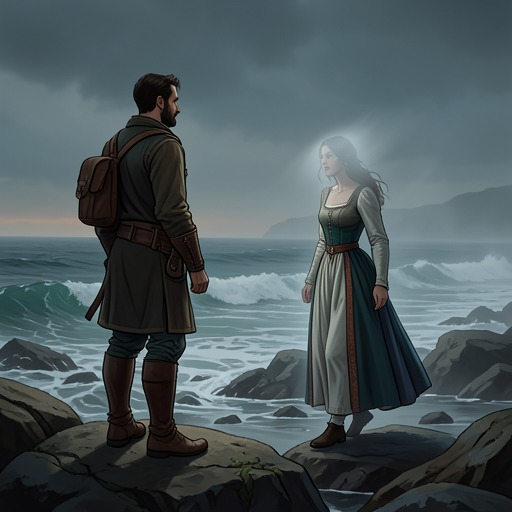
The relationship soon exceeds ordinary conversation. Sitting silently opposite one another, Jeanne and Philip experience what Philip understands as a mutual answer of the soul rather than an exchange in human speech. Their shared breakfast follows this silent recognition, and they then tell one another their names and histories. Jeanne identifies herself as the Demoiselle Jeanne d'Ys, while Philip becomes the first human stranger to enter the emotional world from which her upbringing has kept her apart.
Her love is explicit and reciprocal. When Philip asks whether she is afraid for him, Jeanne answers, "For you, Philip,—I love you." The declaration gives a direct verbal form to the connection that had previously been conveyed through silence and looks. Philip embraces and kisses her, repeating her name, while Jeanne trembles against him. Her response is not calculated courtship but an intense movement from isolation to attachment, as though the stranger’s arrival has opened the enclosed life of Château d'Ys all at once.
The Viper and the Disappearance
The romance ends at the moment of greatest physical closeness. While Jeanne lies in Philip’s arms, a viper strikes his foot and then his ankle, sending a sharp pain through him. Philip tears the snake away and crushes its head, but the poison leaves him weak and numb; he falls as his vision slowly closes, still aware of Jeanne’s arms around his neck and her cheek against his lips. Jeanne’s last presence is therefore defined by care and proximity, not by a choice to abandon him.
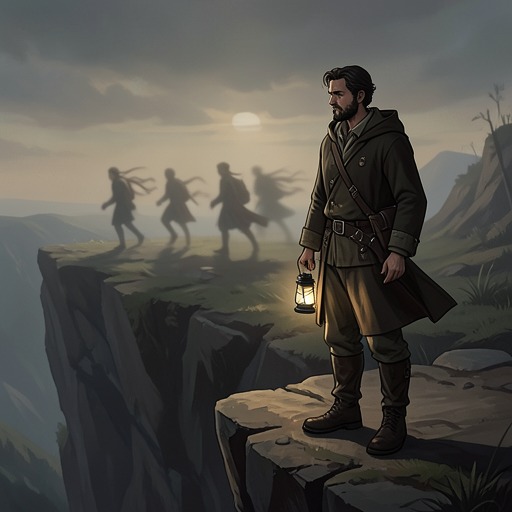
When Philip opens his eyes, Jeanne has vanished. The stream, flat rock, and crushed viper remain, but the hawks and blocs are gone; so too are the garden, fruit trees, drawbridge, and walled court. In their place stand ivy-covered, crumbling ruins through which great trees have grown. A falcon rises from the treetops, circles upward, and disappears into the clouds, preserving a final image of the vanished household while offering no route back to it.
Philip then finds himself kneeling before a ruined shrine carved for Our Mother of Sorrows. Beneath the Virgin, the cross, and the thorns, an inscription begins, "PRAY FOR THE SOUL OF THE DEMOISELLE JEANNE D'Ys, WHO DIED". The memorial overturns the immediate reality of the encounter: the young woman who has just welcomed and loved Philip is presented as someone already dead. Her fate is consequently inseparable from the story’s collision between living experience and historical ruin, and her disappearance leaves Philip with testimony that cannot reconcile what he felt with what the monument declares.
Narrative and Thematic Significance
Jeanne d'Ys embodies the threshold between an enclosed legendary world and the ordinary human world represented by Philip. Her household preserves old books, inherited stories, falconry, religious gestures, and an aristocratic mode of welcome, while the moor itself remains uncertainly positioned between landscape and enchantment. She is both mistress of this world and its prisoner: she can command falconers and birds, but she has never crossed the boundaries that define her existence.
Her character also gives the story its tragic reversal of the conventional love plot. The meeting promises recognition, mutual speech, and a shared future, yet the viper interrupts the embrace and the ruins erase the setting in which the love seemed to occur. The inscription does not simply announce Jeanne’s death; it makes her entire identity unstable, forcing Philip to confront whether the Château d'Ys was a surviving place, a supernatural visitation, or an experience governed by a time inaccessible to him. Jeanne’s decisive narrative function is thus to make love feel immediate while making its object belong to a vanished past.