Kerselec
The King in YellowKerselec is the Breton settlement and coastal landmark that frames the narrator’s loss of direction. From its cliffs, the moors seem comprehensible and nearly level, but away from that vantage they become a deceptive wilderness. The narrator’s inability to return to Kerselec leads him toward the stranger, more ceremonious world of the Château d’Ys, making the place the last recognizable point in an ordinary landscape before the narrative crosses into the uncanny.
Setting and Appearance
Kerselec is associated with cliffs overlooking the sea and with broad moorland stretching toward the horizon. From the cliffs below Kerselec, the narrator had looked across sombre downs that seemed level as a meadow. Distance concealed the true scale of the terrain: grassy hollows became great valleys dense with gorse and heather, while apparently scattered boulders revealed themselves as enormous granite cliffs. The landscape’s apparent simplicity is therefore a visual deception, produced by the elevated view from Kerselec.
The sea provides the narrator’s most reliable geographical reference. He knows that the island of Groix can be seen from the cliffs, and believes that finding the ocean again would clarify his position. Yet the moors repeatedly frustrate that plan. Streams cross his path but run inland rather than toward the sea, ending in reedy pools, swamps, or silent ponds. The place is marked by flowering gorse, heath, granite boulders, and the absence of trees or houses, so that Kerselec’s nearby human presence disappears almost completely once the narrator is within the open country.
The Narrator’s Disorientation
The narrator loses his way after wandering across the moors while shooting. By nearly four o’clock, he has been away from Kerselec since daybreak, though he cannot determine how far he has traveled. He lays down his gun, kneels behind a rock, lights a pipe, and studies his watch while attempting to reconstruct a route from whatever landmark he can remember. The practical details of time, weapon, and physical position emphasize that his predicament is not initially supernatural: it begins as an ordinary failure of navigation intensified by the landscape.
Kerselec’s old guide, Goulven, had warned him that the district was a bad place for a stranger and advised him to take a guide. The narrator had confidently answered that he would not lose himself. Once seated amid the moorland, with the sea wind in his face and no tree or house visible, he recognizes the error in that confidence. His earlier certainty becomes an ironic measure of the terrain’s power to defeat an outsider’s assumptions.
Fatigue deepens the danger. The narrator’s attempts to follow streams lead nowhere, the gun begins to chafe his shoulder despite its double pads, and the sinking sun throws a level light across the yellow gorse and pools. Kerselec thus functions not merely as a place he has left but as a destination whose loss becomes progressively more urgent: returning there is the difference between reaching known shelter and spending the night exposed on the moor.
Kerselec as Threshold
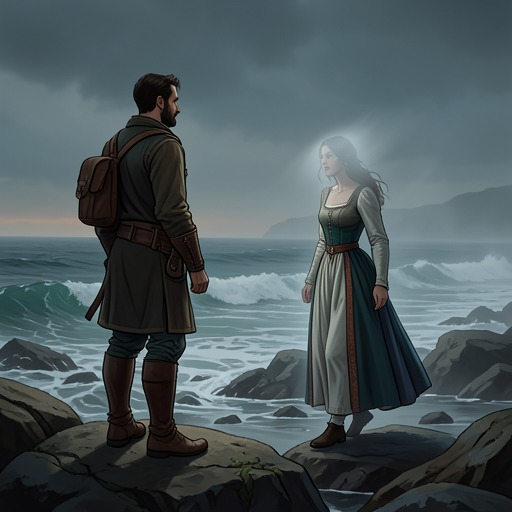
When the narrator meets the falconer’s daughter, Kerselec is the first place-name that establishes the distance between his world and hers. He explains that he has come from Kerselec, but she is astonished that he could have reached her vicinity from there. She tells him that even with a guide he could not walk back to Kerselec that night. Her knowledge of the terrain immediately supersedes his own attempted calculations, and her statement confirms that the apparent proximity of the settlement is meaningless after dark approaches.
The encounter changes the meaning of the lost route. The narrator had been seeking a peasant’s hut, food, and shelter; instead, the girl leads him to the Château d’Ys. There, after he drinks from a cup she has personally offered and welcomes him into the house, he wakes the next morning in an ancient bed to the sound of a horn. Kerselec is therefore the point from which the narrator’s practical search for safety becomes an entrance into a distinctly different social and architectural world.
Narrative Significance
Kerselec embodies the unstable boundary between familiar geography and the unknown. It is close enough to serve as a promised point of orientation—the sea and the island of Groix should make the route intelligible—yet distant enough, once lost, to become unreachable before nightfall. The contrast between the level appearance of the moors from Kerselec and their actual valleys, bogs, and cliffs gives the location a central visual principle: what seems open and legible from afar conceals depth, obstruction, and danger.
The place also marks the narrator’s passage from self-reliance to dependence. His refusal of Goulven’s advice leaves him exposed, while the woman encountered beyond the lost route supplies the guidance he rejected at the beginning. Kerselec’s narrative role lies in this reversal. It is the last setting in which the narrator believes that observation and confidence will suffice; once its landmark disappears, survival depends on another person’s knowledge, and the ordinary map of the Breton coast opens onto the mysterious hospitality of the Château d’Ys.