Lethal Chamber
The King in YellowThe Lethal Chamber is a Government facility established to provide painless death to people who can no longer endure physical suffering or mental despair. Opened publicly in New York on April 13, 1920, it transforms a formerly prohibited private act into an authorized civic service. Its classical beauty, military ceremony, and carefully framed language of relief make it one of the clearest signs that the apparently tranquil United States of this future has reorganized death itself as an instrument of public administration.
Origins and Legal Foundation
The Lethal Chamber emerges from a long political movement to repeal the laws prohibiting suicide. The agitation began in the winter following the removal of the Dodge Statue in 1900 and finally produced legislation in April 1920. The Government then announced that a Lethal Chamber would be established in every city, town, and village in the country. The policy is presented as both humanitarian and utilitarian: individuals suffering intolerably would be granted release, while the community would supposedly benefit from removing such people from its midst.
The Governor’s inauguration speech makes the institution’s governing principle explicit. The state acknowledges a person’s right to end an existence made intolerable by bodily pain or mental despair, while also treating suicidal people as a social class whose removal may improve the collective condition. The policy is therefore not merely an expansion of individual liberty. It joins compassion to administrative selection, placing the decision over the manner and setting of death within a regulated public system. The Governor further claims that the repeal of the prohibitions has not increased the number of suicides, using that statistic to defend the policy before the facility is extended nationwide.
Site and Architecture
The first Lethal Chamber stands on the south side of Washington Square, between Wooster Street and South Fifth Avenue. The Government acquired the block in the winter of 1898, demolishing the shabby buildings that had housed cafés and restaurants serving foreign residents. It enclosed the entire site with a gilded iron railing and remade it as a formal garden containing lawns, flowers, and fountains.
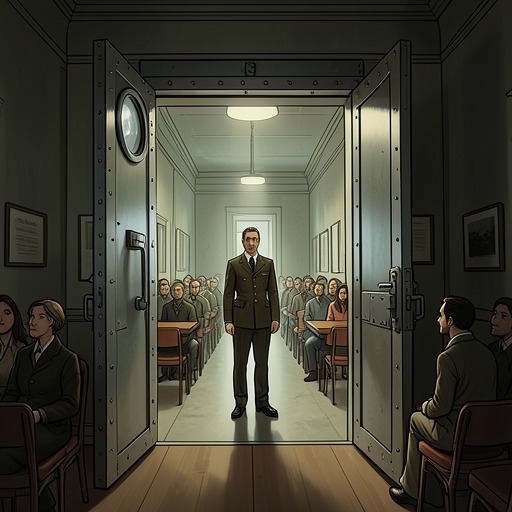
At the garden’s centre is a small white building in a severely classical style. Six Ionic columns support its roof, and its single entrance is made of bronze. Before the door stands a marble group of The Fates, created by the young American sculptor Boris Yvain, who died in Paris at the age of twenty-three. The arrangement gives the building an aesthetic authority that exceeds its practical function. Death is not hidden in a cellar, hospital ward, or criminal enclosure; it is placed inside a beautiful civic composition, guarded by art and classical symbolism.
The surrounding garden heightens this contrast. After the ceremony, the paths are deserted, while fountains ripple, sparrows bathe in their basins, and white peacocks move across the lawns. A pigeon sits so still on the arm of one of The Fates that it seems part of the sculpture. Ordinary urban leisure and an institution of death occupy the same carefully landscaped space, making the Chamber appear less like an exceptional horror than a permanent feature of the city’s civic scenery.
Inauguration and Institutional Display
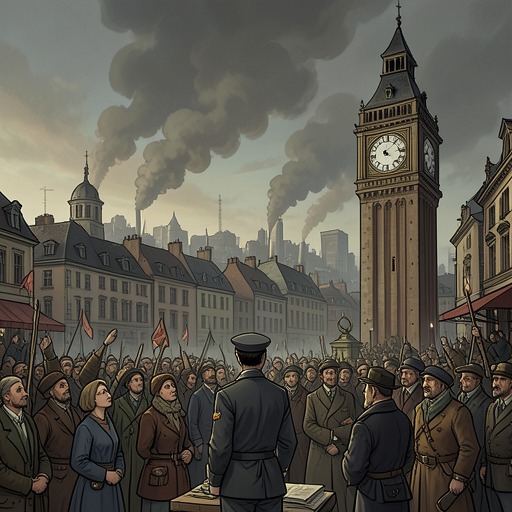
The inauguration is conducted as a major state occasion rather than a discreet opening. A regiment of United States lancers forms a hollow square around the building. On a raised tribune facing Washington Park stand the Governor, the mayors of New York and Brooklyn, senior police and military commanders, representatives of the President, naval and medical authorities, senators, and the Commissioner of Public Works. Hussars of the National Guard surround the tribune, turning the event into a display of coordinated governmental power.
The Governor concludes the ceremony by directing attention toward the white building and declaring that painless death awaits anyone who can no longer bear the sorrows of life. He then announces that the Lethal Chamber is open. The declaration is followed by military movement: the hussars depart with the Governor’s carriage, the lancers wheel into formation along Fifth Avenue, and the mounted police follow. The choreography gives the opening the character of a military or constitutional proclamation. The state does not merely permit the Chamber; it stages its availability with troops, officials, and public ceremony.
This official spectacle also establishes the facility’s paradoxical status. Its purpose is death, but its language is orderly, painless, and benevolent; its guards and ceremonies suggest force, while its public justification speaks of consent and relief. The building thus concentrates the book’s recurring opposition between humane appearances and disturbing institutional consequences.
The First Public Consequence
The Chamber’s first visible use occurs soon after the inauguration. From a study facing Washington Square, Hildred Castaigne observes a young man enter through the garden gates and advance nervously along the gravel path toward the bronze doors. The man pauses before The Fates, raises his head toward their mysterious faces, presses a hand to his own face, and then runs up the marble steps. The doors close behind him.
The scene is witnessed by curious loiterers outside the railing, but the man’s reasons remain unknown. No confession, diagnosis, or explanation accompanies his entrance. The institution’s public openness therefore produces not understanding but spectatorship: strangers watch a private despair become a visible civic act. Half an hour later the loiterers have drifted away, and the frightened pigeon returns to its place on the sculpture. The garden resumes its quiet activity, absorbing the death without visible disturbance.
The Chamber later becomes entangled with the violent collapse of Hildred Castaigne’s world. After Hildred declares his intention to rule and identifies his enemies as obstacles to his imagined empire, Osgood Oswald Vance runs into the Lethal Chamber in a state Hildred describes as demented. Hildred recognizes him and interprets his entrance as proof that Hawberk and Constance Hawberk are no longer in his way. The facility consequently becomes part of a chain of murder, delusion, and apparent self-destruction, even though its public purpose is framed as controlled relief. Its doors can receive the despairing stranger and the murderous antagonist alike, while the surrounding society supplies no reliable distinction between suffering, madness, and death.
Narrative and Social Significance
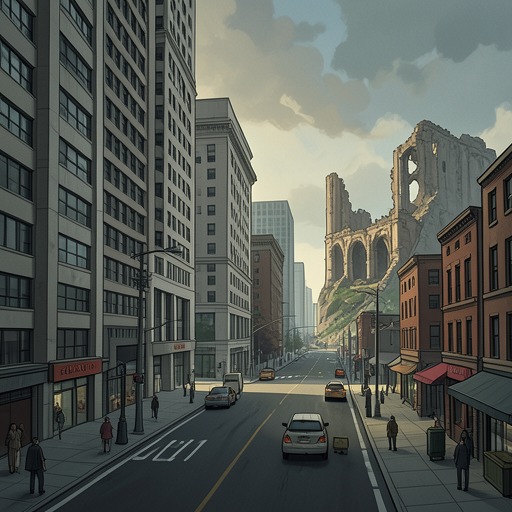
The Lethal Chamber belongs to a future America described as prosperous, militarily secure, architecturally improved, and politically centralized. New York has widened and illuminated its streets, demolished elevated structures, created parks, and replaced disorder with planned civic spaces. Against this background, the Chamber is not an isolated aberration. It is another achievement of the same administrative modernity that promises efficiency, beauty, security, and social calm.
Its location in Washington Square is especially significant because the facility converts a familiar public landscape into a threshold between ordinary urban life and state-sanctioned death. Children play, nurses push baby carriages, soldiers lounge in the park, and fountains sparkle while the Chamber remains visible across the square. The institution’s normality is therefore more disturbing than an openly grim execution site would be. It demonstrates how a society may absorb extreme measures when they are presented through architecture, ceremony, medical language, and claims of collective benefit.
The Chamber also echoes the broader institutional world of the narrative. Dr. John Archer’s private asylum confines Hildred Castaigne after his fall from a horse and treats him as insane before declaring him recovered. Mr. Wilde’s hidden rooms, the military formations surrounding the Chamber, and the formal settings of churches, convents, and art schools all show people being sorted, instructed, guarded, or interpreted by organized systems. The Lethal Chamber is the most final of these systems: unlike an asylum or a church, it does not promise correction, confession, or rehabilitation. It offers an official end, and in doing so makes the state’s power over vulnerable lives appear both merciful and complete.