Louis Castaigne
The King in YellowLouis Castaigne is Hildred Castaigne’s cousin, a cavalry officer, and the presumed successor to the imagined American imperial line. His importance lies in the contrast between the composed, socially recognized man visible to everyone else and the usurper Hildred believes him to be. Louis’s handsome appearance, military bearing, engagement to Constance Hawberk, and final presence at Hildred’s confinement make him the figure against whom Hildred’s invented kingship collapses.
Identity and Public Standing
Louis is identified in Hildred’s manuscript as “Louis de Calvados, born December 19th, 1877,” while Hildred himself is described as his father’s only son and “first in succession.” This genealogy gives Louis a precise place within the fantastic dynastic order that occupies Hildred’s mind. Yet Louis’s actual public identity is more concrete: he belongs to the twentieth dragoon regiment, formerly stationed at Mount St. Vincent and returning from manoeuvres in Westchester County to new barracks on East Washington Square.
The regiment’s procession presents Louis as an embodiment of polished civic and military order. He rides among troopers in pale blue jackets, jaunty busbies, and white riding breeches marked by a double yellow stripe. Lances carry yellow and white pennons, while sabres, spurs, and carbines produce a bright, disciplined clatter. Hildred sees Louis riding with his squadron and judges him an exceptionally handsome officer. The scene gives Louis a visible authority grounded in uniform, rank, collective ceremony, and public recognition rather than in the occult inheritance claimed by Hildred.
Family, Succession, and Marriage
Louis’s relationship with Constance Hawberk is a crucial part of the conflict surrounding him. Hildred studies the manuscript’s succession scheme obsessively and then discusses how Constance and Louis are getting along with Mr. Wilde. The question connects Louis’s romantic life to the imagined political future: if Louis marries Constance, the union helps establish the legitimacy of the order Hildred wants to control.
Louis later tells Hildred that he is going to be married to the sweetest girl on earth. The announcement produces an intense reaction in Hildred, who believes for a moment that his heart has stopped, although he keeps his eyes on Louis’s face. Louis’s happiness is therefore double-edged in the narrative. To Louis, marriage is an intimate and ordinary promise; to Hildred, it is evidence that Louis is occupying a place in the family and social structure that Hildred desires for himself.
Louis’s connection with Constance is also suggested through the street scene outside Hawberk’s shop. As the regiment passes, Louis turns and looks directly toward the shop, and Hildred assumes that Constance must be at the window. Louis’s gesture is restrained and private, but Hildred transforms it into part of the dynastic drama. The scene shows how little Louis needs to do for the narrator to make him a rival: his glance, uniform, and impending marriage are enough to make his established life appear like a claim upon Hildred’s imagined throne.
Conflict with Hildred Castaigne
Louis does not initially behave as an enemy. When Hildred demands that he renounce the crown, Louis looks startled but responds kindly, asking what he is supposed to renounce. After Hildred specifies “The crown,” Louis answers that he renounces it and offers to walk back to Hildred’s rooms with him. The exchange exposes the radical difference between the two men. Louis treats the demand as confused but harmless; Hildred interprets the response as a formal surrender of sovereignty.
This apparent concession intensifies rather than resolves the conflict. Hildred returns to Mr. Wilde’s rooms convinced that the transfer has been completed. He takes the diadem from its case, puts on the white silk robe embroidered with the Yellow Sign, and places the crown on his head. In his mind, Louis’s courteous compliance has become the legal act that makes him king. Louis’s ordinary kindness thus becomes absorbed into Hildred’s delusion and recast as political submission.
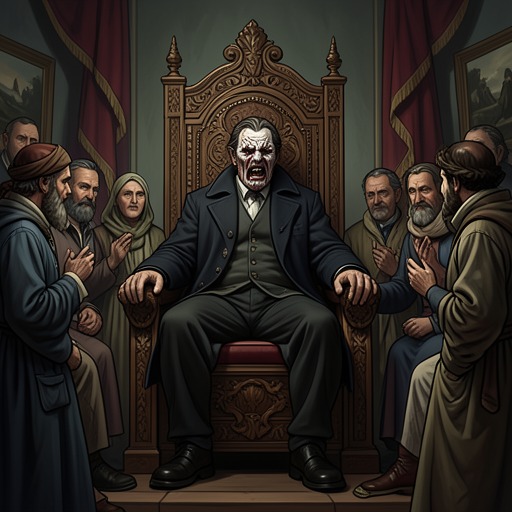
The final confrontation reveals how completely Hildred has reversed their positions. After Mr. Wilde is found mortally wounded and Hildred is seized and bound, Hildred sees old Hawberk and, behind him, Louis’s ghastly face, while Constance stands farther away, weeping. He cries that Louis and the others have seized the throne and empire and accuses them of being crowned with the crown of the King in Yellow. Louis is therefore not merely a family member at the scene of Hildred’s arrest; he is the imagined usurper who has replaced the narrator’s fantasy of sovereignty with the visible reality of police restraint and institutional authority.
Narrative Function and Ending
Louis is filtered almost entirely through Hildred’s unreliable narration, so the reader encounters him in two incompatible forms. One is the handsome, well-regarded officer returning with his regiment, a man whose affection for Constance and willingness to accompany his distressed cousin suggest ordinary social conduct. The other is the rival claimant within Hildred’s imperial mythology, a figure who supposedly stands between Hildred and the crown. The narrative never grants Louis an independent interior account, and that absence is important: his apparent menace is largely produced by Hildred’s interpretation.
At the end, Louis’s presence helps confirm the collapse of that interpretation. Hildred is restrained after the killing of Mr. Wilde, and an editorial notice states that Mr. Castaigne died the following day in the Asylum for Criminal Insane. Louis survives as part of the world that can identify, contain, and outlast Hildred’s fantasy. His “ghastly face” reflects the horror of the scene, but it does not establish him as a conspirator. Instead, it marks the moment when Hildred’s supposed coronation is exposed as confinement, his empire as delusion, and Louis’s supposed defeat as nothing more than a fiction created by the narrator’s failing mind.
Thematic Significance
Louis functions as the stable social image against which Hildred’s fractured self-conception is measured. Military rank, family genealogy, romantic attachment, and public ceremony all give Louis recognizable forms of belonging. Hildred possesses none of these securely, so he replaces them with a symbolic crown, the Yellow Sign, and claims to hidden knowledge of Hastur, the Hyades, and the Lake of Hali.
The contrast also gives the story its grotesque reversal of coronation. Louis’s harmless statement that he renounces the crown becomes, in Hildred’s mind, the necessary act of succession; Hildred’s ceremonial robe and diadem then lead directly to a room where violence, arrest, and institutional diagnosis replace imperial triumph. Louis’s decisive narrative role is consequently not that of an active revolutionary or villain, but of the ordinary cousin whose real-world status makes Hildred’s imagined kingship appear, for a brief and terrifying interval, like a political struggle.