Madame Marotte
The King in YellowMadame Marotte is the proprietor of a Parisian pension de famille who receives Hastings and Dr. Byram when they seek rooms near the Convent. Her brief appearance turns the boardinghouse into a comic institution: it advertises respectability and comfort, yet its domestic order is already compromised by concealed disorder, linguistic confusion, and the theatrical performance of hospitality.
Proprietor and Setting
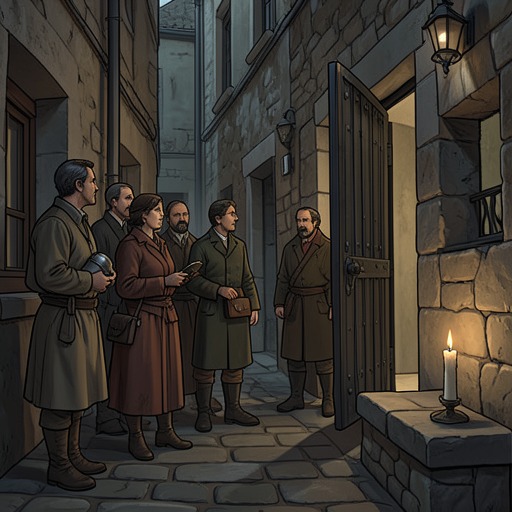
Madame Marotte presides over the house at 201 bis, an address marked by an iron gateway and reached through a garden. Dr. Byram initially notices the evident respectability of the surroundings, though his attention is drawn uneasily toward the Convent across the street. The setting presents the pension as a controlled domestic refuge, separated from the street by a gate and garden, while the printed instructions at the entrance reduce access to a sequence of regulated signals: one pressure for the porter, two for the servant, and three for the parlour.
The house is therefore both welcoming and procedural. Hastings follows the instructions by pressing the electric button three times, after which a maid leads the visitors through the garden and into the parlour. Madame Marotte’s authority is immediately visible in the way she rises from breakfast to receive them, bringing with her the atmosphere of coffee and a black poodle. Her establishment is not an abstract lodging house but a lived domestic space, complete with servants, residents, breakfast guests, animals, and the practical negotiations of rented rooms.
Performance of Hospitality
Madame Marotte greets the visitors with exuberant assurances that receiving them is a pleasure and that her pension is especially intended for Americans. She insists that the staff speak English, at least to varying degrees, and presents the house as a place where foreign guests can feel at home. Her speech is heavily marked by a mixture of French and English, but she treats this linguistic instability as evidence of cosmopolitan service rather than as a barrier.
Her salesmanship becomes especially pronounced when she explains that the pension is serious and that its clientele is of the best. She describes it as a family pension where one is at home, turning ordinary lodging into a promise of moral security and personal belonging. The claim is undercut by the surrounding details, yet Madame Marotte delivers it with conviction. Her authority depends less on demonstrable order than on the confidence with which she names the house respectable.
Domestic Disorder and Comic Contradiction
The boardinghouse’s apparent seriousness is punctured by a glimpse through the open dining-room door. Hastings sees a young man with a big head and several elderly gentlemen at breakfast before the door closes, while the stout proprietor brings the visitors into the parlour with the black poodle. A latch clicks, and Madame Marotte fails to notice the maid slapping the big-headed young man behind the parlour door. She coughs, casts a deadly glance toward the disturbance, and immediately resumes her bright public manner.
This moment establishes the distance between her advertised pension and the household actually operating behind its doors. She does not investigate the slap or explain it; instead, she suppresses the disturbance through a glance and returns to hospitality. Her management is thus performative and improvisational. Respectability is maintained not by eliminating disorder but by preventing it from interrupting the conversation with paying guests.
Role in the Visitors’ Search
Madame Marotte’s exchange with Hastings and Dr. Byram is practical as well as comic. Dr. Byram eventually manages to obtain information about the prices, and the visitors go upstairs to inspect Hastings’s prospective quarters, testing the bed springs and arranging the weekly allowance of towels. Dr. Byram appears satisfied, suggesting that Madame Marotte succeeds in converting her energetic presentation into a sufficiently acceptable lodging arrangement.
Her role also clarifies the travelers’ vulnerability. Hastings is an English-speaking American looking for a place in an unfamiliar Parisian environment, while Dr. Byram is concerned about the moral character of the neighborhood and warns Hastings against making acquaintances among Jesuits. Madame Marotte answers this uncertainty with the language of clientele, service, and domestic comfort. She offers not intimacy in any profound sense, but a commercial version of belonging adapted to foreign visitors.
Characterization and Narrative Function
Madame Marotte is drawn through observable habits rather than interior reflection: she waddles from the dining room, speaks in a hybrid idiom, advertises her clientele, interrupts attempts to question her, and protects the pension’s reputation when a servant’s violence exposes its unruliness. Her body, voice, household, and business claims all work together to make her instantly recognizable, while the contradictions within her performance give the scene its comic vitality.
She also embodies a recurring tension between institutional appearance and lived reality. The pension presents itself as serious, respectable, and familial, but its entrance rules, crowded breakfast room, hidden altercation, and multilingual sales pitch reveal a more precarious arrangement. Madame Marotte does not resolve that contradiction; she personifies it. Her success lies in keeping the contradiction functioning long enough for Hastings to accept the room and for the household to continue under its carefully maintained surface of order.