Middle Ages
The King in YellowThe Middle Ages is presented as a vividly reconstructed world whose presence unsettles ordinary historical time. In the episode at Château d'Ys, a modern traveler discovers that his vanished clothes have been replaced by a complete hunting costume belonging to another century, and the household’s manners, language, birds, and architecture reinforce the transformation. The period becomes the medium through which the narrative turns travel into an encounter with a past that seems to have survived intact.
Definition and Historical Appearance
The Middle Ages appears first as a recognizable historical contrast to the narrator’s modern identity. The replacement garments include a cap, shoes, and a hunting doublet of silvery-grey homespun, together with close-fitting clothing and seamless shoes. Their cut does not belong to contemporary France or Brittany; only after dressing and looking into a mirror does the traveler understand that he resembles a young medieval huntsman rather than a Breton of his own day. The costume therefore functions as material evidence of a temporal shift, not as theatrical decoration.
The narrator’s hesitation before descending emphasizes the social risk of this transformation. His own clothes have disappeared, and the ancient chamber offers no bell with which to summon a servant, so he removes a short hawk’s feather from the cap before entering the household below. That small alteration is the only attempt to moderate the historical disguise. He cannot return to modern normality, but he can slightly reduce the conspicuousness of the role into which he has been placed.
Medieval Life at Château d'Ys
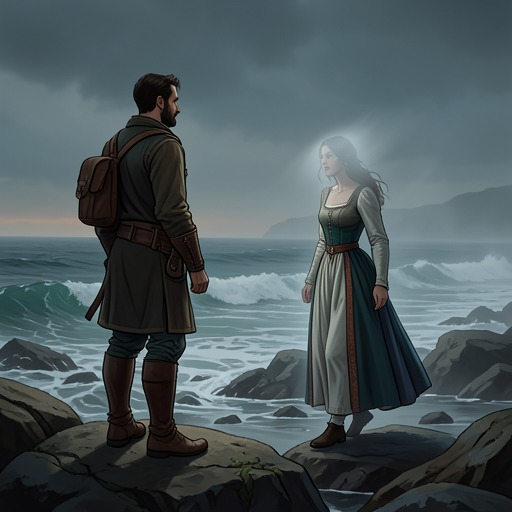
The household confirms the period through behavior as much as through dress. An old Breton woman spins with a distaff beside the fireplace, while the hostess wears a hunting gown edged with silver and carries a favored hawk on her gauntleted wrist. The hostess greets the traveler with grace, takes his hand, and leads him into the garden, where the encounter proceeds with the courtesy and domestic formality of a medieval courtly scene.
Falconry provides the most detailed surviving vocabulary of this world. The hostess distinguishes the falcon-gentil, which takes its quarry in direct chase, from the blue falcon, called noble because it rises above the quarry and drops upon it from above. She also identifies a gerfalcon from the north, a merlin, and a tiercelet, or falcon-heroner. Her command of this specialized language makes the medieval setting intellectually precise: the past is preserved not only in objects and clothes, but in technical knowledge embedded in speech.
She then explains the stages of a young bird’s life. A nestling is a niais; a branchier is just able to leave the nest and hop from branch to branch; a bird that has not yet moulted is a sors; a hawk that has moulted in captivity is a mué; and a wild falcon that has changed its plumage is a hagard. She attributes her knowledge of dressing falcons to Raoul, who taught her the practice. By offering to teach the traveler herself, she makes him a participant in the medieval order rather than a detached observer of it.
Time, Romance, and Perception
The medieval atmosphere changes the meaning of the traveler’s meeting with the hostess. He encounters her not in an abstract historical tableau but in a sequence of intimate gestures: she leads him by the hand, seats herself beside him in the garden, and speaks softly while surrounded by trained and nesting birds. His modern uncertainty is answered by her effortless inhabitation of the older world. The contrast creates the episode’s romance: one figure experiences the period as impossible, while the other treats it as ordinary life.
The scene also makes historical time tactile. Homespun cloth, a distaff, gauntlets, a mirror, a garden bank, and the terminology of moulting and training all anchor the past in practical things. The effect is stronger than a simple statement that the action occurs long ago, because the traveler must wear the period, speak across its customs, and learn its procedures. The Middle Ages is thus experienced as a total environment that reorganizes identity through clothing and conduct.
Contrast with the Modern World
Elsewhere in the volume, time is marked by the pressures of modern urban war: freezing streets, bombardment, cannon fire, starving crowds, ambulances, and industrial violence. In the Paris siege, the city’s cold turns slush to flint, shells cross the sky like shooting stars, and exhausted troops return through the gates at midnight. These scenes establish a world governed by artillery, mass displacement, hunger, and mechanized destruction, sharply opposed to the enclosed, ceremonious, bird-filled life associated with the Middle Ages.
The contrast clarifies why the medieval episode carries such force. The past is not merely earlier than the war-torn present; it offers an alternative rhythm of attention. Falconry requires patient observation of flight, plumage, training, and pursuit, whereas the siege reduces human movement to bombardment, panic, slaughter, and retreat. Against the metallic sounds and collective misery of the modern city, the medieval household preserves a slower and more personal order, though the narrative presents that order through an uncanny rupture rather than through secure historical explanation.
Narrative Significance
Within the book’s sequence, the Middle Ages belongs especially to the romance and supernatural strand represented by The Demoiselle d'Ys, alongside stories such as The Repairer of Reputations, The Mask, In the Court of the Dragon, and The Yellow Sign. The surrounding collection moves among psychological disturbance, mysterious objects, altered realities, and historical or dreamlike displacements. The medieval episode extends that pattern by making chronology itself unstable.
Its deepest significance lies in the tension between historical knowledge and lived immediacy. The traveler recognizes the period through clothing and falconry, yet recognition does not restore control; instead, every accurate detail makes the impossible scene more convincing. The Middle Ages therefore becomes both a setting and a narrative mechanism. It converts the past into an active force, capable of clothing a modern person, governing his social encounter, and making the boundary between historical memory and present experience uncertain.