Mr. Scott (The Yellow Sign narrator)
The King in YellowMr. Scott (The Yellow Sign narrator) is the painter and first-person confessor at the center of the story’s movement from urban observation to supernatural terror. His decisive significance lies in the way his perceptions become the plot’s chief instrument: he notices the churchyard watchman, translates the man’s appearance into images of decay, hears a phrase that seems to invade his thoughts, and finally records a catastrophe whose physical evidence does not explain what happened. His account is intimate, intelligent, and increasingly unstable, making him both the witness through whom the horror is disclosed and the person most deeply altered by it.
Identity and Introduction
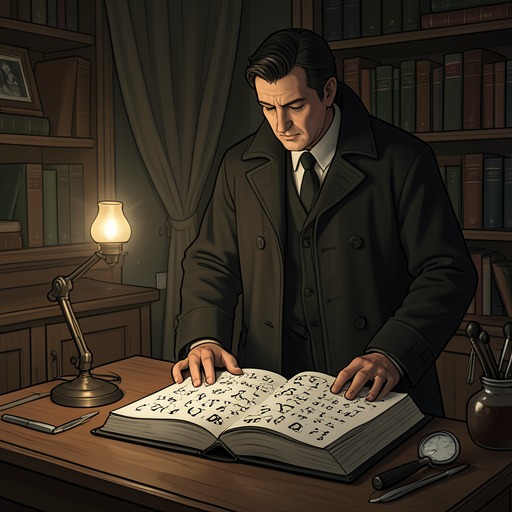
Mr. Scott is introduced as an artist working in his studio near Washington Square. At first, the watchman is only one more indistinct figure in the public scene. When Mr. Scott sees him in the morning, the man’s back is turned; later, after the watchman has entered the church, Mr. Scott notices him again from his window. The recurrence initially seems too trivial to matter. Mr. Scott says that he had forgotten the man after closing the window and returning to his studio, which establishes a contrast between ordinary urban indifference and the attention that follows.
That indifference collapses when the watchman turns his face toward the studio. Mr. Scott experiences an involuntary revulsion and associates the man with a coffin-worm, then with a disturbed grub in a chestnut. The comparison is not merely an insult or a visual description: it gives the watchman a bodily form drawn from burial and infestation. The response also affects Mr. Scott’s art. Returning to his easel, he finds that the flesh tones in his study have become sallow and unhealthy, and he scrapes away the paint with a palette knife. The watchman has therefore entered the narrative first as a disturbance of artistic perception, before he becomes an apparent agent of physical danger.
Life and Plot Trajectory
Mr. Scott’s experience proceeds through a series of recognitions that he cannot master. Tessie Reardon later insists that the churchyard watchman has the same face as the man who drove the hearse. Mr. Scott initially treats the occupation as an honest trade and questions the significance of the resemblance, but Tessie’s certainty gives the watchman’s presence a second setting and a more ominous continuity. The face is no longer confined to a churchyard encounter; it is connected with the hearse and with the imagery of death that has already invaded Mr. Scott’s imagination.
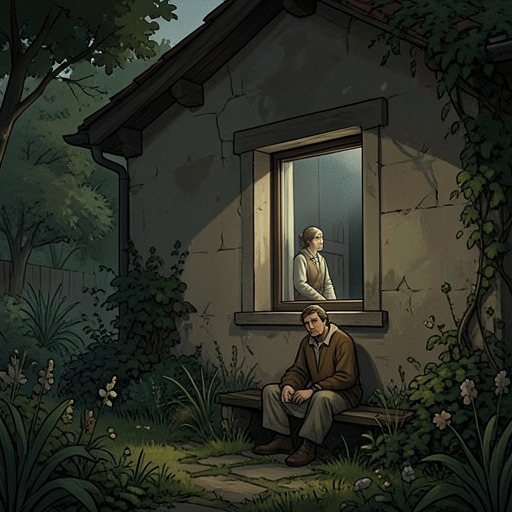
After spending the evening with Edith Carmichael, Mr. Scott returns to Washington Square at dawn. The park is empty, and the watchman is sitting on the church steps. The sight of the white, puffy face produces a chill, while the man’s muttered address provokes an anger disproportionate to the encounter. Mr. Scott imagines striking him with his stick but walks on. Once in his apartment, he cannot escape the voice. It becomes an oppressive sound, compared to oily smoke from a fat-rendering vat or the odor of decay, and the words gradually resolve in his mind as, "Have you found the Yellow Sign?" The repeated question converts an indistinct murmur into a message that appears to know something about him.
The next decisive turn is the discovery of The King in Yellow in Mr. Scott’s library. The book is bound in serpent skin, its pale lettering difficult to read from the floor, and its presence in the apartment contradicts his settled intention never to open it. He had avoided even looking at it in bookshops and had refused descriptions of its contents, especially because of the tragedy of young Castaigne, whom he knew. The book consequently arrives not as an object of casual curiosity but as a forbidden thing that has crossed into his private rooms despite his precautions. Mr. Scott is frightened that curiosity may overcome him and tells Tessie Reardon not to touch it.
Key Actions and Objectives
Mr. Scott’s most important actions are defensive, but each defense also reveals his entanglement. He watches the churchyard from his window, returns to his painting after the encounter, questions Tessie’s identification of the hearse driver, and attempts to interpret the watchman’s muttering as an intelligible threat. His rationalizing language repeatedly reduces the extraordinary to the ordinary: the watchman is called an unhealthy everyday creature, and the hearse is treated as part of an honest occupation. Yet these explanations fail to stop the images from returning or to restore the health of his painting.
His central objective becomes escape from the Yellow Sign, but the narrative gives this objective a troubling contradiction. Mr. Scott and Tessie Reardon come to understand that a black onyx clasp contains the sign. Tessie begs him to throw the clasp away, and Mr. Scott later admits that he cannot explain why he refuses. He believes he wished to tear the sign from his breast and cast it into the fire, yet he does not do so. The refusal is the story’s crucial act of paralysis: the object is recognized as dangerous, the remedy is available, and still the wearer retains it.
The surrounding conversation expands the sign’s meaning through references to The King in Yellow, The Pallid Mask, Hastur, Cassilda, the Hyades, and the Phantom of Truth. Mr. Scott and Tessie Reardon speak of these figures and names while fog presses against the windows, connecting their sealed domestic space with the distant imagery of Hali. The sign is thus not presented as an isolated artifact. It gathers a network of literary and mythic associations, while Mr. Scott’s confession records how reading, memory, conversation, and perception combine to produce its power.
Relationships and Conflict
Tessie Reardon is Mr. Scott’s closest companion and the person who most directly challenges his interpretations. She identifies the watchman’s face as that of the hearse driver, recognizes the black onyx clasp as bearing the Yellow Sign, and urges Mr. Scott to destroy it. Her practical warnings contrast with his inability to act. Their relationship also becomes a shared interpretive space: they murmur about the King and the Pallid Mask, speak of Hastur and Cassilda, and reach an understanding in which each seems to read the other’s thoughts.
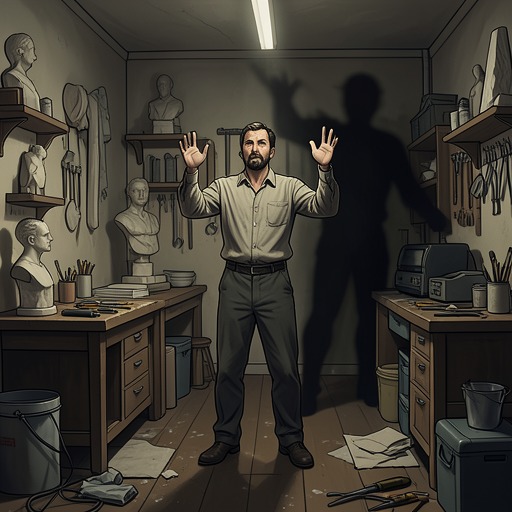
That intimacy makes the final attack more devastating. A black-plumed hearse arrives outside the house, and Mr. Scott understands it as a vehicle for the creature coming to reclaim the Yellow Sign. He bolts the door, but the bolts rot at the intruder’s touch. The watchman enters without becoming fully visible; Mr. Scott feels the cold, soft grasp before he can see its source. The creature tears the onyx clasp from his coat and strikes him in the face. Tessie Reardon cries out, and her spirit flees as Mr. Scott falls. The conflict therefore ends not with a successful confrontation but with the destruction of the protective domestic bond and the removal of the object that has organized the horror.
Change and Ending
Mr. Scott changes from an artist who can dismiss a passerby into a narrator who is physically and spiritually beyond ordinary help. His initial problem is a failure of explanation: he cannot understand why a face changes the color of his painting or why a voice remains in his head. By the ending, explanation itself has become secondary. He is writing while dying, indifferent to whether he survives long enough to finish, and sees a doctor gathering powders and phials beside a priest. The confession is presented as a last act carried out under the shadow of death rather than as an orderly report intended to solve the mystery.
The household’s account of the scene supplies concrete evidence but no stable solution. People were awakened by an infernal scream and found one living person and two dead. The doctor could offer no theory or explanation for the horrible decomposed heap on the floor, identified as the livid corpse of the churchyard watchman. This corpse appears to confirm that the watchman was physically present, yet its decomposition complicates the earlier encounters rather than clarifying them. Mr. Scott’s account closes at the point where material proof and supernatural interpretation remain locked together.
Narrative Role and Significance
Mr. Scott’s first-person narration makes the story’s horror inseparable from the act of telling. He repeatedly distinguishes what he directly saw from what he later understood: the watchman’s voice is first an indistinct mutter, and only afterward does its meaning emerge. This delayed recognition makes the reader experience the same interpretive movement, from banal detail to threatening pattern. The narrative’s chronology is therefore shaped by retrospective revelation, while the emotional force comes from the time spent before the meaning becomes clear.
His testimony is also deliberately limited. Mr. Scott refuses to provide everything he knows, declaring that further detail would not help the world, and he contrasts the secrecy of confession with the curiosity of newspapers and outsiders. The final account withholds a complete explanation even while disclosing Tessie Reardon’s death, his own dying condition, the watchman’s corpse, and the doctor’s bewilderment. Mr. Scott consequently functions as both a reliable witness to immediate sensations and an unreliable interpreter of their ultimate cause. The story’s central uncertainty does not arise because he lacks experience; it arises because his experience exceeds the categories by which he tries to understand it.