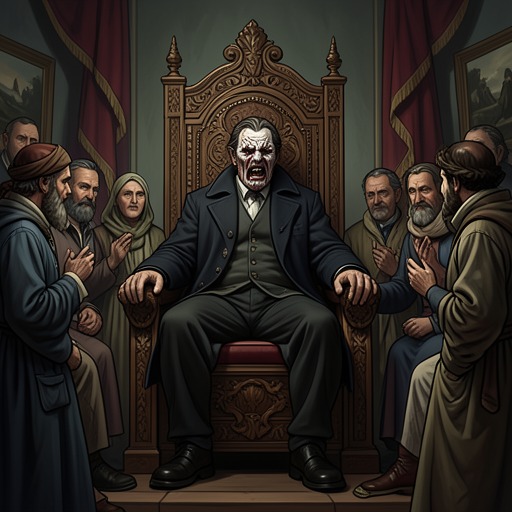
Mr. Wilde
The King in YellowMr. Wilde is the diminutive, mutilated proprietor of the profession known as the Repairer of Reputations. Operating from a concealed room, he converts private disgrace into profitable control over public life, maintaining a network of paid agents who penetrate every social class. His intelligence and administrative reach appear impressive, but his enterprise rests on intimidation, secrecy, and the exploitation of people who fear exposure. By directing Hildred Castaigne’s ambitions and finally dying at the moment of their apparent fulfillment, Mr. Wilde becomes the central mechanism through which personal delusion is translated into political catastrophe.
Identity and Appearance
Mr. Wilde is introduced in a private room reached by three dilapidated flights of stairs. Once inside, he double-locks the door and pushes a heavy chest against it, establishing concealment and defensive isolation as conditions of his work. His body is strikingly unlike the conventional image of authority: he is very small, scarcely higher than a child of ten, with enormously developed arms and thighs. His left hand is completely fingerless, yet he appears to suffer little practical inconvenience from it.
His most conspicuous mutilation is the loss of both ears. Wax replacements, painted shell pink and held in place by fine silver wires, project awkwardly from the sides of his head; he repeatedly adjusts them and rubs the mutilated remains. His face is yellow, marked by fresh scratches, and surmounted by a flat, pointed head that resembles the heads of people confined as intellectually incapable. The narrator nevertheless insists that Mr. Wilde is as sane as himself, creating an immediate contrast between bodily appearance, public judgment, and actual intelligence.
The Repairing of Reputations
Mr. Wilde’s ledger gives his profession a bureaucratic form. Its entries record clients, damaged reputations, proposed repairs, dates, and retainers. Henry B. Matthews, a book-keeper employed by Whysot Whysot and Company, has been disgraced on the race-track and identified as a welcher; his reputation is scheduled for repair by August 1st for a five-dollar retainer. P. Greene Dusenberry, a minister of the Gospel from Fairbeach, New Jersey, has suffered damage in the Bowery and has paid one hundred dollars for prompt assistance. The ledger makes moral and social disgrace resemble ordinary commercial work, with scandal treated as a problem that can be assigned, priced, and completed.
The business is not limited to isolated clients. Mr. Wilde claims that he has five hundred men in his employ, poorly paid but driven by enthusiasm that may actually be fear. These agents enter every level of society: some are pillars of exclusive social institutions, some are prominent in finance, and others dominate the worlds of entertainment and fashionable vice. He selects them from applicants answering his advertisements and describes them all as cowards. Because they possess or circulate information about their fellow citizens, their employment gives him indirect custody of the reputations of an entire city.
His power depends less on constant physical punishment than on the expectation of punishment. When the narrator suggests that his subordinates may eventually turn against him, Mr. Wilde answers that he seldom needs to apply the whip and then only once; the men also like receiving their wages. The remark reveals the structure of his authority: economic dependence reinforces terror, while the ordinary language of employment disguises coercion. His organization therefore joins commercial capital to secret knowledge and bodily threat.
Relationship with Hildred Castaigne
Mr. Wilde is the mentor and political engineer of Hildred Castaigne’s grandiose self-conception. Hildred studies the manuscript Imperial Dynasty of America in Mr. Wilde’s rooms and reads it with intense pleasure, trembling at the vision it contains. The manuscript offers an ideological script for imperial restoration, while Mr. Wilde supplies the practical setting, secrecy, contacts, and confidence that allow Hildred to mistake fantasy for an attainable political program.
Their relationship is not merely intellectual. Mr. Wilde’s ledger and methods suggest an organized apparatus capable of manipulating reputations, recruiting agents, and disciplining opposition. Hildred’s belief that social and political power can be seized is thus supported by a real, though criminal and coercive, network. Mr. Wilde’s apparent rationality makes the delusion more dangerous: he gives form and procedure to ambitions that would otherwise remain private imaginings.
The connection becomes explicit when Mr. Wilde summons Vance from the dark passage leading to his bed-chamber. Vance recognizes Hildred as someone who might save him, calling him different and pleading that Mr. Wilde be kept away. His frightened speech refers to a madhouse, the King in Yellow, and the fear of going mad again. Before the introduction is complete, Mr. Wilde attacks him, encircling his throat with his right hand and leaving him collapsed on the floor. He then returns calmly to the ledger and searches for Vance’s name, making violence appear to be another recorded item of professional business.
Violence, Animals, and Social Stigma
Mr. Wilde’s eccentricity is expressed through his treatment of a vicious cat that he keeps in his room and deliberately provokes. The narrator recalls seeing him sit motionless on a high chair while the animal crept toward him, crouched, and sprang into his face. The two rolled across the floor, scratching and clawing until the cat fled beneath a cabinet, while Mr. Wilde lay curled on his back with his limbs contracting like those of a dying spider. The scene makes his private room a miniature theatre of mutual aggression, where control is pursued through deliberate exposure to danger.
The mutilated body is repeatedly made legible as evidence of abnormality. His missing ears, wax substitutes, fingerless hand, yellow face, and pointed head encourage others to call him insane, while the narrator’s defense of his sanity separates intellectual capacity from socially acceptable appearance. Yet the story also shows how disability and perceived mental difference become entangled with fear. Vance’s recollection of Mr. Wilde’s grasp and the loss of one of his fingers presents bodily violence as the source of lasting horror, and Vance thereafter avoids him because seeing him produces loathing and sickness.
Mr. Wilde’s physical difference therefore carries several functions at once. It marks him as socially marginal, supplies an image of grotesque fascination, and becomes inseparable from the authority he exercises over others. The same society that reads unusual bodies as signs of madness is also vulnerable to the knowledge and coercion wielded by the person it dismisses as deformed.
Death and Narrative Significance
Mr. Wilde’s death occurs when Hildred enters his rooms claiming that the imperial transformation has been accomplished. Hildred puts on a white silk robe embroidered with the Yellow Sign, takes a splendid diadem from its case, and places the crown on his head, believing himself King by right in Hastur and by his knowledge of the Hyades and the Lake of Hali. He expects dawn to unleash a tempest that will shake both hemispheres. Mr. Wilde is absent, however, and the triumph depends on the dead or missing architect of the scheme.
A groan from the dark passage sends Hildred toward the door with a tallow dip. The cat rushes past him; his knife strikes it in the darkness. When he raises a lamp, he finds Mr. Wilde on the floor with his throat torn open. For an instant, a green sparkle appears in Mr. Wilde’s sunken eyes and his mutilated hand trembles, giving Hildred a momentary hope that the master may survive. The hope vanishes as Mr. Wilde’s eyes roll and he dies.
The consequence is immediate collapse. Hildred sees his crown, empire, ambitions, and life itself as lying prostrate with the dead master. Police seize and bind him while he screams and bites at those who approach. Hawberk, Louis Castaigne, and Constance Hawberk appear among the witnesses, and Hildred interprets their presence as proof that they have stolen the throne and empire. Mr. Wilde’s death thus destroys the practical foundation of Hildred’s imagined accession while leaving the delusion intact. He is not only a sinister employer or eccentric recluse; he is the story’s crucial bridge between social manipulation and madness, and his removal exposes how little of the promised empire existed beyond his control.